 Netwrck
Fairy-Tale Fiction.
The Last Exit
Silas Venn had spent forty years learning how to leave rooms. Not through doors. He had never needed doors. When a scene ended, a play ended, or a lover asked him to forget, he could step backward into the room as it was before he had touched it.
At seventy-three, he finally retired.
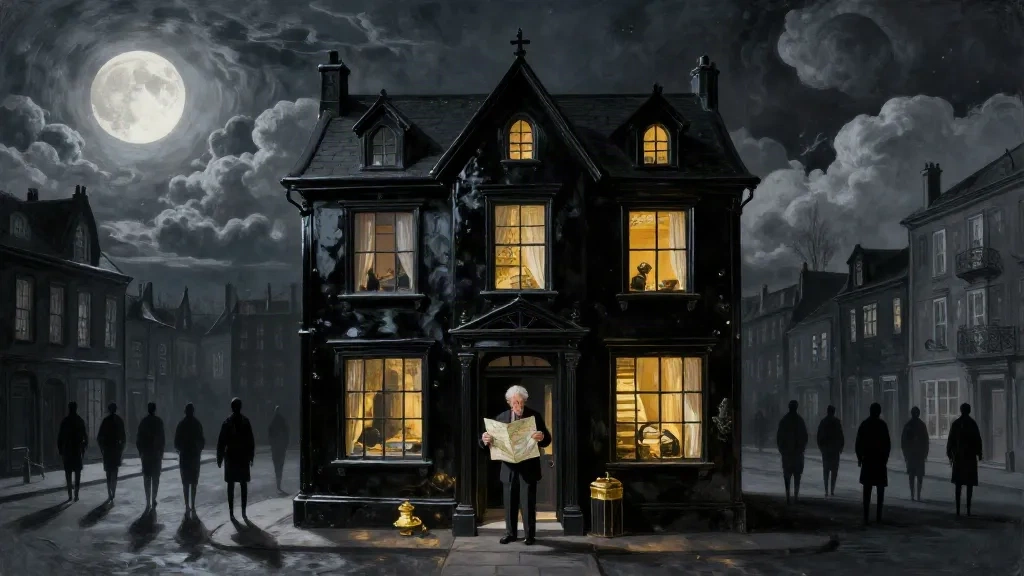
He lived in a narrow room above a clockmaker, where the walls were black lacquer and the windows admitted only thin blades of cold moonlight. Every evening, the city’s shadows gathered beneath them. They voted in the alleys, served tea in the courtyards, and kept careful records of every citizen’s movements. Each person possessed a shadow, and each shadow possessed a person, though neither could explain which had come first.
On the table before Silas lay two things his mother had sent him: a folded map, its creases rubbed soft as cloth, and a music box with a gold-dusted lid.
He had promised his grandmother that, when he was old, he would return to the House of Nine Lies and speak the final word she had left for him.
She had made him promise before her death, when the city still believed shadows were merely darkness.
The House That Grew
The map showed no streets. It showed a sequence of rooms, each one marked with a date. Silas recognized the first: his grandmother’s dressing room, where she had hidden secrets inside the lining of winter coats. The second was the theater backstage after his first performance. The third was the room in which his son had refused to speak to him.
He took the map to the clockmaker.
“The house is north of the old cinema,” the clockmaker said. “Behind the wall where the shadows cast votes.”
Silas found it there. It was small, black-lacquered, and hung with windows that looked into other seasons. When he entered, the house unfolded another room.
A nursery appeared. A stairwell appeared. Then a kitchen filled with wet earth and silver spoons.
At the table sat his grandmother, young as a photograph, though her face was hidden beneath a veil of moonlight.
“You came,” she said.
“I promised.”
She pointed to the music box.
“Play it.”
The melody was seven notes. Silas had heard it once, on the night he left the city. The seventh note opened a room in the wall, and inside stood a man in a minister’s coat, his shadow dressed as a judge.
“He promised my daughter a theater,” the grandmother said. “He promised her a child. He promised me a winter wedding. He promised the city that the shadows would never inherit it.”
The man smiled. “All promises are unfinished.”
Then he lied.
The house groaned. A dining room burst through the ceiling, crowded with strangers. A music room unfolded behind Silas. A corridor raced beneath his feet, and each new room contained another lie spoken by another person: a child denying hunger, a judge denying fear, a mother denying grief.
Silas understood the cost. The house was built from promises the city refused to keep.
The Actor Returns
He played the music box again.
This time he entered the notes.
One room became the dressing room. Another became the backstage. He could re-enter any room he had ever left, but the house had filled itself with lives. He needed an audience to believe him, and the shadows had gathered outside, their faces turned toward the black-lacquered walls.
Silas stepped onto a stage that had not existed.
“I am Silas Venn,” he said. “I played fathers, kings, and liars. I taught audiences to call a lie a necessary kindness.”
The house added a balcony.
He continued. “My grandmother asked me for one thing. I gave her silence.”
The music box slipped from his hand. Gold dust spilled across the floor and gathered into a narrow path.
The path led to the room he had left when his son was born.
Inside, his younger self stood beside a cradle. The child’s shadow was already holding an actor’s mask.
“You promised to stay,” young Silas said.
“No.”
The answer opened another room. Behind the cradle stood his father, who had promised Silas’s mother a house without doors.
Silas picked up the cradle. He entered the memory as the child entered the first stage: trembling, unafraid, already seeing the world as a place waiting for its performance.
“I cannot return to that night,” he said. “But I can return to every room I abandoned after it.”
He went through them. He went through the quarrels, the hospital corridors, the kitchen after the funeral, the empty apartment where his son had left his old theater tickets. Each door opened behind him.
The Word He Owed
When he returned to the House of Nine Lies, the house had stopped growing.
His grandmother stood at the center of the final room. The minister, the judge, the child, and every shadow who had entered were waiting there.
“What did I leave for you?” she asked.
Silas looked at the music box, the map, and the gold dust on his hands.
He had spent his life believing promises were words spoken before leaving. His grandmother had made a different kind: a promise that required him to return.
“Stay,” he said.
The word passed through the room. It entered the walls, the windows, the citizens and their shadows. The house did not add another room. It became still.
Outside, dawn approached, but no sunlight came. The citizens stepped into the streets, and their shadows stepped with them. For the first time, neither led.
Silas unfolded the map one last time. The rooms had vanished, leaving only a single line drawn from the old cinema to the black-lacquered house.
At its end, the map had written:
The promise kept is the room you no longer need to leave.
He closed the music box. Somewhere beneath the floor, its seven notes continued, growing quieter as the city learned that a person could remain.





