 Netwrck
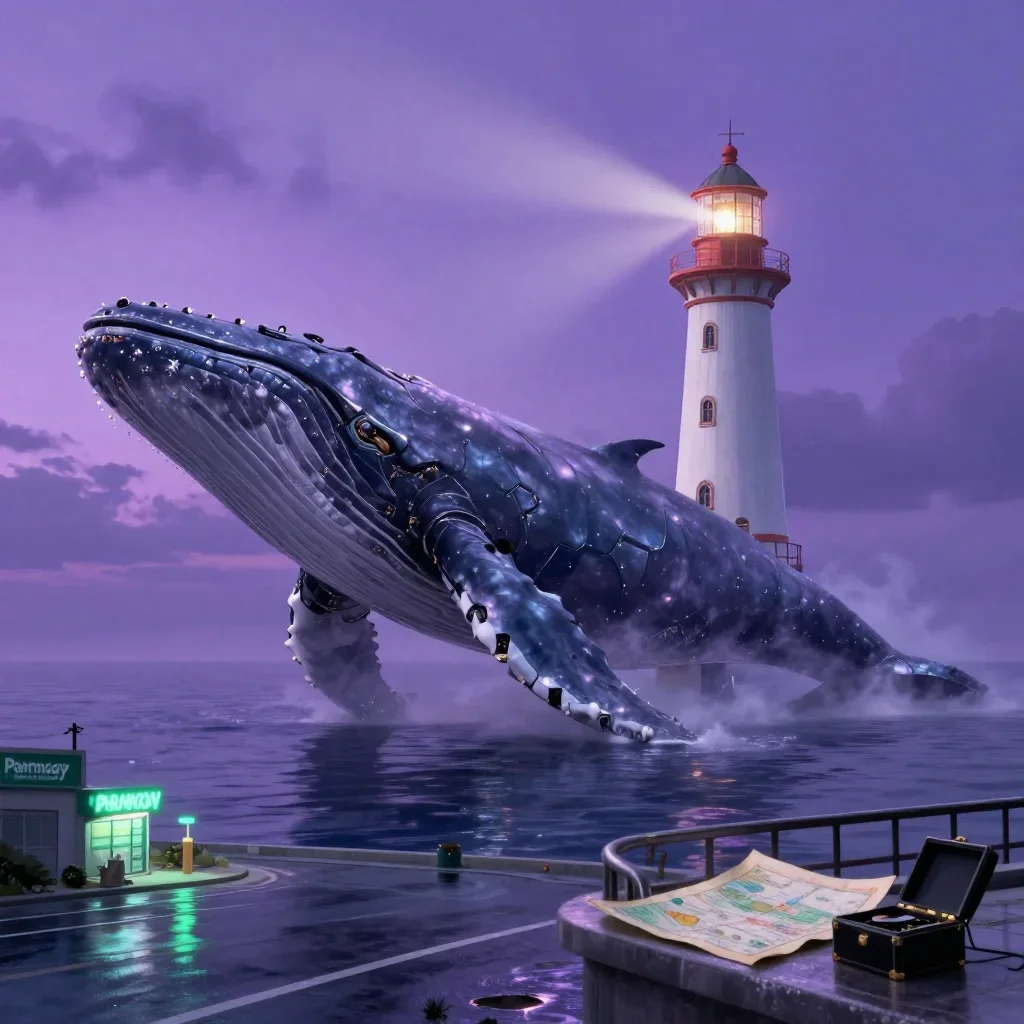
Hopeful Science Fiction.
The Whale at Evening
Elias Vale had spent forty years learning how to leave rooms.
He left dressing rooms through narrow doors, stages through trapdoors, hotel suites while the phones still rang. As a retired actor, he had thought the skill would become useless. Instead, it had followed him into an old life: he could step out of a kitchen and, years later, step back into it without warning. The room remembered him. So did he.
For eleven years he had lived in the lighthouse on the whale’s back. The whale slept beneath the sea, a vast iron body drifting through darkness, its ribs humming with tidal current. Above them stood the lighthouse, its lamp sweeping across the lavender evening. On shore, the little town’s pharmacy signs shone the green of feverfew and bottled storms.
Elias kept his grandmother’s promise on the wall opposite the window: When the whale wakes, bring the light to the drowned garden.
She had made him swear it before her last winter. He had been nineteen, impatient, certain that promises were simply ropes adults tied around children’s wrists. He had promised anyway.
Now the whale still slept, but the lighthouse had begun to ring.
A House With One Extra Door
The house had arrived three weeks earlier, washed up on the whale’s broad shoulder like a square piece of shore.
It was lavender-gray, with wet asphalt pooling around its foundation. The front door opened onto a hallway smelling of rain, floor polish, and green pharmacy light. Elias had entered once to inspect it. He found a dining room, a nursery, a locked pantry, and a music box on the floor beneath a window.
The box was made of black wood, its lid carved with a blue whale. When Elias wound it, a tune emerged in a dozen broken notes. He recognized it from childhood: his grandmother had played the same melody before every audition. He had always pretended not to hear it.
The house had no furniture except a folded map on the kitchen table. The map showed the whale, the lighthouse, and a route through a sea that did not appear on any chart. A thin green line ended at a place labeled Drowned Garden.
Then someone spoke from the nursery.
“You promised,” said a woman’s voice.
Elias entered the nursery. A woman sat beneath the window, her face hidden by a curtain of rain. He did not recognize her. She pointed to the music box and said, “I told the whale I would wait.”
“Who are you waiting for?” Elias asked.
“The person who left.”
Behind her, a door appeared where no door had been. Elias stepped through it.
The room beyond was small and warm. A child sat on the floor, folding paper whales. A man in a railway uniform stood at the window, pretending not to cry. Each figure repeated the same claim: they had been abandoned there. Each repetition made another wall, another chair, another pane of rain-streaked glass.
Elias understood then that the house grew whenever someone lied inside it. Not from malice. Lies were its mortar.
The Actor Returns
He tried to leave by the front door. The hallway stretched into a corridor lined with doors from his former life: a dressing room, a hospital waiting room, the back seat of a taxi in Rotterdam. Behind every door waited someone he had abandoned, though not always by choice.
Then a narrow door appeared between two walls. Its brass number was 2.
He opened it and found himself inside a theater lobby twenty years earlier. The carpet was red. The rain had not touched the windows. At the far end, his younger self stood beneath a broken marquee, rehearsing a speech he had forgotten.
Elias entered.
The room did not throw him out. The ability he had carried all his life let him re-enter any room he had ever left, but the house had changed the rule. The room was a place he had left, and leaving had been the point. The lobby filled with a second lobby, a thousand versions of the same night. In one, he had accepted the role that made him famous. In another, he had refused it and gone with his grandmother to the coast.
He searched until he found the night of the promise. There, the younger Elias stood outside the lighthouse, arguing with his grandmother. The map was in his hands. The music box was in hers.
“You will forget this place,” she said.
“I won’t.”
“You will. That is why I need the promise more than the memory.”
He stepped toward the scene, but the room refused to become a stage. The house had no interest in performance. It wanted the truth beneath the line he had spoken.
Elias admitted that he had forgotten. He admitted that he had chosen the career over the coast, and that the promise had become another beautiful thing he meant to honor later. The admission opened a door behind the fake lobby.
Beyond it lay the lighthouse cellar. His grandmother waited beside a dry well. The whale’s heartbeat shook dust from the rafters.
The Drowned Garden
“The garden is under the well,” she said.
“You died.”
“Not everywhere.”
She gave him the folded map. He wound the music box, and its broken melody found the whale’s rhythm. Under the cellar floor, water began to glow lavender.
Elias descended with his grandmother. The drowned garden rose around them: coral trees, submerged benches, a ring of green pharmacy light glowing beneath the surface. At its center stood a small bronze lamp, dark for a century.
The whale stirred. Its enormous eye opened somewhere above them, and the lighthouse shook.
“You promised the light,” his grandmother said.
Elias carried the lamp through the water. The room tried to grow around them—hallways of lies, doors made from excuses—but he no longer entered them. He remembered every room he had left, and this time he carried the promise with him.
At the garden’s edge, he set the lamp down. The whale’s heart sent a pulse through the floor. The lamp caught.
Its light was not a beam from the lighthouse. It was green, steady, and small enough to hold in one hand. It shone on the drowned leaves until they unfolded.
Elias returned to the house and found the nursery empty. The woman with the rain-curtained face was gone. The extra doors remained, but they opened into ordinary rooms: a kitchen, a bath, a room with a bed and a window. The house had stopped building from lies because no one was telling them.
At dawn, he placed the music box beside his grandmother’s promise and left the lighthouse. The map showed a new line, drawn in green ink, leading away from the coast.
Elias followed it.





