 Netwrck
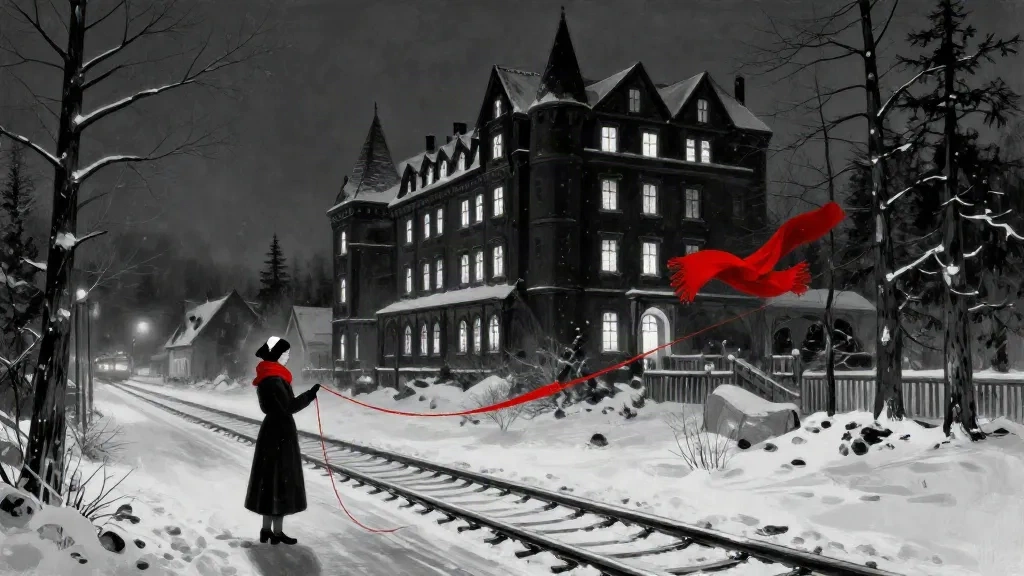
Gothic Fantasy.
The Guests Before the Snow
By November, the Winterwake resort had received every shade of weather except the one people described when they came to Nurse Elian Voss with grief.
“My house misses my brother,” said Mrs. Soren, twisting her red scarf between white-knuckled fingers.
“Houses do not miss.”
“Then explain the drafts.”
Elian wrapped a red wool thread around the woman’s wrist. It led beneath the blue door of the cedar lodge and into a darkness that smelled of wet wool, woodsmoke, and pennies pressed into a child’s palm.
Winterwake lay beneath mountains white as bone. Its grand hotels rose above the pines with lit windows, but their shadows reached the road first: long black carriages of chimneys and balconies, waiting for owners who had not yet arrived. Every dusk, guests complained that something had followed them home. Every dawn, one room was found neatly swept and entirely empty.
That room belonged, according to the resort ledger, to Lucas Soren, age nine. He had vanished from Platform Two on the night his family came to Winterwake, twenty-three years earlier.
Mrs. Soren had never stopped waiting.
“If you want the room restored,” Elian said, “I need everyone who was here that night.”
“There was no one.”
“Then your house has become an excellent liar.”
Stationmaster Vey’s Error
The stationmaster met Elian beside the midnight platform, where the lamps shone coral-white and the rails crossed one another like red thread under a black cloth.
“You are medically incapable,” said Orin Vey, tapping his watch without looking at it. “The Sorens departed at 11:41. The child was accounted for at 11:43. Therefore, no child is missing.”
“He was accounted for by a ticket.”
“A ticket is a promise made in ink.”
“Then why does the ink keep changing?”
Vey’s face was narrow and perfectly composed, but his shadow flinched before he did.
He believed every ending was a scheduling error. At Winterwake, he had kept the twelve-o’clock departure waiting for nineteen years, though no train had crossed the valley since the avalanche. His office was a cathedral of timetables, all departures and almost no arrivals.
Elian laid the family’s red scarf on the platform bench. Its thread continued across the stone, over the yellow warning line, and down beneath the tracks.
“Lucas,” she said.
Somewhere below, a small bell answered.
They found an iron ladder behind the schedule board. Vey carried it down, muttering that problems should be corrected in writing. At the bottom waited a narrow corridor lit by blue lamps. Doors led into rooms that did not exist upstairs: a nursery with frozen milk on the windowsill, a kitchen where six plates held warm food, a hallway lined with red coats.
At the final door, a boy sat with his back against the wood.
“My sister promised to come back before I left,” he said.
Elian remembered Mrs. Soren’s red scarf, folded beneath her pillow every morning for twenty-three years.
“Your sister is here.”
A Map Made of Thread
The family room was a wound in the architecture. Its wallpaper carried a map of the resort, and every route had been stitched shut.
Lucas’s room had waited for Mrs. Soren. The nursery had waited for Lucas. The resort itself had mistaken that waiting for truth.
“I am not dead,” Lucas said. “I am in transit.”
“To where?”
“Wherever the person leaving decides I belong.”
Elian understood. The resort did not feed on death. It fed on unfinished departures. Every family carried some room within it, and every room wanted a person to remain forever.
Vey seized the timetable board. “Then we cancel the departure.”
“You cannot cancel a person’s life.”
“I can delay it.”
He tore the final page from the ledger.
Corridor after corridor darkened. The nursery vanished, taking the smell of warm food with it. Below, the midnight train sounded its horn, and the platform clocks all began running backward.
Elian tied the red thread around Lucas’s wrist, then around Mrs. Soren’s wrist when she was brought down the ladder. The thread tightened, not pulling, but measuring the distance between their hands.
“You do not need to take him with you,” Elian said. “You need to speak before the door closes.”
Mrs. Soren crouched. The red scarf fell from her shoulders.
“I kept your place.”
“I know.”
“I kept your seat beside the window.”
“I know.”
“I was angry when you left.”
Lucas’s fingers loosened.
“I was afraid if I stayed, you would never see me grow old.”
The ticket in his pocket turned white, then coral, then a bright red thread.
What the Platform Kept
The train arrived without smoke. Its windows were black mirrors, and its carriages stretched farther than the valley could contain.
Vey stepped aboard. “If this is an error, I will correct it.”
Lucas looked after him. “Will you return?”
“Every ending,” Vey said, “is a line misplaced in a timetable.”
He meant it as a joke. The stationmaster had forgotten how.
Elian cut the red thread.
No room screamed. The train simply opened its doors.
Lucas boarded, but kept hold of the thread in his hand. Mrs. Soren did not follow. She stood on the platform with both boots on the ground, her scarf bright as a wound.
“I will see you again,” she called.
“You will see me leave,” he answered. “That is different.”
The train departed. Vey remained behind, clutching a blank schedule.
By morning, the resort’s shadows had vanished. Mrs. Soren’s house no longer sighed at night. The red scarf, folded on her table, kept no thread beneath its weave.
Only at the station did Elian find a fresh ticket in the snow, printed in black ink and stamped with the word return.
She put it in her pocket.
Some endings were not accidents.
Some were invitations.





