 Netwrck
Fairy-Tale Fiction.
The Last Exit
Elias Venn could enter any room he had ever left.
He discovered this at nine, after fleeing his grandmother’s house through the pantry and hiding beneath the stairs. When he called it a trick, she told him the pantry had swallowed him. He laughed. She did not.
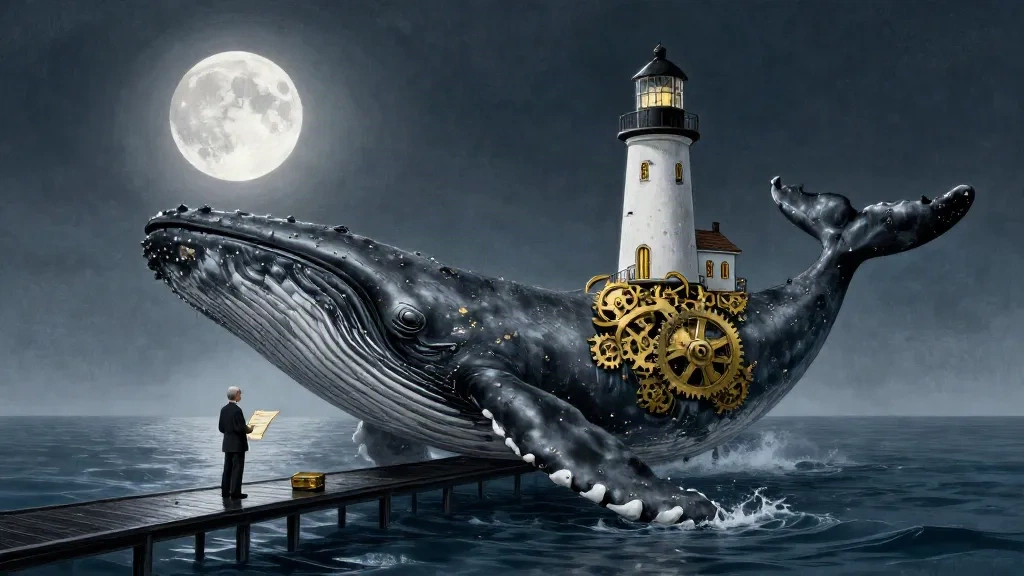
Now retired from the stage, with silver whitening his temples and no plays left to memorize, he returned in a black lacquer skiff. Ahead rose the Beacon of Saint Orra, fastened to the broad back of a mechanical whale. The whale lay half-submerged in the northern sea, its iron scales damp with cold moonlight. Each breath lifted the lighthouse a little. Each exhalation set the bells shivering.
His grandmother had died there. Before that, her grandmother had kept the light, and the grandmother before her. The promise belonged to their line: when the whale woke, they would enter the captain’s room and shut the engine of his dreams.
Elias carried a folded map, softened by generations of hands, and a music box whose tune had one note missing. He climbed the whale’s flank and entered the lantern room.
The House of Added Doors
The keeper’s house crouched beneath the tower, black with weather. Elias had left it once, thirty years earlier, after shouting at his grandmother that promises were debts and actors were paid to tell lies.
“That was a lie,” she had said.
The house had added a door.
He found it between the larder and the coal cellar: narrow, varnished, and fitted with a gold-dust knocker. He remembered no such door. When he entered, he found himself in the room he had left that night.
His younger self sat beneath the window. His grandmother stood by the hearth.
“You came back,” she said.
“I never left.”
A door appeared behind her.
Elias understood. The house measured truth by its walls.
He said, “I came because I promised.”
No door appeared.
He opened the music box. The familiar melody climbed the stairs, silver and thin, then stopped before the missing note. His grandmother had always turned the key at that point, as though some melody required human completion.
Now the silence pressed against the windowpane.
“What note is missing?” Elias asked.
“The one your great-grandmother refused to play.”
Again she spoke truly, but the house shuddered. A third door opened in the wall. Beyond it came the measured tread of boots.
The Captain’s Quarters
Elias unfolded the map. It showed the lighthouse and the whale, though neither had looked like themselves. A golden thread descended through five rooms, ending beneath a small black door drawn inside the whale’s heart. His grandmother’s handwriting filled the margin: Do not let the sleeping captain hear the song.
He remembered dismissing the instruction as theatrical nonsense. He had never once opened the map’s final fold because fear had made curiosity seem like cowardice.
Now the house forced the matter. The younger Elias repeated every boast. The grandmother answered every accusation. Each denial made a door groan somewhere in the walls.
At last Elias knelt before her.
“I was afraid staying would make me ordinary,” he said. “I was afraid you would see that I could not become what you promised I would.”
The room went still.
She touched his face with two fingers. “I never promised your greatness, my heart. I promised your return.”
The map brightened along its golden thread. The missing note appeared in the music box, though its key was still.
At dawn, Elias descended through the growing house. The lying rooms had sealed themselves, but the oldest staircase opened onto the whale’s interior. Brass ribs curved around him like the skeleton of a cathedral. Pipes carried seawater in blue veins. Deep below, the captain’s engines turned without heat.
The Engine of Dreams
The captain lay beneath a canopy of black glass, enormous and masked by gold dust. His chest rose with the whale’s breathing. Around him waited mechanisms that could wake a city, drown a coast, or turn every human dream into daylight.
Elias found the final door. It required his grandmother’s promise spoken in his own voice.
“When the whale wakes,” he said, “we will enter the captain’s room and shut the engine of his dreams.”
The lock opened. The music box began to play. Its last note struck the engine, and the whale opened one immense eye.
Inside the chamber, a single control waited beneath a white lever. Shutting the engine would end the whale’s breath. The lighthouse, the house, and everyone aboard would sink into the northern sea.
His grandmother appeared on the map’s golden thread, not as a ghost, but as ink drying into the route home.
Elias had spent his life mistaking departure for freedom. Now the promise was plain: he had to leave before the whale woke, and never abandon those who remained behind.
He pulled the lever.
The engine stopped.
The whale carried the lighthouse toward the last edge of moonlight, its bow pointed toward harbor. Against the brightening sky, its black body looked less like a vessel than a door.
Behind Elias, every room in the house became a room he had loved.
He did not choose one. He opened the front door, stepped onto the whale’s head, and began the long walk home.





