 Netwrck
Fairy-Tale Fiction.
The Last Door on the Stair
Marlow Venn had spent sixty years learning how to leave a room. The trick was simple: cross the threshold, turn once, and let the door shut before the audience saw the fear in your face.
He had played kings, beggars, fathers, and one notorious duke who could not remember his own name. When his knees failed and his voice narrowed to a thread, the theater gave him a small apartment in the Ninth House, where every resident remembered the future and no one remembered yesterday.
On the first morning, a woman in a silver coat told him what would happen before it happened. A child in the stairwell recited the weather for a day that had not arrived. In the lift, a pale clerk said, “You will visit the black-lacquer room at nine,” then added, “Do not let it hear you lie.”
Marlow had no quarrel with instructions. He had made his living by telling people what they wanted to hear.
The Map Folded Like a Secret
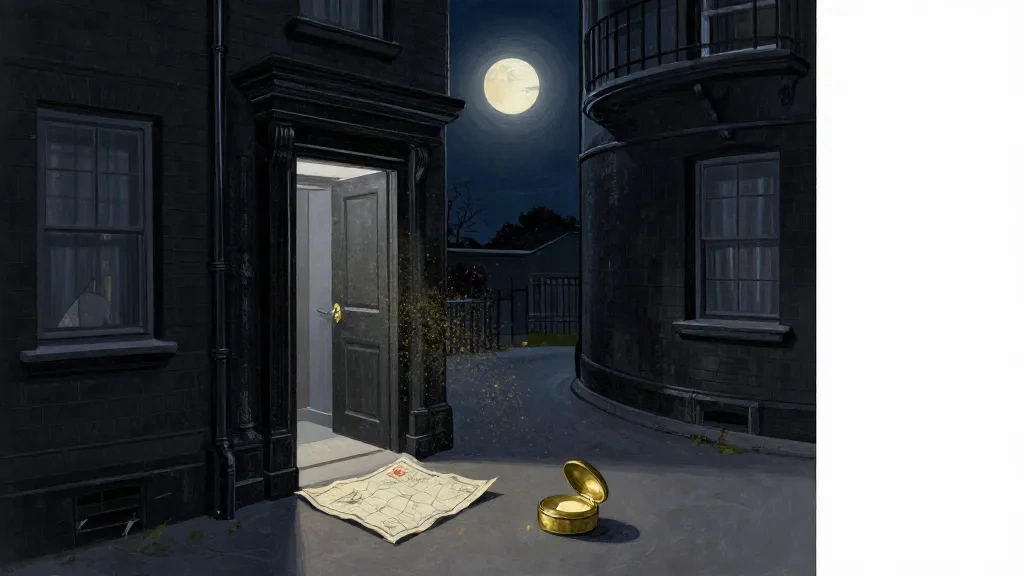
His grandmother, Alma, had left him a map after her funeral. It was folded into a square so small it looked like a pressed flower. On the paper, black-lacquer rooms crowded around a courtyard, their walls marked with gold dust. One room had no number.
Before she died, Alma had made him promise to deliver the map to the room where their family began. She had pressed it into his palm and said, “I could not enter. You can.”
He did not ask how she knew. In the Ninth House, questions were expensive; answers arrived with consequences attached.
At eight-thirty, Marlow stood before the black door. The music box in his coat pocket had been silent since Alma gave it to him. Its tiny dancers were frozen beneath the lid, one leg lifted, one hand extended.
He opened the door.
Cold moonlight spilled across a room with no furniture. The walls shone as if polished with black lacquer, and gold dust drifted above the floor in slow, deliberate streams.
“I came to keep my promise,” he said.
A new doorway appeared in the far wall.
What the House Remembered
Beyond it lay a narrow room filled with empty chairs. Every chair faced a window, and every window showed a different version of the street below: Alma young, Alma old, Alma walking toward a station with the map folded in her hand.
“You said you came to keep a promise,” said a voice from the window.
Marlow turned. The room had changed. The black door was gone.
He was still an actor. He recognized the trick: make the audience believe the lie was the only exit.
“I am Marlow Venn,” he said. “I returned because I promised Alma I would bring her map to the first room.”
The house shuddered. Another doorway opened behind him.
“That is true,” said the voice.
“I know,” said Marlow.
The music box began to play.
The tune was his grandmother’s, though he had never heard her play it. The dancers beneath the lid moved without a mechanism turning. They stepped lightly from shelf to shelf, carrying dust in their hands.
He followed them through the door.
They climbed a stairwell that had been added while he was still speaking. At the landing, a window displayed the night he had left Alma alone in her house. He had promised to return before midnight. He had not.
The house made another room.
This one was warm, smelling of wet earth and apples. Alma sat at a table, young and stern, holding the map.
“You are late,” she said.
Marlow looked at the music box. The dancers had stopped.
“I know,” he said.
A Promise With a Door in It
He crossed the room and set the map on the table. Alma did not touch it. Her hands were folded around a small brass key.
“I wanted to ask why you kept it from me,” he said.
“No.”
“I came to deliver it.”
“I know why you came.”
The admission opened the floor beneath the table.
Gold dust poured upward. The black walls split, revealing the courtyard beyond them. At its center stood the first room: a narrow chamber with a window facing east.
Alma stood in the doorway, exactly as she had on the morning she left home.
“The promise was never the map,” she said. “It was this: when the house forgets what happened, you will remember where it began.”
Marlow understood, then, why actors returned to empty stages. A room held nothing until someone entered it with the courage to fail there.
He opened the music box.
The melody filled the courtyard. Every added room appeared at once, each door opening on a life he had chosen not to repeat. He walked through none of them.
At the first room, he placed the map on the floor and turned it until its folds matched the seams in the lacquered walls. Gold dust gathered along the paper’s edges. The music box danced once, then stopped.
Behind him, the house began to collapse—not violently, but gently, like a sigh returning to a sleeping body.
Marlow kept his promise. He did not repair the family’s past.
He gave it a door that opened forward.





