 Netwrck
Fairy-Tale Fiction.
The Market Below the Moon
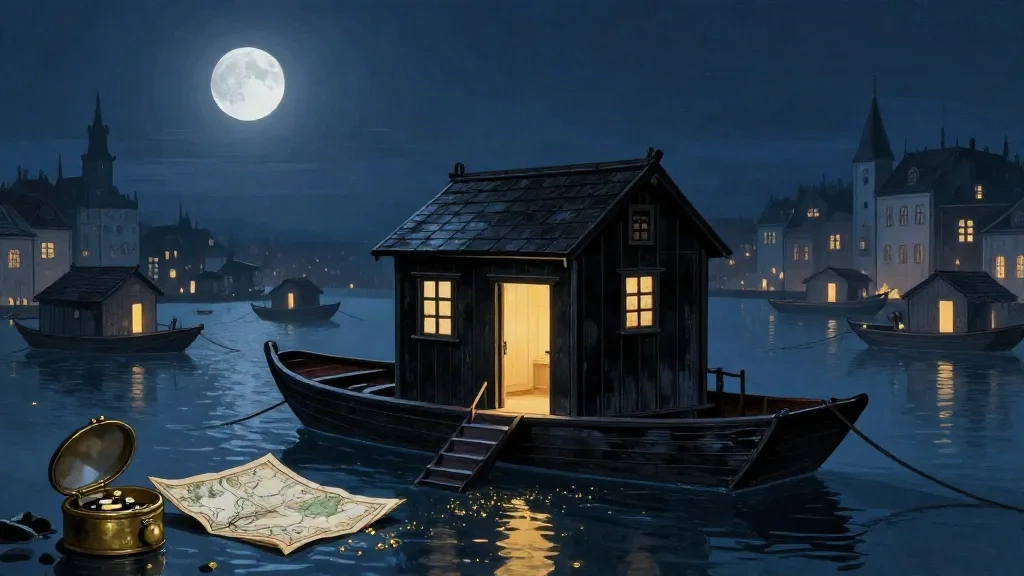
At the hour when the moon turned its pale face toward the clouds, the floating market appeared above the sleeping city.
It had no ground beneath its stalls. Black-lacquered boats drifted through cold blue air, their hulls chained to one another by threads of gold dust. On the tables lay memories that had lost their owners: a glove remembering a warm hand, a blue button remembering a coat, a pocket watch ticking inside an empty promise.
Among them was the room.
It stood upright on a barge of black wood, its walls made of floorboards and wallpaper and one narrow window filmed with moonlight. A brass plaque above the door read: THE ROOM HE LEFT.
Silas Venn recognized the wallpaper before he recognized the house. He had been an actor for forty years, and every room he had ever left remained behind his eyes: dressing rooms, hospital waiting rooms, a cold kitchen after his daughter locked the door. The market had found the one room he had spent a lifetime trying to forget.
Inside the coat pocket of the door hung a folded map. Its paper had gone soft with age, though no hand had touched it. Across one corner, in his grandmother’s narrow hand, were eight hundred sixty-one small marks.
She had promised his mother that when Silas turned sixty-one, he would return the map to the room where the city kept its forgotten things. She had died before the birthday. So had his mother. The promise remained, an unpaid coin.
The House Grows
Silas opened the door.
Warm air met him, scented of dust, coal smoke, and orange peel. A round table stood beneath a low ceiling. Two cups rested on it, one chipped, one painted with a gold crescent.
“You are late,” said a woman seated by the window.
She wore a dress from his grandmother’s youth. Her face was hidden by a black veil, but her hands were folded exactly as his grandmother had folded hers while listening to the lies of actors.
“I am here,” Silas said.
“That is not the same as keeping a promise.”
He placed the map on the table. The music box in his pocket began to play without being touched. It was the box his mother had given him on the day she left, with a silver dancer whose leg had been broken and repaired so often it moved crookedly.
The woman stood. A crack ran through the wallpaper behind her.
“Who came for me?” she asked. “Who promised to take me home?”
“I don’t understand.”
“You do. You have been understanding since you were eleven.”
Then she lied.
The room answered immediately. A new doorway opened in the east wall, breathing out cold moonlight. Behind it appeared a narrow staircase, and on its first step lay a small gold key.
Silas looked at the map. A new mark had joined the eight hundred sixty-one: eight hundred sixty-two.
The Shape of a Lie
He climbed the staircase.
Each room above was smaller than the last. In one, a boy was rehearsing a speech beneath a glass ceiling. In another, an old man was apologizing to an empty chair. In the third, a young woman was telling everyone that she had never been afraid.
The lies were not cruel. They were ordinary, frightened little walls built to keep the world from entering. Yet the house had sharpened them into corridors, staircases, locked cupboards, and chimneys breathing white sparks.
At the top, Silas found his daughter.
She was nine years old, holding the music box, her red scarf wet with rain. He had left her in a hospital corridor seventeen years earlier. No—
He caught the lie before it could take root. His daughter was forty-two now. She had her mother’s mouth and his own stubborn chin.
“I came to take you home,” she said.
“You came to ask me to leave,” he said.
The room shuddered. Gold dust sifted from the ceiling.
Below them, his grandmother rose from the table. The woman in the veil lifted her head, and beneath the black cloth Silas saw every face she had ever worn while pretending not to be afraid.
“The promise was never the map,” she said. “It was this: when the room begins to grow, tell the truth about what you abandoned.”
Silas opened the music box. The dancer turned once, twice, then stopped before the broken repair.
He had abandoned his mother because he believed his father’s accusation about the map, the room, and the woman waiting inside it. He had abandoned his daughter because staying meant admitting he was afraid. He had abandoned his grandmother because she had asked him to become someone braver than he believed himself to be.
The Door Kept Open
“I left because I was afraid,” he said. “I left your mother alone. I left my daughter waiting. I left you to carry a promise that was never strong enough for two hands.”
The veiled woman took off the mask.
It was his grandmother, unchanged, her eyes bright with tears. Behind her, the false rooms folded shut one by one. The market rang with the small bells of the boats, and all the lost memories answered at once.
“Then keep the promise now,” she said.
Silas unfolded the map. Every mark was a room his family had entered and left. He drew a final line from the center to the edge, making a door where none had existed.
The music box began to play again. This time the dancer moved smoothly, turning in a circle of gold dust.
His grandmother took his hand. Together they stepped through the new door.
On the other side was the room he had left at eleven: warm, small, and honest. His mother sat at the table. His daughter, grown, poured tea. Moonlight entered through the window without bringing any new walls.
Silas finally understood that a promise was not a bridge already built. It was the decision to keep building when the river rose.





