 Netwrck
Speculative Fiction.
The Citizens of Shade
By noon, the shadows had formed a queue outside the theatre. They stood beneath the awning with their hands folded inside their coats, patient as unpaid mourners. Each belonged to someone nearby: the butcher's shadow wore a cleaver-shaped notch, the children's shadows hopped when their owners did, and the shadow of the old clock tower stretched across the square like a black road with no destination.
Jonas Vale recognized one immediately. It had his narrow shoulders and one bent thumb, though it was younger than he was and wore no silver at the temple.
“You left me at the stage door,” it said.
Jonas had been an actor for forty-two years. He had played kings, debtors, fathers, men confessing in wartime, and once a lighthouse keeper who never left his room. Retirement had not diminished his talent for re-entering. He could return to any room he had ever left: the dressing room where he learned to cry on command, the apartment where his daughter was born, the kitchen where his wife told him he was already gone.
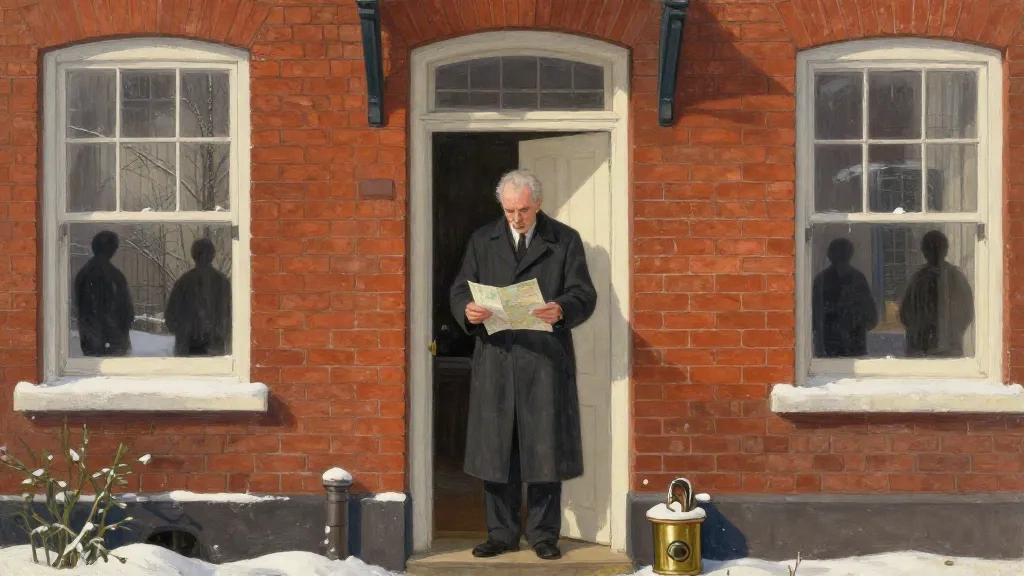
He put two fingers to the folded map in his coat and followed his shadow toward Bellwether Lane.
A House With No Last Room
The house was small, red-bricked, and surrounded by a garden gone charcoal with winter. Its windows shone with pale light despite the late hour. Jonas had been born inside it. So had his mother, and her mother before her.
His grandmother had promised his father that, when the city was ready to remember, someone would carry the map to the room beneath the eastern wall. She had never said what the map showed. Before she died, she had pressed it into his hand and made him repeat the promise.
Jonas had repeated it. Then he had become an actor, and actors made promises sound convincing by giving them proper pauses.
Inside, a woman in a red coat was arguing with a shadow.
“I never said the money was stolen,” she told it.
The shadow pointed toward the floor.
“I never said it was mine either,” she said.
The house groaned. A doorway appeared in a wall that had been solid, opening onto a narrow room filled with folded chairs. Warm air carried out the smell of dust and oranges.
Jonas understood then. The house grew a room whenever someone lied inside it. The room was not a punishment. It was a confession with walls.
The woman looked at him. “You are the last one who promised her.”
The Map Under the Floorboards
They searched until the music box began to play from an empty shelf. Its melody had been his grandmother's, though she had never owned it. The tune had only three notes, repeated so patiently it sounded like a question being asked in a language no one admitted to speaking.
In the new room, Jonas lifted a board. Beneath it lay a shallow iron chest. The map had been split along its center, each half covered in handwriting. His half showed the lane, the house, and a black line descending below the eastern wall. The other half was missing.
The red-coated woman searched her coat and produced it. “Your father gave it to me. He said the promise was dangerous if carried by one person.”
Jonas fitted the pieces together. A route appeared, ending not beneath the house but beneath the theatre, at the stage door where he had left his shadow thirty years earlier.
“The city is ready to remember,” the woman said.
“No,” Jonas said. “It is ready to make us forget.”
As if offended, the house shuddered. Another doorway opened in the ceiling. A room descended slowly, its walls lined with mirrors. In every reflection, Jonas saw himself entering somewhere he had never left.
He understood the trap. A promise could become a room if it was carried alone. It could grow until it contained every possible version of the person who made it.
What the Dead Witness
He placed the music box on the floor and opened the chest. The map had one more mark, invisible until the tune stopped: a small square beneath the theatre, in the room behind the wall where actors waited for entrances.
Jonas entered the mirrors. The first reflected room was his mother's bedroom. The second was the stage door. The third was a room he had left on the night his wife died.
In that last room, his wife sat beneath an amber lamp and folded paper into a paper bird.
“You promised her,” she said.
“I promised to finish it.”
“That is the same sentence when you are afraid.”
He crossed to her. She had been dead for nineteen years, but memory had kept the room exactly as he left it, including the dust, the chipped cup, and the dark line beneath the bed where the map had once been hidden.
He placed the folded map in her hands. Then he took the music box from his coat and set it beside her.
“Tell me where the room is,” he said.
“You already know.”
He returned to the theatre through the stage door. The waiting room had become a new room, its walls covered with names. His grandmother's name was at the bottom, followed by a date three days in the future.
Beside it, his own name had been crossed out.
Jonas lifted the music box's lid. The three notes played. The hidden door opened behind the mirrors, and cold winter light spilled across the floor.
He stepped through, carrying both map halves at once. Behind him, the city filled with the sound of footsteps, each one belonging to someone who had finally come home.





