 Netwrck
Fairy-Tale Fiction.
The Last Door Above Water
At the end of his career, Orin Vey retired to a house with black-lacquered shutters and a roof that complained whenever rain touched it. He had played kings, messengers, fathers, and once a doorbell in a play no one remembered. In every room he left, he left a little of his stride behind: a polished floorboard, a familiar cough, the shape of a hand on the wall.
That was the gift, or the curse. Years later, when his sister sent word that their mother’s house was to be emptied, Orin found himself standing before its locked front door.
He had not merely lost the key. He had left the house on the night of the flood, carrying his mother’s promise sealed inside a folded map.
The promise had been made to his grandmother: before the river rose high enough to swallow the family name, someone would return to the house and open the room beneath the nursery stairs.
Now Orin was seventy-two, the map was soft at its folds, and the music box his mother had left him still played one measure whenever he opened it: a silver note, a pause, then a note that sounded like a door being unlocked.
He could go back.
He closed his eyes and stepped out of his own bedroom.
The Archive of Departures
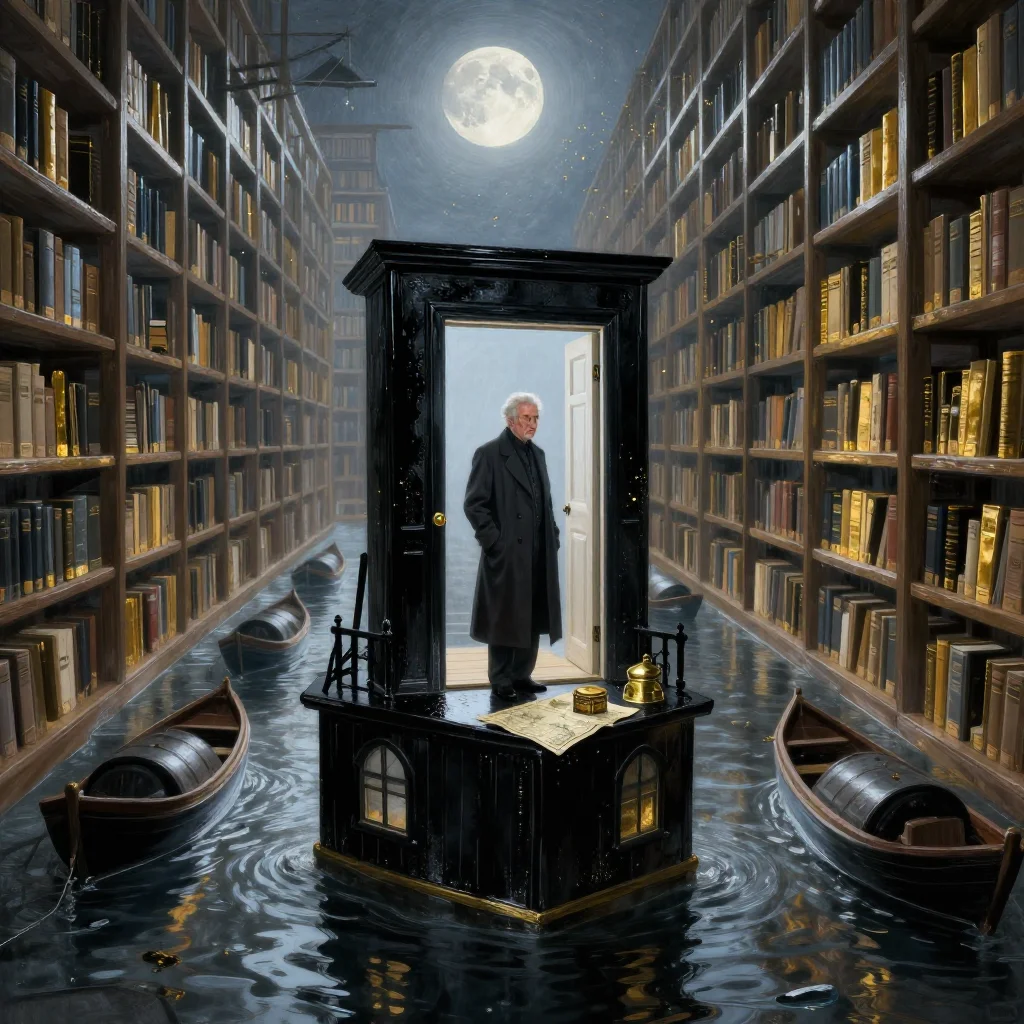
Water received him ankle-deep, then waist-deep, then black and cold around the ribs. The flood had turned the lower city into an archive, its streets submerged beneath shelves of ledgers and drowned biographies. Librarians rowed between the stacks in narrow black boats, calling directions through a language made of splashes and pencilled numbers.
“Looking for a house?” one asked.
“Looking for a room,” Orin said.
She studied the map, but did not touch it. “Houses grow rooms.”
“When someone lies inside them.”
She nodded. “Then the room appears where the lie went.”
At dusk, they reached the drowned market. Lanterns floated on the water, their gold dust settling on lacquered eaves. The music box in Orin’s coat answered a lantern with three delicate notes. On a black-lacquer sign, newly grown from the wall, someone had written: NO ONE ENTERED.
Orin knew the handwriting.
It was his mother’s.
His first lie had been easy: he had told her he would never leave. His second had been cruel: he had told his grandmother the room was already empty. The house had listened. Each denial added a door, a corridor, a locked chamber behind the walls.
What the House Ate
They rowed through the market and found the house where Orin had left it, now floating on a black island of bookshelves. Its windows shone with cold moonlight. Each time a librarian lied about the weather, a new wing rose from the roof: a conservatory, a nursery, a dining room set for guests who had never arrived.
The front door was open.
Inside, the floorboards shone as if newly polished. Orin’s footprints led away from the threshold, though he had made none. At the end of the hall, the music box began to play without being touched.
He followed the sound.
Behind the nursery stairs, he found the room beneath.
It was smaller than he remembered. Gold dust lay along the floorboards. A moonbeam entered through a high window and illuminated a cradle, a wooden horse, and a locked chest covered in black lacquer.
Orin knelt beside the cradle. Inside lay a strip of paper bearing his grandmother’s handwriting.
Do not open what you cannot carry.
Outside, the house groaned. A fresh room pushed through the ceiling, and plaster dust fell like snow.
Orin understood. The house had not been waiting for a key. It had been waiting for a truth. His mother’s promise was not to open the room. It was to return what the room had taken.
He set the folded map on the cradle and placed the music box beside it.
The Door That Fits
He could not carry the whole past. That had always been the trouble with leaving.
So he began with the smallest thing.
He told the house the truth about the morning he departed: he was afraid. He had hidden beneath the stairs while the water rose, listening to his mother promise the grandmother’s return. He had let fear make his silence sound like obedience.
One room dissolved.
He named the second lie: he had known his mother was ill and chosen the stage over her bedside. Another room folded into the walls.
Then he told the truth about the promise. He did not know whether he could keep it. He had carried the map because carrying it was the only promise he could still make.
The locked chest opened.
Inside rested a golden key, warm as a living hand. It was not a key to a room. It was a key to the house’s original shape, before fear and denial had taught it to grow.
Orin lifted the key and opened the door behind the cradle.
Cold moonlight poured through. Beyond it was not a chamber, but the exact room where he had stood the night before leaving: his mother alive, his grandmother watching, the map still folded on the table. The figures did not move. They were not ghosts. They were the hours he had refused to return to.
He stepped through.
Behind him, the drowned archive became one black-lacquered house, its extra rooms collapsing into walls. The librarians rowed home beneath a sky scattered with gold dust. At dawn, the house stood above the water again, small, ordinary, and open.
Orin kept the map. He kept the music box. He kept the promise, but no longer as a debt.
It was a door he had finally learned how to enter.





