 Netwrck
Hopeful Science Fiction.
The Last Exit
At sixty-eight, Elias Vale returned to the Monastery of Slow Gravities, carved into a comet whose lavender rock never agreed to remain still. Thirty years after leaving home for the stage, he still carried his final room with him: the kitchen doorway, his mother’s hand on the jamb, her last words folded around a map.
Keep this folded until you find a child born beneath a green pharmacy sign, she had said. Play the box only when you understand the direction. He had pretended not to ask which direction. Pretending had been easier than admitting he could not promise forty years.
Inside his coat, the music box pressed a small brass tooth against his ribs. Its melody had eight notes, one fewer than the eight inhabited levels of the comet. Beyond the monastery’s cloister, wet asphalt from the landing platform shone violet under the lamps.
A House of Growing Rooms
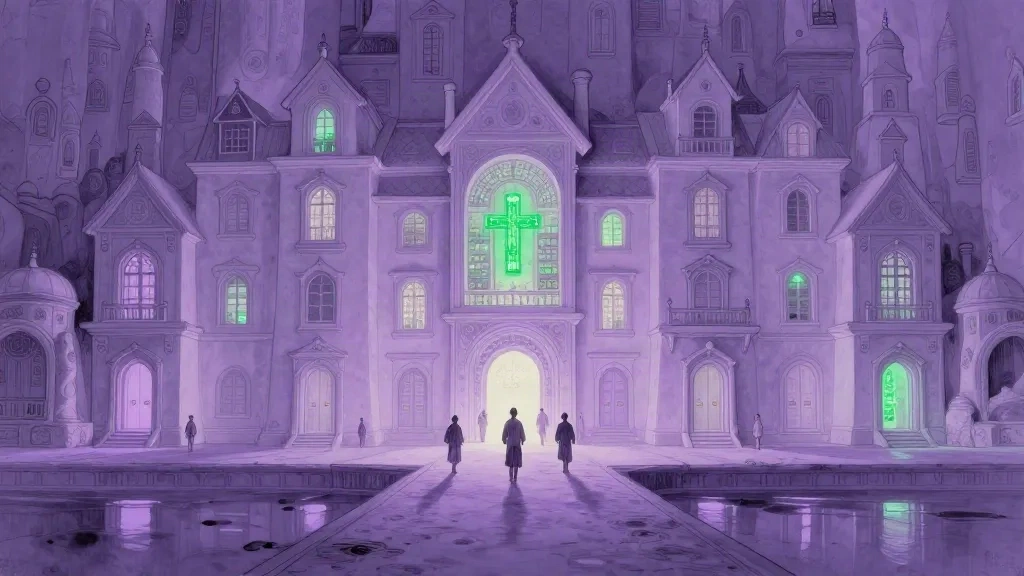
The House of Departures stood in the oldest crater, its doors facing every corridor at once. A slate above them warned: EACH LIE ADDS A ROOM. Monks crossed the threshold only to leave, then returned through the same doorway, never through the walls that now pressed against the cloister.
Elias recognized the rule. An actor had spent his life learning that, once a room was believable, its occupant could speak the impossible into existence. His own denial had done the same. During a broadcast, he had claimed he would never leave the theater. The House had heard him and built a green dressing room.
He entered and found a mirror, a chair, and a wall clock stopped at sunset. The mirror reflected the room he needed to revisit: his mother’s kitchen on the comet’s first winter. When he touched the reflected doorframe, cold plaster met his palm. He stepped through, arriving with a bowl of hot barley soup still in his hands.
The Direction Under Eight Notes
His mother had vanished before dawn. He remembered the bowl, the green light of the infirmary sign, and little else. For years he had toured the stars performing courage while nursing the conviction that courage included never surrendering a room.
That conviction had left him unable to re-enter any doorway. Fear locked his hands to every exit. The House did not mock this. It built a nursery because he had lied to himself, claiming he wanted to forget her.
Inside lay the old kitchen. His mother sat beside the stove, young again for the hour he had never allowed himself to revisit. The folded map lay under her cup, beside the music box. She told him the box’s missing note was not a direction but a person: a newborn who would inherit the route through the comet after the aging colonies vanished.
What the Walls Remember
Fresh mortar cracked along the ceiling. The House had added a corridor because he had doubted her. He spread the map across the table. Lavender ink showed a path that doubled back through rooms yet unborn, ending at a green cross fixed to a blank section of paper.
Elias played all eight notes. On the eighth, a chime sounded below the floor. He re-entered a buried nursery through the music box, emerging in time to catch a newborn sliding from a midwife’s arms. Above the door, a pharmacy lantern cast its honest green across the child.
You found the direction, the child said. It was pointing both ways.
So it had been. A promise was not a straight road, nor was a room only the place one had left. Elias placed the folded map in the infant’s hands and the music box against her palm. Far above them, a wall stopped growing, because no one present had lied.





