 Netwrck
Speculative Fiction.
The Monastery of Missing Hours
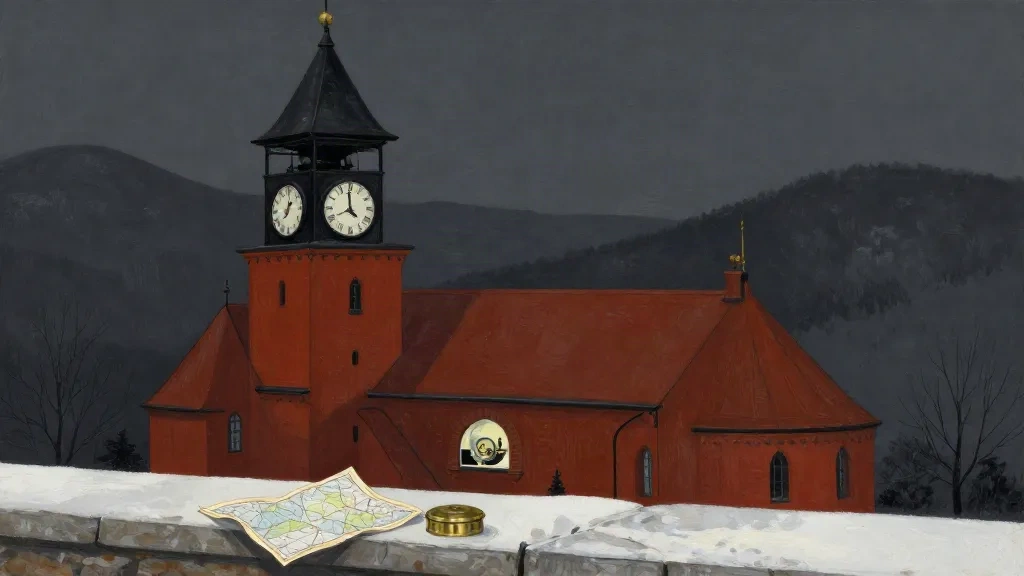
The clockmakers’ monastery stood in a country where dawn might arrive twice before breakfast. Its towers carried no faces, only blackened dials, and inside the refectory the monks argued pleasantly over what year it was. One watched the sun. One watched bread. One declared that grief kept better time than either.
Nera Vale came to the eastern gate in November, seventy-one years old, leaning on a cane she kept mostly for the theater of having a cane. She had left the stage twenty-six years ago and had not gone back to any of it, though she still read the scripts aloud in an empty flat to hear whether a line was honest. It never was. That was the trade.
She had a name for her talent: making a room. You built a room out of words, and a person walked into it and believed the floor. For forty years she had been paid enormous sums to do exactly that, and had been applauded for it, and had believed for a long time that it was the same as telling the truth in a louder key.
She had never been anywhere. She had only been described.
At the gate she showed the map and the music box, and told the gatekeeper her grandmother’s errand. He listened with the patience of a man who has learned that people arrive carrying things that must be set down.
“Promises are heavy cargo,” the gatekeeper said. “The road is lighter without them.”
He was lying. Nera knew because the wall beside him gave a small iron cough and opened onto a corridor that had not been there when she arrived.
“Who did your grandmother make the promise to?” he asked, afterward, when it was too late to matter.
“The last clockmaker.”
“Ah,” he said. “Then it was made in a house, and houses keep the terms.”
The House That Fed on Falsehoods
The corridor belonged to a narrow house with blue shutters and a cellar smelling of wet plaster. Its owner, Sister Iven, welcomed them with tea and denied owning a cellar.
Another room appeared behind the kettle.
Iven was perhaps sixty and had Nera’s face at nineteen: the sharp jaw she had spent a decade dieted away, the mole below the left ear, the slight lift of the upper lip she had never once been able to fix in a mirror and had therefore made a feature. Nera had worn that face in the spring of her career, in the green coat, in the first play anyone had let her lead.
“You were written,” Iven said, before Nera asked. “Not by me. Someone wrote me down, and then someone walked in.”
A room needs a floor, a door, and a lie the occupant has not noticed they are standing on. Take away the lie and the occupant is standing in the cold.
“The house feeds on falsehoods,” Nera said.
“The house eats,” Iven said, filling the cup again. “The distinction matters when you are what is being eaten.”
The house agreed with her. A door opened in the ceiling, and behind it stood the flooded stage: black water to the shins, a wooden platform, canvas painted as a river, the smell of river mud and hot footlights. On the bank stood a girl of nineteen in a green coat, holding a small brass object against her chest like a wound she was proud of.
“I drowned in Act Three,” Nera said. “The critics said I improved.”
“You drowned on a Tuesday,” Iven said. “The house kept the day. It has most of your days.”
She stepped into the water. It closed cold around her knees, though the house stayed dry beyond the walls. Her younger self looked up with an expression Nera had spent fifty years learning to make and had never once felt.
“I made a hundred thousand rooms,” Nera said, “and I could not make one my daughter could sleep in.”
“Lie,” the house said. It spoke through the water, through the boards, through the walls. Not hostile. Tired, the way a doorframe is tired. Lie and it opens.
It did not want the big ones. It never did. Nera gave it a small one, exact and cheap: she said aloud that her mother had been called Sabine.
Her mother had been called Sabina. She had been four when she corrected her, and the monastery had been four, and that had been enough to hold a door open on a name.
The corridor lengthened. Somewhere ahead, water dripped with the patience of a stagehand counting.
“Small lies,” Iven said, falling into step. “That is what the house prefers. Grand confessions fill a hall. Small ones are load-bearing.”
She took the music box from her coat and raised the lid. Fourteen notes crossed the water, brass and thin, the same fourteen notes she had heard every night of her childhood through a locked door. The girl on the bank did not drown. She set down the brass object, looked at it, and went up the steps to where a small boy was waiting at the wing.
The river went quiet. Iven set down the cup.
“Your grandmother came here,” she said. “That is not a lie.”
The house groaned, pleased by the distinction.
The Ledger of Small Lies
Between the refectory and the bell tower they crossed nine rooms, and in eight of them Nera counted.
It was a habit older than the cane, older than the stage. On good nights she had counted the lines she had invented in the wings — nineteen for the second act, twenty-two for the speech, none of them true, all of them load-bearing. Now she counted her own, and the arithmetic was worse than she had guessed.
She had told her daughter, Mira, that she left the theater for Mira’s lungs. Mira had been five and had a wheeze each October, and it was nearly true, which was the worst kind. She had told Mira the monastery was a printing office. She had told Mira her mother had loved the sea, because the sea is a thing that does not explain itself and cannot contradict you. She had told Mira, on the last night, I will come back and tell you the whole of it, and had meant it, and had not come back, and had let eleven years do the rest without ever telling her it had lied.
“You keep a ledger,” Iven said.
“Everyone keeps one. You call it a part.”
“I call it a part,” Iven agreed, “and I have four hundred and six of them, and none of them will let me out of the house.”
The Hour Kept Out
They descended past shelves of clocks with their hands removed, and beneath the bell tower the folded map warmed against Nera’s palm. Its rust-red thread had begun to move, stitching itself toward a blank square of floor.
Iven lifted the boards with a grunt that belonged to a woman of sixty. Cold winter light shone upward although no window opened in the earth. Inside lay a glass-domed mechanism: a motionless clock face surrounded by gears turning without teeth, making a sound like a mouth working behind a shut door.
“The monastery was built over a fault,” Iven said. “When the bells rang for noon, one hour fell through. It took your mother at the crossing and it has been widening ever since. Your grandmother’s music box holds it. Fourteen notes is not a song. It is a measure — the shape of a thing being prevented from spreading.”
Nera did not ask what had been in the hour. She had spent her life asking rooms what they contained, and she knew the shape of the question, and she knew it was a door.
“How many measures are left?”
“The box has played twice tonight.” Iven said it kindly. “You can hear the difference. So can the house.”
Nera listened. The brass of the mechanism was not thin now. It was scraped, the way a singer is scraped at the end of a run, and under the scraping there was a hiss, and under the hiss the patient count of something enormous being held at arm’s length by a woman with her hands spread.
Then she asked the question that mattered, because she had spent her life knowing which question mattered.
“Who knew?”
“The last clockmaker.”
“He knew what was in the hour. And he asked my grandmother for a promise anyway.”
“He asked her for a promise,” Iven said, “and she gave it, and it was the hour of her giving that he meant, and she knew it, and she gave it anyway, because a fault that is widening does not wait while a family finds out the terms.”
Nera stood a long time over the glass.
“So a promise can be kept exactly as given,” she said, “and still be a lie by another name.”
“Everything kept is a lie by another name,” Iven said. “That is the whole of what I know. I have never been able to say it without the house listening, and the house is not interested in being told. The house is interested in being given.”
Nera turned the key inside the music box.
An Exit Remembered
The mechanism beneath them struck once. The floor buckled. Across the monastery the clocks disagreed more violently, bells rang at once, and the newly grown rooms began pressing against one another like shoulders in a dark stairwell.
And at the eastern gate, because the house knew the whole of Nera’s ledger and had been listening for fifty years, Mira arrived.
She came up the road in the last of the doubled light, forty-one years old, with her mother’s jaw and none of her mother’s face, holding in her hand a letter from the monastery that Nera had not written and did not remember sending.
“You said the theater was the sea,” Mira said, when she saw her. “You said the sea is why you left.”
“I said a great many things.”
“Say the true one now, while the walls are moving, because I have come thirty years to hear it and I will not do it twice.”
Nera looked at the glass, and at the boy on the wing in the drowned room behind her, and at the green coat she had never been able to put down because she had made it into a person and a person requires a body.
“I left because I was good at it,” she said, “and being good at it was the only way I had ever felt like a person, and a person who is a person in every room at once is not a person in any of them, and I could not bear to find that out in front of an audience, so I found it out in a corridor and then I came home and I gave you the sea, and you were five, and the sea did not check.”
Mira did not say anything for a while. A clock somewhere above them ran backward and stopped.
“All right,” she said.
Nera opened the map and laid it over the glass dome. Her grandmother’s thread found the absent gear and pulled tight.
A promise is not a thing you keep. It is a door you leave open.
She entered the missing hour.
For one breath she stood in every room she had left: the flooded stage, the burning theatre, the locked chamber at the end of a corridor where a little girl of four had listened to a woman pack a bag and had not been told why. Then all the doors opened onto the same pale winter dawn, and she was made to look at what she had kept out.
Not her mother’s death. The monastery had never taken that. It had taken the hour in which her mother said I am going to the crossing and I will be back before the bells, and had not been back before the bells, and had come back at nine the next morning without the hour in her, and had spent the rest of her life being a woman who left once and had no memory of why.
That hour had been good. That hour had contained the last time her mother had laughed at something Nera said on purpose, and the whole of it was a goodbye, and the whole of it was coming back now.
She understood, standing in it, that her grandmother had not hidden a grief. She had hidden a weekday. There is a difference, and it is the difference you can live beside.
“Bring it back,” Nera said to the hour, “and the leaving comes with it.”
The hour agreed, the way a room agrees when the walls have been waiting.
What the Monks Did With Noon
She carried nothing back. The music box lay open beneath the tower, silent, its last note still glowing like a coal in a hearth nobody had banked. On the map the rust-red thread formed a small square around the words kept by leaving, and then, slowly, unpicked itself, room by room, and the paper was only paper again.
The corridor was still there. It went to a plain house with blue shutters and no cellar, and a woman in it of sixty with the face of a girl of nineteen, who served tea and denied nothing, because denying is a door, and the door had gone out of her.
“Will you stay?” Nera asked.
“I have nowhere that grows,” said Iven. “I will have to buy rooms, like anyone else.”
They swept the drowned stage out of the refectory. It took two days and a great deal of salt. The monks, who had argued cheerfully about the year for generations, found a single noon and did not enjoy it. Time that agrees is thin food. One of them wrote in the refectory book that the year was, to the best of his determination, the year, and underlined it twice, and then sat a long while with his pen hovering, because a determination is not a fact and he had been raised honest.
Nera found she could no longer remember the first line of anything she had ever learned. Thirty years of them — the speeches, the soliloquies, the small cruelties she had delivered to houses that never existed — gone clean, like a row of hooks with nothing on them. She had built a career out of words that were not true, and the hour had come back through her and taken the untrue ones, and she found she could not be sorry about it, which frightened her more than the loss.
Her mother lived nine years longer. She came back at nine in the morning with the hour restored, and she was gentle about it, and she said, one evening, without preamble, that Nera had been a tiresome small girl and that she was glad the winter had gone early that year.
Nera said she was sorry about the lungs.
“Yes,” her mother said. “I know. It was not the sea.”
The Second Bell
At the eastern gate, Mira waited beside a cart with one good wheel and Nera’s things still packed, because Nera had not said she was leaving and had not said she was staying, and the daughter had come to watch the bells out of a stubbornness that came from both of them.
“Come to the house,” Nera said. “I have rooms. I can describe them for you.”
“I have a house.”
“Yes,” Nera said. “You have a house. I am told that is the same, now, without the lies.”
The bells rang for noon. Far away, somewhere beyond the blue shutters, a bell rang a second time, and the second note arrived exactly on time.
Nera listened to both. She had spent her life knowing precisely which of two things was the invention, and she found that she could no longer tell, and that this was not a loss, and that it was also not a pardon. Somewhere under the floor of the world the gears turned on without teeth, holding nothing now, holding nothing at all.





