 Netwrck
Fairy-Tale Fiction.
The Whale’s Last Light
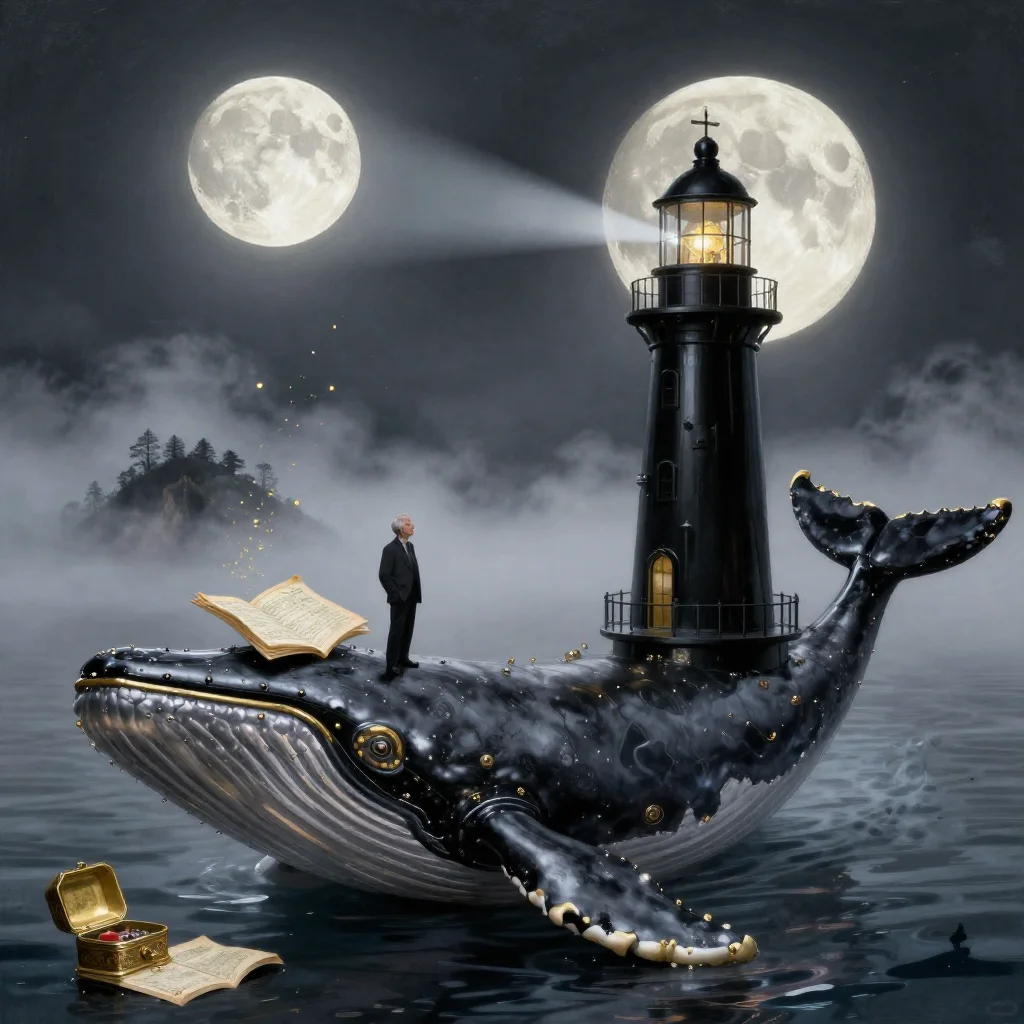
After forty years onstage, Alaric Venn retired to a lighthouse built on the broad back of a mechanical whale. The whale lay becalmed beyond the shipping lanes, black lacquer shining under a moon that seemed too cold to cast warmth. Its ribs opened like折叠 shutters, revealing brass gears that turned in silence. On its spine, the lighthouse swept a narrow beam across the empty sea.
Alaric kept the light because his grandfather had kept it before him, and because his grandfather had made him promise to return.
That promise had been delivered in a language Alaric barely understood, on the last night of a winter tour. The old man had pressed a folded map into his hand and a music box into his other palm. Keep the light, he said. When the whale opens its fourth eye, follow the map to the room that waits for an honest face.
Alaric had spent sixty years avoiding the sea. Now the whale’s body creaked beneath the floor, and a small brass eye opened between two ribs.
The Unfinished Corridor
Inside the lighthouse, the map unfolded into a single line: a spiral beginning at the lantern room and ending beneath the floor.
Alaric knew every room he had ever left. He could step through a closed door, across a vanished stage, or into the dusty kitchen where his mother had cried before his final audition. The trick was useless whenever the room did not yet exist.
A corridor now extended past the stairwell. Its walls were wet with black lacquer, and gold dust floated in the air like sparks refusing to fall. At the far end stood a white door.
“You came back,” said a woman behind it.
Alaric had never heard her voice, but he knew its shape. It was his grandmother’s voice, younger than he remembered.
He opened the door. Inside, a theater waited in miniature. Empty seats faced a stage where a dozen actors repeated the same gesture: one hand shielding the eyes, the other pointing beyond the curtain.
“The whale remembers every performance,” the woman said.
Alaric looked down. A new doorway had appeared behind her, leading to a room filled with folded wings.
He stepped toward it.
“You promised to keep the light,” she said.
The words were true. Yet the woman turned away, and another room opened beyond her, smelling of rain, salt, and burned paper.
That was when Alaric understood the house’s appetite. Lies did not merely escape. They took root.
A Map Written in Reverse
He unfolded the map again. Its spiral had changed. A new line crossed the paper in red thread, leading toward the room of folded wings.
Alaric played the music box.
The melody had no beginning. Its first note arrived only after the last, looping backward like a memory refusing to end. Gold dust lifted from the floor and gathered into a narrow path.
He followed it.
In the wing room, actors stood dressed as judges, sailors, children, and ghosts. One wore his grandfather’s face. Each had been invited to tell the truth, and each had concealed something.
“You lied to me,” Alaric said.
The old man smiled. “I lied to the whale.”
Around them, doors multiplied.
The music box chimed. Every actor turned toward the sound, but Alaric crossed the room and seized the one wearing his grandfather’s face.
“The light is not a beacon,” the actor whispered. “It is a lock. Something beneath the whale has been waking, and the tower keeps its eyes shut.”
Alaric struck the false face with the music box. The gold lid broke. Inside, instead of a mechanism, lay a tiny folded map.
It opened by itself.
The two maps together showed a door beneath the lighthouse, shaped like a whale’s mouth.
The Door Under the Sea
Alaric descended through the new rooms. The house shifted around him, inventing hallways for every hesitation. He passed a nursery where an infant practiced breathing, a dining room where his grandmother was young again, and a dressing room filled with costumes for roles he had abandoned.
At the bottom, the whale’s mouth waited.
Beyond it lay a chamber of black water, perfectly still. The lighthouse beam entered as a golden line and illuminated a sleeping shape far below.
His grandfather’s voice came from the water.
“The promise was never to keep the light,” it said. “It was to let it shine somewhere else.”
Alaric understood then. The old man had been trapped beneath the whale, holding a lock open with the tower’s living flame. If Alaric extinguished the light, the whale would wake. If he left it burning, the old man would remain chained below.
He drew the two maps together. Their lines formed a route through the sleeping chamber.
The whale shuddered. Water climbed the walls.
Alaric stepped into the dark.
Behind him, every room the house had grown began to close. The actors vanished. The theater folded shut. His grandmother’s voice faded into a single unfinished line of music.
At the whale’s heart, Alaric found his grandfather bound by golden threads. The lighthouse light was the knot.
Alaric raised the map. The paper turned to warm metal beneath his fingers.
He did not cut the promise. He completed it.
He opened the map into a door, sent the beam through it, and called the old man toward the only future that did not require a lie.
At dawn, the whale carried a single lamp across the northern sea. Alaric watched from the lighthouse gallery, no longer able to enter any room, because the whale had reached the end of its long dream.
The music box remained in his pocket, silent. Its final tune was waiting for another lighthouse, another coast, another person willing to ask what a promise was made to protect.
In the whale’s wake, three small islands appeared on the horizon. Each bore a black tower, and in every tower a gold window shone for one hour after midnight.
Alaric had promised his grandfather to return. He had never promised the dark to keep his secrets.





