 Netwrck
Hopeful Science Fiction.
Tomorrow Came Back Empty
Everyone in the Vesper Apartments remembered the future, though no two agreed on its shape. In the laundry room, Mrs. Bell knew the exact hour the machines would fail. On the eighth floor, the boy called Senn predicted rain three days before the clouds gathered. At the front desk, Mr. Vale could recite the date of his own disappearance, but not the date of his birth.
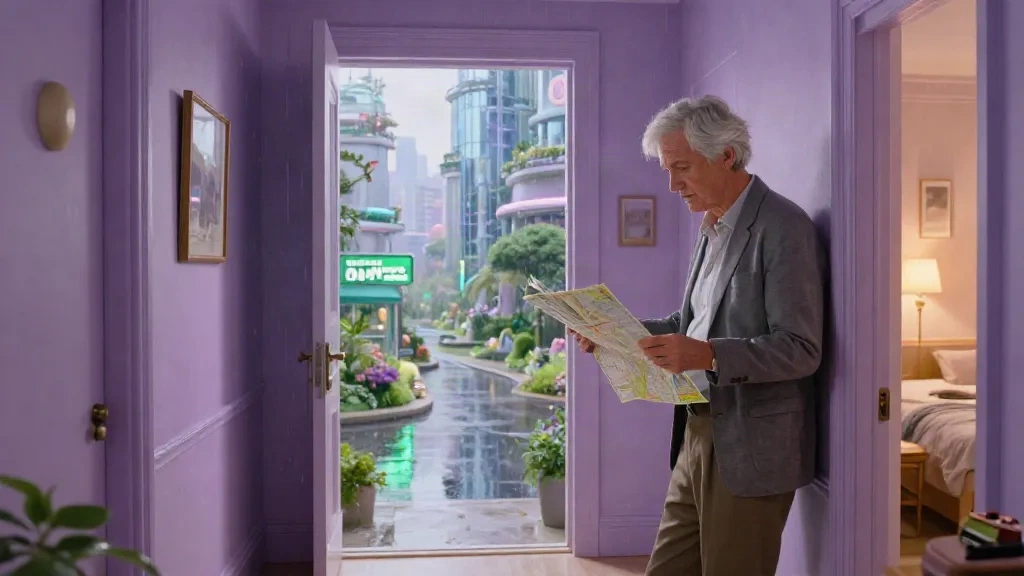
Julian Venn had spent sixty-four years acting in rooms, then left the stage because every room had begun to feel like a sentence. He moved into Vesper House when the city’s theaters went dark. His room was lavender, with a narrow window overlooking wet asphalt and the green pulse of the pharmacy sign across the street. Each morning, he knew what would happen that day before it happened. He avoided making plans. Plans were promises made to people who had not arrived.
One morning, Julian remembered a promise he had already broken. It belonged to his grandfather, who had lived in Vesper House before the remembering changed. Before Julian left home for his first audition, his grandfather pressed a folded map into his hand and said, “When the north room begins to miss us, take the hallway east. Never use the elevator.”
Julian had laughed then. The map had remained in a drawer for forty years, its creases softened by his fingers. This morning, he knew he would need it.
The Hallway East
The elevator stopped at the fourth floor, opened its doors, and revealed a room Julian had never seen: a small theater with nine empty seats. A woman sat in the front row, though her face was blurred by tomorrow’s uncertain light.
“You promised,” she said.
“I’m sorry.”
The walls sighed. Somewhere behind them, a floorboard lengthened into a corridor. Julian unfolded the map. The paper was damp at the edges, as if it had been carried through rain. Its ink showed a route through rooms that did not exist yet: the north room, the room behind the music box, the room where the truth waited.
He entered the first room. His grandfather stood beside a piano, younger than Julian remembered, with a silver music box in both hands. The room smelled of lavender dust and rain on pavement. On the table lay a list of names.
“You said you would return the box to the family,” Julian said.
His grandfather nodded. “And you said you would tell them what happened to me.”
Julian looked at the list. The names belonged to tenants who had lived in Vesper House before it began remembering the future. None had known how they died. They had simply vanished, leaving behind unfinished sentences and unpaid bills.
“I don’t know what happened to you.”
“Then don’t invent it,” his grandfather said. “Bring the box to the north room. Let them choose.”
Rooms Made of Mistake
Julian took the music box, but the room resisted him. When he said, “I am afraid,” a nursery appeared behind the piano. White walls, a mobile turning above an empty crib, and a green pharmacy glow reflected in the window. The nursery was the first room the house had added to his grandfather’s confession.
Julian tried the east corridor. At every turn, the building changed. A kitchen opened around a meal still steaming. A bedroom contained a suitcase packed for a journey never taken. A bathroom held a mirror in which Julian was younger, smiling at a woman who had not yet become his mother.
Each room had been made by a lie. Not his lies alone. The lie of a tenant who said she was never afraid. The lie of a man who claimed he had not left. The lie of a child who promised to return home after growing up.
“You cannot pass,” said the music box, waking inside Julian’s coat.
“Tell me where the north room is.”
“There is no north room.”
That was a lie. The map trembled against his palm, and a new door appeared at the far end of the corridor. Julian entered without answering. The door opened onto a bare room with a single chair. A tall window showed the future of Vesper House: towers of lavender glass, gardens beneath the asphalt, and a sign glowing green above the entrance. The room’s future was peaceful, but its present was empty.
What We Carry
On the chair sat a note in his grandfather’s handwriting.
Do not keep the promise for me. Keep it for the people who come after us. A promise is not a lock. It is a door left open.
Julian set the music box on the floor. Its melody began, delicate and uneven. The names on the list appeared in the windows outside. One by one, the missing tenants stepped into the room. They did not accuse him. They asked what they had been meant to become.
Julian could have invented beautiful answers. He had spent a lifetime doing that. Instead, he told them the truth: he had promised his grandfather to return the box, then forgotten. He had chosen a career over the promise because applause felt more certain than love. He had let the map gather dust while the future continued moving without him.
With each sentence, the room stopped changing. The nursery dissolved into warm light. The kitchen returned to an ordinary wall. The empty windows cleared, revealing the real hallway and the green pharmacy sign shining through the rain.
At last, one tenant remained: a girl no older than Senn. She held the music box’s key in her palm.
“What did you promise?” she asked.
Julian looked at the folded map, then at the room his grandfather had preserved. “That the future would still have room for the past.”
He turned the key. The melody changed. Notes climbed through the apartment, opening windows, unlocking doors, carrying the old promise forward. The north room appeared around him, no longer a room of grief but a room of choices.
By evening, Julian was home. The map lay unfolded on his table, and the music box played softly beside the pharmacy-green light. He did not remember tomorrow. For the first time, he did not need to. He knew only this: the promise had kept him moving, and now it belonged to everyone.





