 Netwrck
Fairy-Tale Fiction.
The Door He Left Open
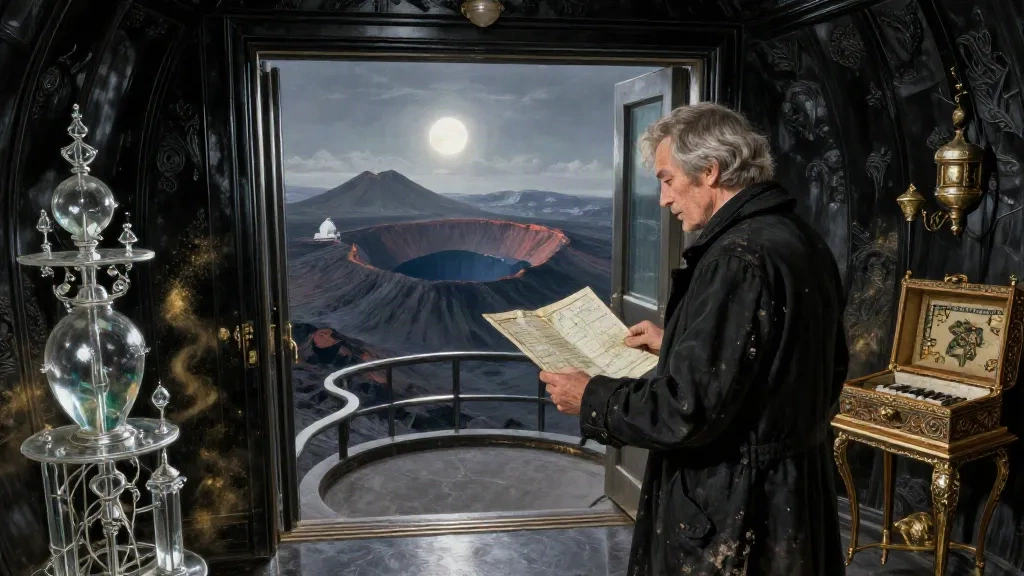
Elias Venn had left the mountain observatory at seventeen, wearingstage makeup, a borrowed coat, and a promise he had not yet learned how to break. Thirty-eight years later, the volcano slept beneath the mountain like a swallowed bell. Its crater was filled with snow, and the observatory clung to the western rim, half marble, half black lacquer, its windows reflecting cold moonlight.
Elias had been an actor for four decades. He could enter any room he had ever left. Not return through the door, exactly. The room folded around him when he touched its handle: a dressing room in Prague, a hospital corridor, a childhood kitchen, the blue corridor of the theater where he had last seen his daughter. He had used the gift to vanish from difficult conversations, but never to revisit the rooms that mattered.
In his coat pocket lay a folded map. His mother had sent it three days before, along with a music box whose melody had no name. She had died before he could ask what either object meant. On the map, in violet ink, were six lines and one instruction:
Deliver the box to the room beneath the western moon. Do not speak until the door has closed.
The House That Grew
The observatory door stood open. Inside, dust lay on the floor in perfect rectangles, as if someone had been measuring the house while it slept. Elias entered the reception hall. To his left, a fireplace opened and widened, revealing a room he had never seen. Inside it stood a table, a decanter, and a younger man in a conductor’s coat.
“You promised,” the man said.
Elias knew the voice. It belonged to the director who had given him his first role, and then denied him the last.
“I was young,” Elias said. The floorboards shifted. A crack split along the ceiling, and another room appeared behind the fireplace: a dining room with blue curtains, a birthday cake, and his mother’s face turned toward someone beyond the frame.
He pressed his hand over his mouth. The rooms stopped growing.
At the center of the hall waited a staircase descending into the rock. He unfolded the map. The lines moved beneath his fingers, matching themselves to walls, stairways, then a narrow passage no architect would have drawn. The music box began to play without being opened.
Its tune was his daughter’s lullaby, the one he had sung before leaving the hospital.
Beneath the Western Moon
The staircase ended at a circular chamber lined with black lacquer. Gold dust floated in the moonlight, settling on a row of empty chairs. A second staircase continued down, but the map ended at a door set into the floor.
Elias heard voices behind it. His mother promised the sleeping volcano that the observatory would remain a place where people could confess what they had done. His father promised that if she ever left, he would return. Both promises had been broken, though neither had been spoken aloud to him.
He knelt and placed the music box on the threshold.
“I came back,” he said.
The chamber inhaled. A room formed around him: a green room, a dressing room, a nursery with a moon painted above the crib. In every room stood his daughter, older each time, asking the same question.
“Where were you?”
Elias had rehearsed a hundred answers. Some were true. Some were kinder. None were enough.
“I was afraid,” he said. “I thought if I stayed, I would become someone who could not leave.”
The walls shuddered. The false rooms began to collapse, exposing bare stone. At the center, the music box had opened. Inside, instead of a mechanism, rested a small black key.
The Promise Kept
Elias understood then. The room beneath the western moon was not a place. It was the place a promise made when it was true, before fear wore it into a convenient shape. The key would not open the observatory. It would open the final room his mother had left.
He turned it in the lock set into the floor.
The ground opened onto the volcano’s crater. Snow slid away in a slow silver tide, revealing a garden of black glass. At its center stood a small observatory, bright as a match flame beneath the moon. His mother waited on the steps, younger than he remembered, her face calm.
“You kept your promise,” she said.
“I kept yours too.”
She shook her head. “I asked your father. He asked the mountain. No one asked you.”
Elias looked back. The house above him was full of rooms now, each one containing a life he had left behind. He could enter any of them. He did not.
At dawn, the volcano breathed once. Gold dust rose from the crater and settled on the observatory roofs. In the villages below, people woke with the same forgotten melody in their heads.
Elias stayed in the black-lacquer chamber, listening to the music box play until its last note became indistinguishable from the wind.





