 Netwrck
Speculative Fiction.
The Last Train from Elsewhere
Elias Venn retired from the stage with a cough, a modest apartment, and the habit of entering rooms he had already left. He could do it only once each: place his palm on the door, remember the room, and step back into the exact arrangement of light, dust, and furniture that had received him years before.
His father had promised that the house at Salt Meridian would keep one room empty until Elias returned. The promise had been made in a railway carriage, thirty-eight years earlier, when Elias was an angry young actor and his father was a mapmaker with rust-red fingers.
“A promise needs a room,” his father had said. “Otherwise it is only noise.”
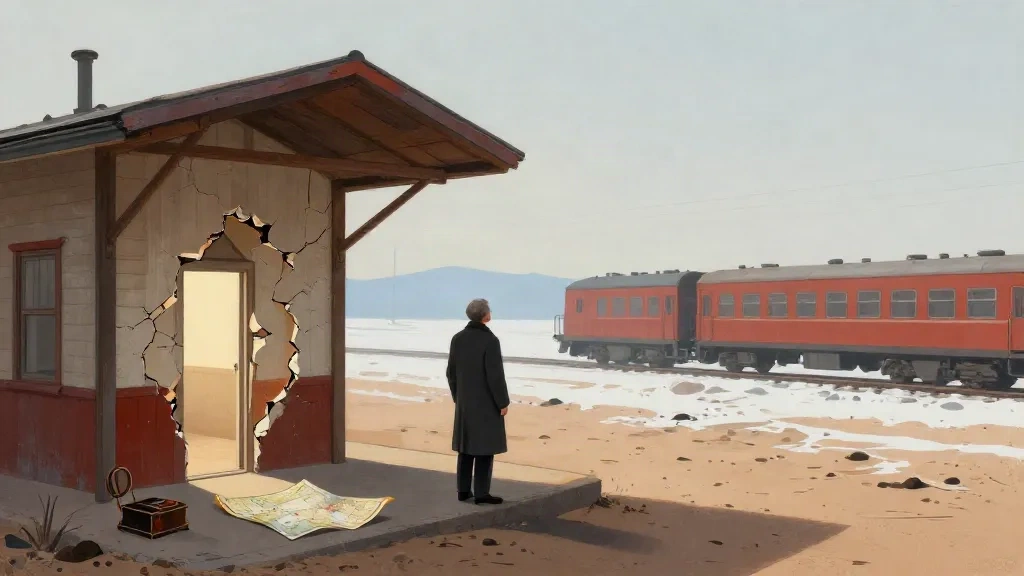
Now the house stood beside a desert station where the rails ended in pale winter light. A train arrived every thirteen minutes from another century, its windows full of blue snow and people who had not been born. The conductor waved Elias aboard without asking his name.
The House Adds a Door
At the station, a woman in a charcoal coat was waiting beside a small music box. Its lid was carved with a folded map.
“You are late,” she said.
Elias looked at the house. It had one door, though the roof stretched far beyond the walls. As they approached, a second door appeared beneath the eaves. Warm light leaked from its keyhole. A third followed, then a fourth, each opening onto a room visible through the wood.
“The house grows a room whenever someone lies inside it,” the woman said.
Elias recognized her from a production of Hamlet. She had played Ophelia, and he had played the king in a summer theatre with no air conditioning. He remembered the exact room where she had confessed, years later, that she had never loved him.
“You lied to me,” he said.
“Yes.”
Another room burst from the wall.
Inside, a younger Elias sat beneath a rust-red sun, accepting a telegram from his father. The message said: Do not come home. I will keep the room.
Elias knew the telegram was false. His father had come home that night, carrying the folded map and the music box, and had left again before dawn. The lie had opened the room because it had waited too long for him to enter it.
Rooms Filled With Other Lives
The woman’s name was Mara. She had come from the train with a brass key and a list of departures. She said the house had begun claiming lives. Every person who entered with a false story received a room where that story became convenient, until the rooms crowded against the desert and the walls began breathing.
Elias descended through twelve rooms. In one, his father laughed in a kitchen that smelled of oranges. In another, an actress apologized for a marriage that had never occurred. In a third, a boy confessed that he had not been afraid when the mine collapsed.
Each room offered a version of him that was easier to live with. Each version had forgotten why he had come.
On the final landing, he found his father old, asleep in a chair beside an unopened door. The music box sat at his feet. Its melody had stopped.
“You promised to keep one room empty,” Elias said.
His father opened his eyes. “I kept the room empty for you.”
“You left me in another.”
The old man tried to rise. The house shuddered, and a new room appeared behind him.
What the Map Kept
Elias took the music box and unfolded the map. Its creases were pale from age, but a charcoal line led from the house to the rails and beyond them to a place marked only by winter light. On the back, in his father’s hand, were three words: Leave the truth here.
Elias wound the box. Its single tune returned, delicate and wrong in the thin air. The walls stopped breathing.
He knew then what his father had done. The promise was not to return, nor to keep a room waiting. It was to keep the room from being filled with explanations. His father had preserved an emptiness so Elias could choose without being directed.
“I don’t know how to keep a promise,” Elias said.
“Then keep it imperfectly,” his father answered.
Elias opened the door. Beyond it was a room with no walls, only the desert station under a rust-red sky. He stepped through, carrying the folded map, while the house collapsed behind him into a heap of doors.
The woman from the train took the music box. The train arrived. Elias boarded without looking back.
In the desert, a single room remained standing beside the rails, its door closed, its window pale with winter light, and its silence deliberately, stubbornly empty.





