 Netwrck
Hopeful Science Fiction.
The Monastery Without Morning
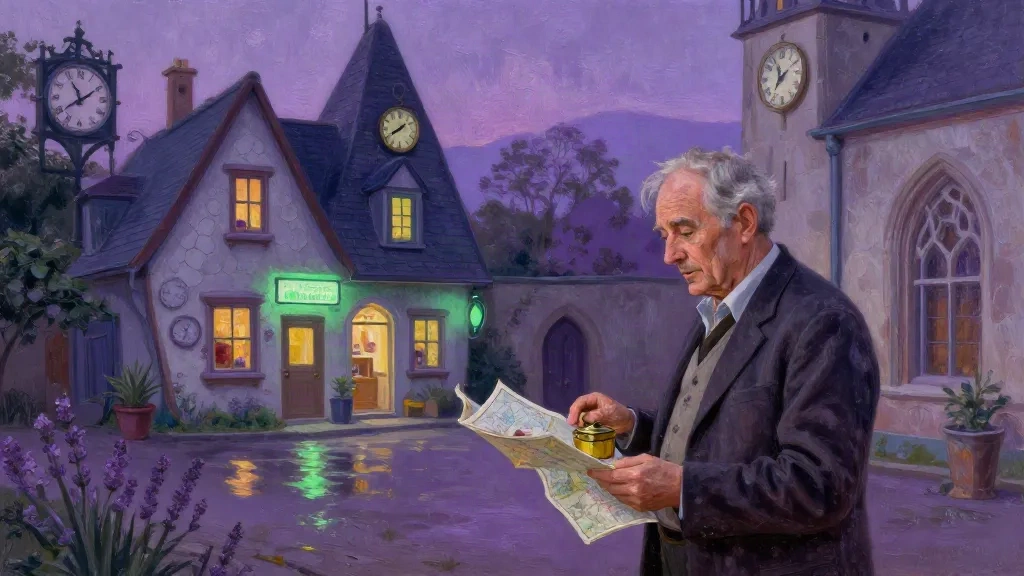
At the monastery of clockmakers, no two clocks agreed. Some ran backward beneath lavender ceilings. Others trembled whenever rain touched the wet asphalt outside. The country had lost reliable time, and the monks repaired what little order remained: brass hands, wooden cases, tiny silver bells that marked meals and prayers by seasons rather than hours.
Elias Venn, retired actor, arrived carrying a folded map and a music box with no key. He had been told the music box belonged to his grandmother, but she had denied it before leaving the monastery. That denial had been the last promise she made him: “Do not come looking for the room I took with me.”
He had spent forty years obeying. Now his knees were unreliable, the theater had closed, and the promise had become heavier than its meaning. On the map, written in violet ink, was a route from the monastery to a place called the First Morning.
“Your grandmother drew this,” said Sister Ily, the oldest clockmaker. “She was not a clockmaker.”
“She acted.”
“People mistake acting for truth. This house does not.”p>
Rooms Made of Lies
The house stood at the monastery’s eastern edge, where the pharmacy signs cast their green light across the walls. Elias entered carrying the map. The foyer opened into a kitchen he remembered from his childhood, though he had never been there.
“You promised to return,” said a young woman at the table.
Elias knew her face. She had been his daughter in a play, the one who died before the curtain rose. He had left that room decades ago, abandoning the role before opening night. The house had kept it.
“I promised,” he said.
Behind him, a door opened.
The new room smelled of rain on stone. Inside, his grandmother sat beneath a pharmacy sign, turning the keyless music box in her hands. She looked exactly as she had when she denied owning it.
“You lied,” she said. “You said you came only because your knees hurt.”
The house shuddered. A second door appeared, then a third. Elias watched walls rearrange themselves, trapping the lie in fresh rooms.
Sister Ily’s voice came from the foyer. “The house grows wherever a lie has been spoken. Do not feed it.”
Elias opened the map. The route had changed. A line now led through every room his grandmother had denied him: the garden where she buried a brother, the infirmary where she had pretended not to know him, the room where she had promised his mother that Elias would become an actor.
He stepped through the first door.
What the Actor Remembered
In the garden, his younger self waited beside a broken fountain. Elias gave him the line he had abandoned: “A life is not a performance, but every performance is a life.” The boy repeated it, and the house trembled.
In the infirmary, his grandmother whispered that she had never wanted him to become an actor. He let her speak. The lie had been mercy, but mercy still made rooms.
By the third room, exhaustion dragged at his ribs. He remembered why he could re-enter anywhere he had left: every departure carved a door in him. The gift had made him an actor. The curse had made him someone who could never truly leave.
The music box began to play without a key. A simple melody emerged, eight notes repeated. His grandmother smiled.
“Your mother taught me that,” she said.
“You promised to give it to me.”
“I promised to keep your father’s route from vanishing.”
She placed the map on the table. The ink brightened, revealing a second path beneath the first.
The First Morning
At dawn, the monastery clocks began to chime together. The sound did not divide into hours. It moved outward through the country, across wet asphalt and fields tinted lavender, waking people who had forgotten what morning looked like.
Elias followed the hidden route. It led not to a place, but to a room beneath the monastery’s oldest clock. There the previous generation’s promises had been stored, each folded into a map too delicate for ordinary hands.
His grandmother’s map held one promise: that the country would remember a future worth inheriting.
Elias pressed it into the clock’s empty face. The mechanism turned. New rooms stopped appearing. Somewhere above them, the house released a breath and became ordinary again.
At sunset, Sister Ily found him holding the music box. It had gained a small silver key.
“Your grandmother kept her promise,” he said.
“No,” she replied. “She kept the promise your father made to her.”
Elias opened the box. The melody reached the courtyard, and every clock began, at last, to measure the same passing minute.
He did not go back inside. He had left enough rooms for one lifetime.
Some promises are not chains. They are doors left unlocked for the next generation.





