 Netwrck
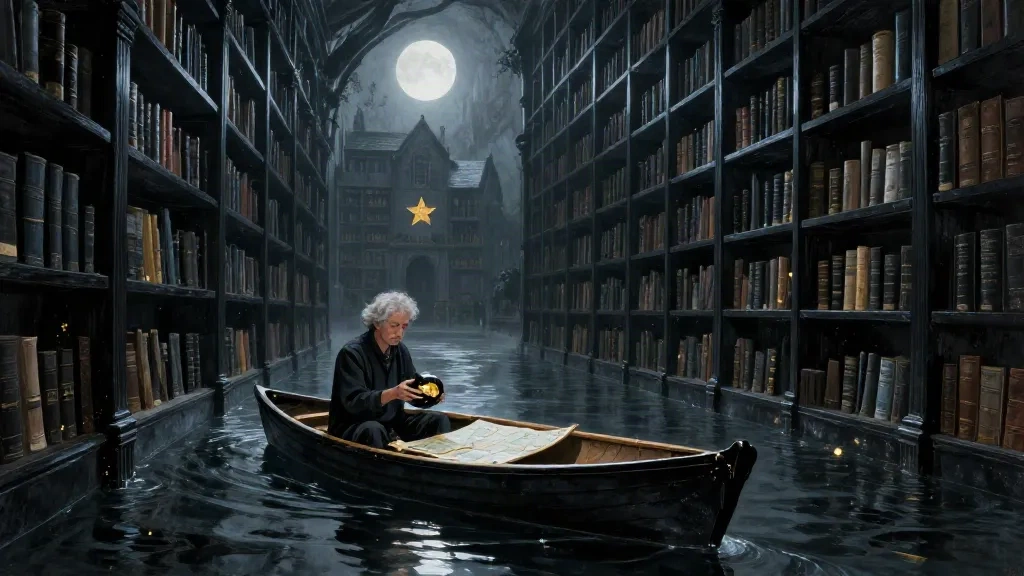
Fairy-Tale Fiction.
The House Below the Stacks
At low tide, the archive showed its shelves like drowned columns, and Mara Venn rowed between them in a lacquered skiff.
She had been an actor for forty years, remembered chiefly for the roles she played after leaving the stage: a queen in mourning, a saint with a stolen voice, a woman who could walk through walls without touching them. Now she was retired, though retirement had done nothing to quiet her feet.
In her coat pocket lay a folded map and a small music box. The map showed a house beside the water, marked with a gold star. The music box had belonged to her mother, who had promised her daughter a room that could not become smaller.
At the archive desk, an elderly librarian waited beneath a lamp shaped like a paper boat.
Promises are heavy cargo,
the librarian said.
They make the boat list.
Mara unfolded the map.
I promised my mother I would bring this back.
She placed the music box on the desk. The tune inside it had not played in thirty years, yet the librarians across the flooded hall lifted their heads at once.
The First New Room
The house stood beyond the last shelf, its black lacquer walls reflecting the cold moonlight. Mara had left that house as a child. She remembered the blue stair, the brass key beneath a loose tile, and her mother closing the music box before leaving through a door that opened onto winter.
Her mother had gone to deliver a message. She had promised to return before the house forgot her.
The house remembered everyone except those who had lied inside it.
Mara crossed the threshold. The music box began to play, each note a drop of water.
In the entrance hall waited a small room filled with folded curtains.
Where did that come from?
Mara asked.
The house answered with another door.
Beyond it stood a kitchen, a nursery, a theater, and a narrow room containing two people who had never existed. Each time Mara passed through a doorway, the walls breathed outward. Somewhere behind her, floorboards joined and a ceiling rose.
She remembered the warning from the map, written in her mother’s angular hand: Do not promise what the house can use.
At the center of the parlor lay a chest covered in gold dust. Its lock was shaped like an open mouth. Mara had the key, but the key was warm.
The Weight of Falsehoods
She remembered now. Her mother had not left to deliver a message.
She had left to find the actor’s father, who had promised to return after abandoning them. Mara had spent childhood inventing his endings: killed in a river, vanished at sea, waiting outside the archive. The lies had filled the house until it had pushed its walls into the village and drowned the road.
Mara put the key into the lock. The chest whispered.
She told the house she had been afraid of her mother.
A corridor appeared behind her.
She told it she had hated her father.
The roof split open, admitting a moon sharp as a knife.
She told it she had not come to keep her mother’s promise.
The music box stopped.
Silence gathered in the new rooms. Then, from somewhere beneath the floorboards, a man said,
You promised to forget me.
Mara looked at the black window. Her reflection was old, but not as old as the face appearing behind her.
The Last Door
The house had grown around its oldest lie: that the promise could be returned without being fulfilled.
Mara opened the chest. Inside lay a second music box, black lacquer clouded with gold dust. When she lifted its lid, a miniature actor stepped onto the stage within and began to play a role no one had ever seen.
He wore her mother’s face.
Mara understood. Her mother had not asked her to bring home an object. She had asked her to bring home the truth.
So Mara opened the final door.
It led into the house as it had been before the lies: one room, a table, two cups, and a child waiting by the window.
The child looked up.
Did she come back?
Mara placed both music boxes on the table. The newer one played the first bars of the old song. In the moonlight, gold dust rose from the black keys and settled on her hands.
No,
Mara said.
But I kept my promise. I found out where she went.
She opened the chest one last time. Inside was no message, no key, no forgiveness. Only a child’s drawing of a house floating among silver stars.
Mara carried it to the door. Behind her, the false rooms collapsed one by one, each lie losing its wall.
When she stepped outside, the house was small again. The map had changed. The gold star was gone.
At dawn, the librarians found a black house reflected in the archive water, with no windows and no doors.
They also found a retired actress sitting in a skiff, holding a music box that played a melody no one remembered learning.
Mara listened until the final note faded.
Then she rowed toward the open sea, carrying the promise where it belonged: not as a thing to be kept, but as a truth allowed to set her free.





