 Netwrck
Fairy-Tale Fiction.
The Market of Unclaimed Things
Every winter, the market of lost memories came down from the mountains and hovered above the drowned fields. Lanterns burned without flames. Brass staircases unfolded into air, and the vendors arranged their stalls beneath black lacquer roofs dusted with gold.
Elias Venn went there because he had nowhere else to go. He was seventy-one, a retired actor remembered chiefly for roles that no one living could verify. In his trunk he carried a folded map with a crease through the shape of a pear and a small music box whose tune had stopped three notes before the melody ended.
The map had belonged to his grandmother. Before she died, she had pressed it into his hands at the door of the old theater.
“Keep my promise,” she said. “Not mine. Yours.”
He had never understood. Neither had the actors who found him, the doctors who examined him, or the young girl in the market who pointed toward a stall hung with black cloth.
“Promises are memories without witnesses,” she said. “They grow heavy when no one remembers them properly.”
The House With One Extra Door
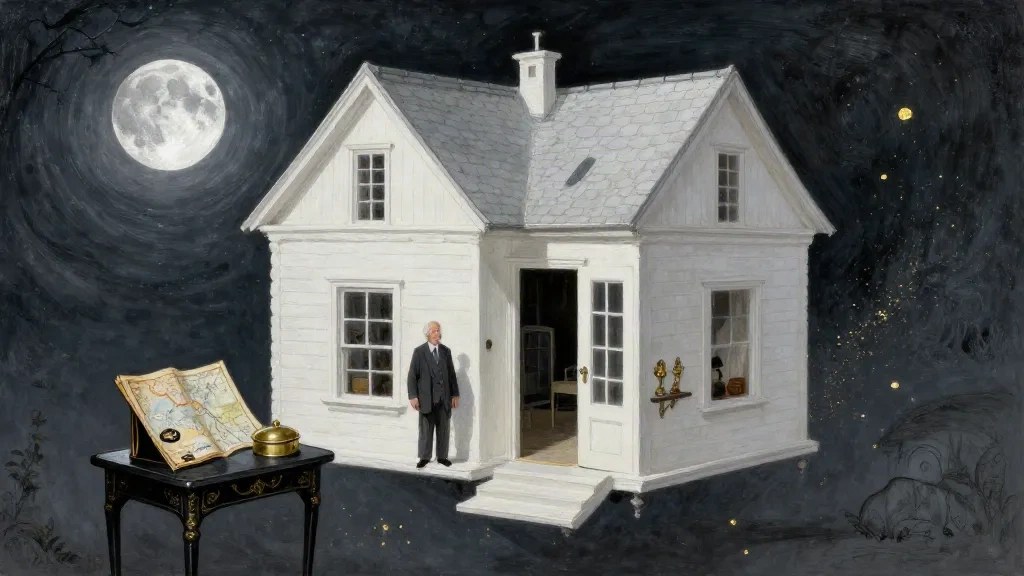
Beyond the stall lay a narrow island floating in cold moonlight. A white house stood upon it, every window shut. Elias unfolded the map. The pear-shaped crease pointed directly to the house.
He climbed the steps, expecting the silence of an ordinary place. Instead, a door opened in the wall where no door had been.
Inside, a woman in a green dress sat beside a cold hearth. “I never left this house,” she said.
Elias looked at the dust on her sleeves. “There is no hearth.”
Then the room appeared. Stone walls unfolded from the plaster, carrying a window, a chair, and a narrow bed. The woman vanished.
He searched the house. In the first room, a boy insisted he had never stolen bread. In the next, a soldier swore he had not deserted. Each lie added another room. The house expanded around him, creaking like a ship taking on water.
At last Elias opened the music box. The three unfinished notes trembled through the corridors. Doors stopped opening.
A child appeared in the new room. “My grandmother said the market had stolen her last memory,” the child said. “She sent me to buy it back.”
Elias remembered the theater on the night of his grandmother’s promise. A fire behind the stage. A script in his hand. A woman shouting from the wings: Tell them you did not know.
He had lied. He had said he did not know who had locked the stage door, even though he had taken the key.
His grandmother had kept the truth for him. The promise was not to remember her sacrifice. It was to return the stolen thing.
The Door Behind the Music
The music box opened into a fourth room. Cold moonlight covered the floor. On a table lay an envelope addressed to Elias in handwriting he recognized as his own.
Inside was the stage key.
The envelope also held a note:
You were twenty-three. You were frightened. Fear is not a knife, but it can make you hold one. Tomorrow, tell the truth and leave the theater. Do not ask why I kept it for you.
Elias read it twice. The lie had grown a room, but the room had not trapped him. It had shown him the exact place where courage had failed.
He placed the key on the table. Behind him, the new walls began to crack. Gold dust leaked from the seams and fell into the moonlight like stars.
“Promise kept,” he said.
Nothing answered. Then the music box played its fourth note.
A House With No Unfinished Room
By dawn, the white house had become a lantern again, floating above the market. Its windows were open. Inside, the lost memories drifted through the rooms like pale moths, no longer owned by anyone.
Elias placed the map and music box on the vendor’s counter. The woman in green cloth examined the key.
“This is not a memory,” she said. “It is the beginning of one.”
“Then sell it,” Elias said. “Give it to whoever needs a door.”
Before he left, he unfolded the map. The pear-shaped crease had become a small black square, exactly the shape of a stage door.
He did not return to the theater. He opened the music box whenever the road narrowed, and the unfinished melody told him which way was forward.
Some promises, he learned, are not made to keep the past intact. They are made to prevent the past from growing another room.





