 Netwrck
Speculative Fiction.
What the house remembered
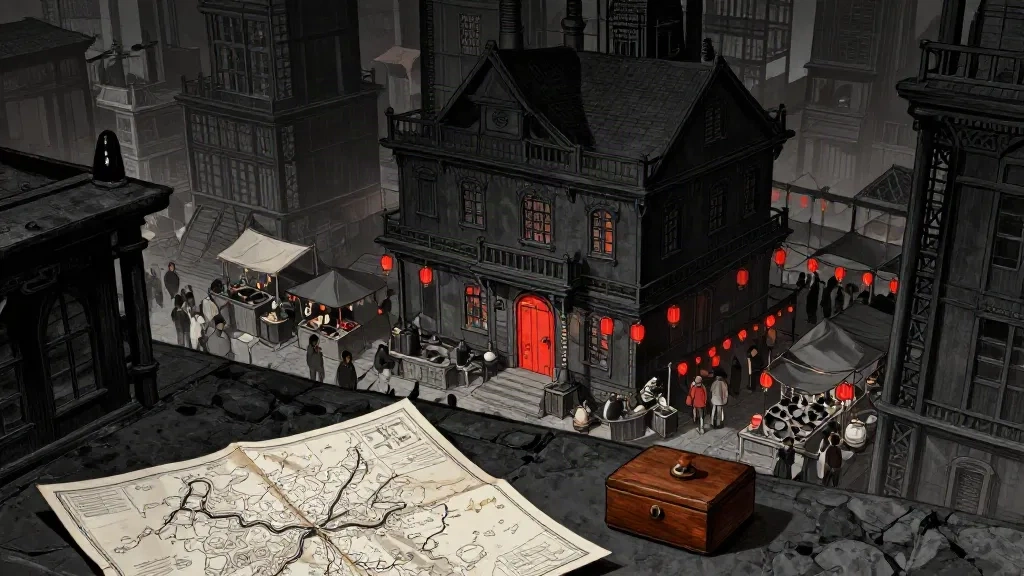
Every winter, the night market set up beneath Platform Nine, where the city's towers ended at their first floors and the old roads had been bricked over generations ago. Lanterns glowed rust red above stalls selling charcoal tea, salt cakes, and batteries polished to look like stars. Pale winter light leaked from the rails above, thin as a blade.
Silas Venn found the market by remembering the smell of hot iron. He had been an actor for forty years, remembered in dressing rooms from seaside provinces to the royal repertory. Now retirement had reduced his entrances to a pharmacy and his exits to a rented room with no clock.
He could re-enter any room he had ever left.
Not return to it, exactly. The ability opened the door, restored its dust, and placed him inside it with the afternoon he had departed still preserved in every surface. His younger self continued in the mirror. He could correct the mistake that sent him fleeing.
He had used that gift to beg forgiveness from a director, retrieve a confiscated script, and watch his first wife choose the train without him. He had never used it to go home.
In his coat pocket lay a folded map drawn by his father and a music box with no right hand.
The promise under Platform Nine
The map led into the dark beneath the market.
Silas descended behind the tea stalls, through a hatch marked only with the number 9, and down stairs that remembered the soles of his feet. The music box played one tune with each step. It had belonged to his sister, Mara, who had been born with only one hand and filled the missing one with a crooked tune from their mother.
At the bottom stood a narrow house pressed between the foundations of the towers.
It was charcoal black, with a red door and windows glowing winter-pale. His father's handwriting crossed the threshold in salt:
Forgive me when this house has finished listening.
Silas entered. The room inside was the kitchen in which he had grown.
His father sat at the table, younger than Silas remembered. A cup of tea steamed between them.
“You promised to perform for me,” Silas said.
“I promised you a role,” his father replied. “The house took my meaning.”
The floorboards shifted. Beyond the kitchen appeared a narrow stair and a door marked SILAS.
He understood then. A lie did not merely sound in this house. It opened a room.
Every room a door
His father began to explain, but a stranger knocked.
She entered with wet feet and asked whether the room was a theatre. Silas said no. Two rooms opened: a dressing room and an empty auditorium.
The stranger asked for a costume. Silas called her Mira. He was certain, then less certain, then certain of the opposite. Six more rooms appeared, branching through the house like breaths.
The man in the kitchen grew older with every addition. His promise—return from the city with a part worthy of their family—had hidden inside the house, where a word had been wrenched loose and rewritten as performance.
Silas had promised his father one performance too. Before leaving for his first season, he had sworn: when I become important, I will return and show you what I can do.
Then he had spent thirty years confusing importance with postponement.
At dawn, the black house stood above a crowd. The market had opened in its corridors, spilling lantern light from impossible windows. The central room held a stage.
There, decades younger, Silas stood beneath painted stars.
His father waited in the wings.
What an audience keeps
The house offered Silas a choice. It would restore the performance, and every person who had crossed his life would forget how he had failed them. His father would remember only the promise they had actually made.
Or Silas could speak the truth plainly: he had not returned. He had been afraid that his father would see the mediocre actor beneath the celebrated name.
“You kept the promise,” his father said, misunderstanding again.
“No,” Silas answered. “I made it. Then I broke it. I let wanting your approval become an excuse not to earn it.”
The theater dissolved. Dressing rooms, auditoriums, corridors all vanished in a thunder of settling timber. For one moment, the festival below remained—the dangerous red lane filling with bodies, then thinning as every lie discovered a locked door.
What was left was the kitchen and the door marked SILAS.
He entered. Beyond it waited the rented room he had left that morning, unchanged. On its table sat a sheet of paper.
His father's final line had never been performance.
I saved you the first part that mattered. Your own.
Silas took out the music box. With no right hand, it could only play what was missing: the melody his father had hummed while making bread, a song no audience had earned and no house could turn into another room.
He left the box on the table and walked into the room. Behind him, the door closed gently.





