 Netwrck
Hopeful Science Fiction.
The Train That Missed Its Century
At 4:17 each afternoon the station clock stopped at the same wrong minute. Nobody had ever reset it. The mechanism had been sound in 1949 and the maintenance men who came twice a year checked the sign, wiped the glass, and left the hands alone, because the first man who tried to fix it came back the following Tuesday with his hands shaking and would not say what he had seen in the gears.
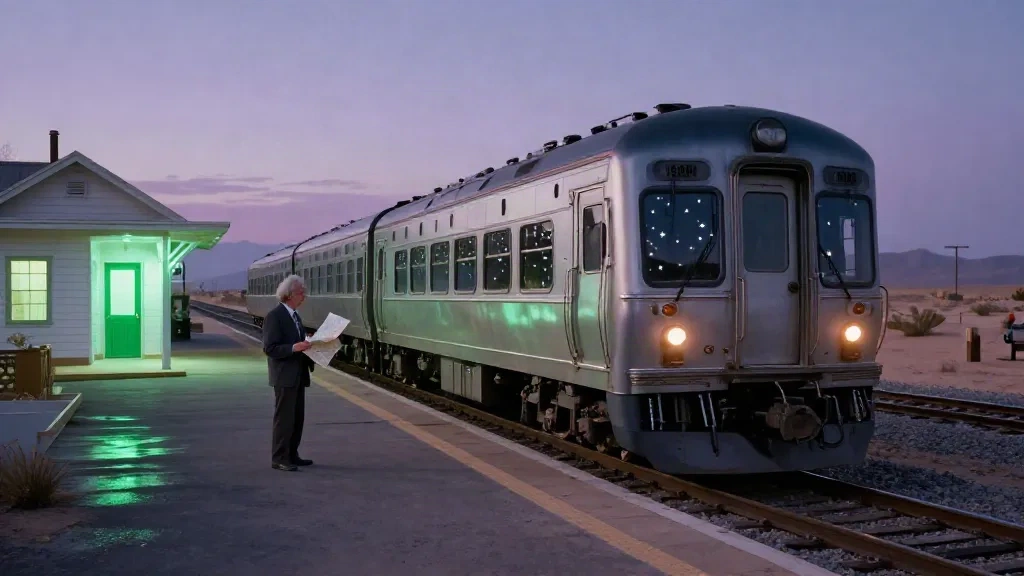
By the time Samuel Vale came down to the platform, the paint on the board had gone the color of a bruise, and the desert beyond the tracks shimmered over wet asphalt. It had not rained here in eleven years. The water came up anyway, from somewhere under the rails, and pooled in the low places so that the whole station stood in a mirror an inch deep, reflecting a sky that had no business being that color at this hour.
He had been an actor for fifty-two years. Fathers, judges, kings, a pharmacist in a television serial who died slowly over nine episodes, and once — for four performances, in a seaside rep company nobody remembers — a lighthouse keeper who never saw the sea. He had learned to build a person out of posture and a remembered voice, to hold a room by breathing slightly slower than the people in it. Retirement had made him uncertain which face was his own. In the glass of the ticket window his reflection arrived half a second late, like an actor who had forgotten his lines.
He had a folded map in his coat and a small music box in his pocket, and he had told himself on the train for six hours that he was here to close a matter, not to answer a question. That was already two lies, and he counted them without knowing why he was counting.
He could re-enter any room he had ever left. Not return in time — return in space. The moment he crossed a doorway behind him, the room stayed available somewhere behind his eyes, folded up like linen: the cramped green pharmacy where his mother had hidden barley sweets beneath the counter and pretended not to hear him stealing them; the dressing room on Wardrope Street that smelled of dust and hot bulbs; the kitchen in Birmingham where his grandmother had made him swear, with her hand flat on his chest, that he would never lie under a roof.
That oath had outlasted the woman who made it by thirty-one years. He had broken it lightly, the way one breaks a thing that is already broken — the harmless lie to a lover, the bigger ones to an agent, the one to a woman in a hospital corridor in 1974 that he would keep his career, which was the first time he heard himself make a promise he had already decided to break and did it anyway, cleanly, like a man stepping over a puddle.
At 4:18 a train arrived with silver engines and windows full of stars. It made no sound at all. The heat came off it in a wave that smelled of hot dust and cut flowers.
The conductor was a tall woman in a coat the gray of platform concrete. She took his ticket without looking at it, which no conductor had ever done in his life, and turned it over. It was not a ticket. It was a photograph of Samuel at twenty-six, standing in the hard white light of a desert noon outside a low green house, squinting, one hand on the doorframe as if holding it shut.
“Third time I've seen that print,” she said. “You look like a man with something behind him.”
“Is there a train to Birmingham?”
“There's a train that leaves for Birmingham,” she said. “They are not the same sentence, and you'll want to be careful about the difference before Thursday.”
He did not ask how she knew the day. He had spent a lifetime learning not to ask how people knew things, because the answers were always worse than the not-knowing, and because a question asked at the wrong moment in a scene is a sign the actor has stopped listening to the room.
The House With One Extra Door
The house waited across the rails, though Samuel had never seen it in his lifetime. It sat low and square on a foundation of pale stone, walls the green of pharmacy signs, lavender curtains moving behind the windows although the air was dead still. It was smaller than the photograph had made it look. Photographs lie about scale. Photographs also lie about doors, and this one had shown him two; in life the front of the house had four, and while he was standing in the road counting them, a fifth appeared at the end wall, flush with the paint, no dust under it, no shadow.
When he crossed the threshold the music box began to play in his pocket, unwound, brass bird turning, one clear note over and over with a small brass rattle underneath like a swallowed laugh.
Inside, everything was familiar and nothing was the right size. His grandmother's red chair, worn pale on both arms. The yellow cup with the chipped handle, which had been in a case in his mother's house for forty years. A kitchen drawer holding a fork, a button, three letters in a language he did not speak, and a railway timetable for a line that closed in 1911. A clock that said 4:17 and was running, correctly, at nothing.
On the table lay a map folded along routes no railway company had ever printed. The paper was soft as skin. He spread it with the flat of his hands the way he had once been taught to handle a script, thumbs at the corners, not pulling.
A blue line ran from the station to a small square marked only with a five-pointed star. He turned the map over. He turned it back. The star did not move, which he found more unsettling than if it had.
“You promised not to lie,” he said, to the walls, in the voice he had used for the pharmacist's death scene, which was the worst thing he could have chosen and he knew it even as he did it, and the house answered with a door.
Beyond it: a nursery painted midnight blue, the light low and bluish as underwater. A narrow iron bed. A woman asleep on her side, thin, one hand closed around the hand of a child who was not there, whose fingers curled around nothing and kept the shape of it, the way a hand keeps the shape of a glass it has been holding for an hour after you take it away. Samuel knew the face before he knew it was hers. He had seen it in a photograph, in a shoebox, in a photograph on a shoebox, dated the summer he was nineteen: his grandmother at the doorway of a house that was not this house and not white, squinting into sun, holding a folded map in one hand and a boy by the wrist in the other.
“She promised to wait here for the train,” a voice said.
He turned. No one stood in the hall. The lavender curtains moved once, hard, like something had passed behind them and gone through the wall.
He stood in the doorway of the nursery for a long time and did the thing he had done in every room of his life when he did not know what to do next: he waited for someone else to indicate. In a theatre it is the actor's job to lead, and the surest sign of a failed performance is a leading man standing still while the other performers look at him. He had been doing it since 1968. He was still doing it now, in a nursery, at sixty-eight, waiting for a cue from a woman asleep in a bed eighty years before he was born.
Then he crossed the threshold and another door appeared in the far wall, and the house made it easy, the way good houses do, the way stage houses do with a wagon that was always already there.
The Rooms the House Grows
Beyond the new door was a dining room crowded with people who had clearly arrived from different years and had stopped arguing about it. A boy in a school uniform laughed with his head back, delighted, at something a woman in a silver pressure suit said with a completely straight face. A man in a 1940s overcoat kept trying to sit down in a chair that a taller, thinner man from another decade was already occupying, and both of them pretended not to notice. Near the sideboard someone was burning letters, one at a time, holding each to the flame with the corner of a silver bowl. Beside him a girl of perhaps sixteen played the same melody Samuel carried in his pocket, on an instrument with more strings than a piano, and got it almost right: the third phrase was a beat early, and Samuel's teeth ached in sympathy.
“The house grows a room for every lie,” said the woman in silver. She had a drink in one hand and had not drunk from it in some time. “Every one that gets told inside it. Not every one that's thought. That's the mercy. Don't get excited about the mercy, it's structural.”
“And my promise keeps them from taking the whole house?”
“Your promise keeps the doors from opening onto each other all at once,” she said. “There's a difference and it's the only thing that's kept your grandmother on this side of an argument.”
He looked at the map. The blue line had not moved. It still ended under the nursery floor, which he understood to mean the star was not upstairs.
“Who are you?”
“Oh, I'm nobody's aunt,” she said. “Come back when you've been a liar properly and we'll talk about names. Right now you'll only ask mine and I'd have to decline, and it's exhausting, declining.”
The burning man laughed without looking up. “She was the first one here,” he said, to no one in particular, in a voice worn thin by repetition. “I was the second. I told a woman I would stay. I stayed forty minutes. The house has a room with the light exactly as it was when I left and my coat is still on the hook and it has been a very long time.”
Samuel understood, with the clarity that only humiliation reliably produces, that he was standing among the moral inventory of his own century. Every liar who had been told the truth by the architecture. He looked at the overcoat man's hands and thought: forty minutes. He thought of a Sunday in 1994 and a woman's face and his own voice being pleasant and warm and utterly without weight, and then eleven years of Tuesday lunches, and then nothing, and then a phone call in a corridor, and the corridor.
He thought: it builds a room for every one. And I have furnished mine very well.
What the Music Box Remembered
He went back to the red chair and sat and remembered the last conversation with his grandmother, which he had spent forty years filing under a joke.
She had been ninety-one and impatient with everything in the room except herself, including the dust, the clock, and the way the station swallowed trains. She had put the music box into his hands and kept her own there underneath it, so that he could not take it without taking hers.
“Promise me you'll keep the station open,” she said.
He had said that actors made promises for a living. It had been a good line. It had gotten a laugh, and the laugh had been the point, and the point had been to move the moment past the request so he would not have to answer it.
She had looked away. “Not to me. Not about this.”
He had laughed because the train was late, because the platform was empty, and because he had understood with total clarity that accepting would mean taking on a responsibility with no stage, no interval, no second unit, and no audience to tell him where to stand. Actors do not lie to audiences. Actors lie to the thing the audience came for, which is other people, which is the truth, which is a room that grows.
That was the lie. Not the joke. The joke had been the lid.
Underneath it: he had known the station would close. A letter in 1977, opened and re-folded and never mentioned, a line about passenger figures. He had known the last train was the last train. He had let the argument for closure win because the alternative was a life spent holding a door open for people who mostly went the other way, and he had chosen the parts, and the parts had been kind, and kindness was the delivery system of nearly everything he had ever done instead of the difficult thing.
He knelt on the floor of a house that had grown out of his own omissions and opened the music box. The bird rose. It beat its wings with a sound like small paper and sang one clear note, and the dining room went quiet in a way that rooms do not usually go quiet, because there were people in it.
The girl with the many strings stopped playing. The burning man lowered the bowl.
And Samuel understood that the music box was not a souvenir. It was a key. It had been put into his hands by a woman who was not a mystic and had no idea what she was doing, who had simply wanted to make sure he would have to keep one thing.
He entered the memory of the house. Not by remembering it. There is a difference and it is the difference between a stage set and a room, and he knew it now, having spent fifty-two years on both sides of it: he stepped into it.
The dining room was gone. He was standing on the platform, and it was lavender evening, the hour before the desert goes blue, and his grandmother was there with the map in her hand and her coat over her arm, alive, standing slightly turned toward the track the way people stand when they are listening for something they cannot see yet.
He could smell the dust. He could feel the paper under his fingers, a real paper, a real map, the blue line drawn in ballpoint that had gone brown with age, and her knuckles on the table were cracked and specific and he had not looked at them once in 1966, he had been looking at her face like a man reading a lighting plot.
The conductor was under the clock, in the same gray coat, younger by nothing that mattered.
“The last train leaves in one minute,” she said, and then, more quietly, in the voice of a woman reading from a timetable she did not write: “It leaves with the people who are owed.”
Samuel unfolded the map again. The blue line had moved on the table while he was not looking, the way a sleeping man's hand moves, and it now ran from the nursery door to the platform and stopped at the star, and the star was under the clock.
His grandmother said, “You'll have to say it where she can hear.”
“I don't know what to say.”
“Then you'll have to stand there and not be clever,” she said, “which was never your problem, Samuel. Your problem was that you were good at things and it stopped meaning anything.”
He understood. The promise had never been about the platform and the lamp standards and the ticket window. It had never been about keeping a building open. It was about the route between the people who had left and the people waiting for them, and the route was the only thing the house could not furnish. Walls it could grow. Rooms it could punish a man in for forty years with a coat on a hook. But a route between two people required somebody to stand still in it and be honest in both directions, and that was a job, and he had been out of work two years, and it was the only role he had ever been cast for that asked him to be exactly himself, with no costume, no wig, no motive, and no audience to check the result on.
A Door That Stayed Open
He walked back out of the memory with the map folded in his hands and the blue line warm against his palm, and he told the dining room what he had learned, and the woman in silver said, “Well, that's the first useful thing anyone's said in this room in thirty years.”
“How many of you are there?”
“Enough that the house has stopped growing and started only rearranging,” she said. “Which is worse, if you think about it. Growth is honest. It just adds. Rearranging takes things away from where you'd find them.”
He took the music box out to the platform. The sky had gone the depth of a bruise. Behind him the house groaned, not like a building settling — like a person getting up out of a chair after a long time — and a door appeared in the lavender wall of the kitchen, and another in the wall of the nursery, and another above the bathroom window that had not existed that morning, and then another, and then so many that the doors became the wall, and the wall became a section of corridor Samuel knew better than any stage: the ward corridor, 1974, with the notice board and the smell of floor polish and the doorway at the end.
He looked at it for a long time. He did not go through. He stood beside it with the music box in one hand like a man holding a door in a gale, and the room behind him stayed open, and the corridor stayed open, and the two of them simply existed side by side, which is the whole of what anybody can do about the past, and more than most manage.
The conductor raised one hand.
“One passenger,” she said. “And you'll be the one who stays to hold it, because the house can't cross the tracks while a lie is standing in it, and there's one still standing.”
Samuel waited for the sentence to finish, the way a good actor waits, and the sentence had finished; she was simply giving him time to understand, which he had not expected and which undid him more efficiently than any cruelty could have.
He thought of the parts. Fifty-two years of parts, and every one of them a promise made to a room, and not one of them a promise to a person. The fathers who never came back. The judge who was kind at the end. The lighthouse keeper who never saw the sea, in which he had stood in the light for four performances while the audience wept at a man being denied the horizon, and which he now understood had not been about the sea at all, but about a man who kept a lamp burning for ships that stopped coming, and had not once checked whether anything was out there.
He had spent a lifetime becoming other people. Perhaps this was the role that required no costume, and perhaps the reason he had resisted it for so long was not fear but the plain, professional terror of a man who has been praised for fifty-two years for a thing he cannot actually do.
He turned toward the house and called out, across the wet asphalt, in the voice he had used on stage for an audience of nine hundred because a person of nine hundred deserves the full delivery:
“Grandmother. The station is open.”
He waited. He did not add anything clever. It cost him more than the four performances in the seaside rep.
The blue line on the map blazed from edge to edge like a filament.
The house door widened until its frame touched the station wall, and the two buildings stopped being separate. Warm air moved out through the join, carrying the smell of rain on hot asphalt, and dust on wool, and — faintly, underneath, the way a smell is carried from a far platform — a bar of soap and clean cotton.
The overcoat man was the first across. He went past Samuel with his hand briefly on Samuel's arm, which was a liberty, and said, “Forty minutes was a bad afternoon. I hope the other one goes better.” Then the girl with the many strings, playing as she walked so that the third phrase was still a beat early. Then the burning man, who put his letters down one at a time on the platform bench, which nobody asked him to do and which meant more than anything anyone said that night.
Samuel boarded the silver train last.
In the window he saw his grandmother's reflection on the platform, exactly as she had promised, standing slightly turned toward the track, listening for something she could not see. Beside her stood the woman in silver, and the boy in the school uniform, and all the travelers who had come through the rooms, and the conductor with her hand on the clock housing. Not ghosts. People, in a queue, in the way people queue who have somewhere to be and have decided to be patient about it.
“Right,” said the conductor. “Where are you actually going?”
He had a question ready that was very good, and it was a deflection, and he heard himself start to say it.
“Birmingham,” he said. “My mother's kitchen. There's a version of it I never went back into properly.”
The conductor looked at him for a moment longer than a conductor should.
“Then go and be in it,” she said, “and don't take the room apart looking for the lie. It's only a room. You'll only find the one you already told.”
The clock resumed. 4:18. 4:19. 4:20, and the minute hand moved like a thing finally permitted.
When the train took the border, Samuel opened the music box one final time. The little brass bird sang over the desert, thin and clear and slightly ridiculous, and behind him the house added no rooms at all. It held the doors open — lavender bright against the wet asphalt, every one of them, into the pharmacy and the dressing room and the ward corridor and the midnight-blue nursery where a woman slept with her hand closed around the shape of a child who had not arrived yet and would, in nineteen years, from a different platform, take a train to a desert in the heat of a white noon and stand in a road squinting, one hand on a doorframe, as if holding it shut.
It held them open until the last light of another century came up and found the clock still running, and Samuel Vale, who had never once in his life been asked to be himself and had always assumed it would be a small part, watched the dark come out of the sand and understood that it would be a very long engagement, and that no one would applaud it, and that he was going to do it standing up, in the open, in the traffic.





