 Netwrck
Speculative Fiction.
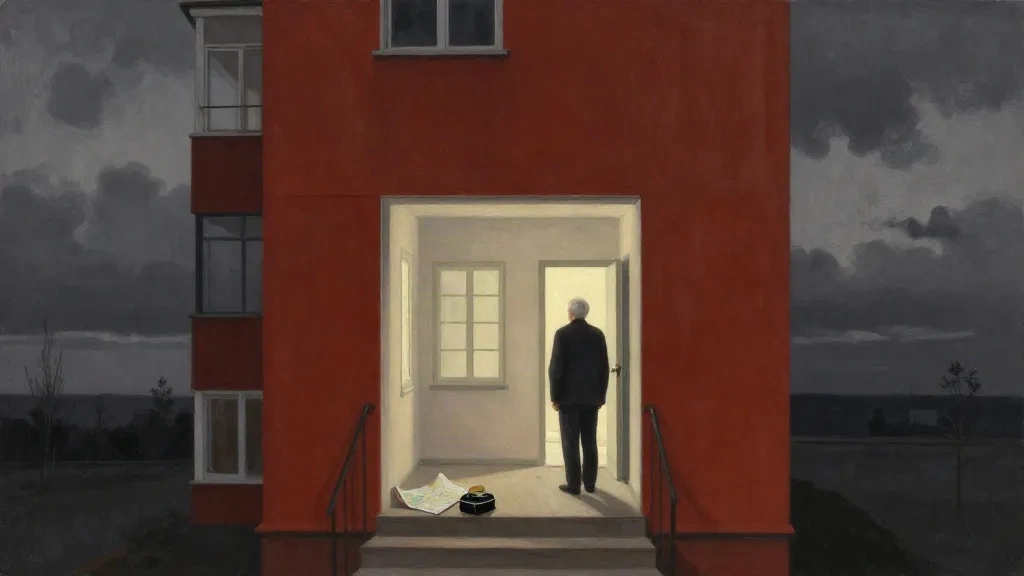
The Tenant Who Knew Tomorrow
By the time Emil Varga moved into the Meridian House, he had forgotten three languages, four wives, and the taste of his mother's coffee. Retirement had taken the rest in small, sensible portions.
He retained one talent. Any room he had ever left, he could enter again.
Not by remembering its shape. The walls were waiting when he arrived: the pale winter light falling through the same curtains, the same squeak beneath the third floorboard, the same ash in the fireplace if the fire had burned there. Time folded around him, but rooms did not. They opened wherever his keys had once turned.
Emil lived in Apartment 8B, where every resident remembered the future instead of the past.
Mrs. Vale knew which elevator would break Tuesday morning. The boy in 3C could predict the widow's telephone call before the widow made it. Emil disliked their company. They spoke in future tense, trimming their sentences whenever the present became uncomfortable.
On the brass plate inside his apartment, beneath a folded map, someone had written a promise in pencil:
I will tell you the truth when the box begins to play.
The handwriting was his own, though he had never made the promise.
A Room for Every Falsehood
On the seventh evening, the music box began to play.
It sat on the mantle, black lacquer, small enough to cover with his palm. A tune emerged: six notes, then a pause, then six notes again. The nursery rhyme from his childhood. His mother had kept such a box on the bureau in their old apartment.
Emil stood still. Beyond the walls came a soft cracking.
The hallway extended by three feet. A new door appeared beside the elevator.
He found the room behind it furnished for two people. One chair was occupied by a young woman in a rust-red coat. Her face was his mother's, though older.
“I came to tell you the truth,” she said.
“You promised to tell me the truth.”
“I promised not to leave without telling you why.”
Then the building shuddered. A door opened behind Emil, and another, and another. Each room held a version of the same conversation: his mother leaving, his mother staying, his mother dying in the hospital, his mother alive at the kitchen table.
Every discrepancy created a passage. Every lie made the house larger.
He understood then. The building had not remembered his past. It had been listening to his attempts to remember it.
What the Map Kept
Emil unfolded the map. Pencil lines crossed yellowed streets, circling a theater that no longer stood. A date marked its demolition: June 14, 1989. Beneath it, in his own hand, were three words: Tell her after.
He had been fourteen when his mother left. The theater manager had offered him a place in his first production. Emil chose the stage over the hospital. The performance lasted one hour. By its final scene, she was dead.
For thirty years, he told himself he had promised to tell her the truth after the play, not before. The grammar of cowardice, polished by repetition.
He entered the map's room. It was the dressing room from that night, full of cracked mirrors and costumes smelling of dust. His fourteen-year-old self sat beneath a bare bulb, waiting for an apology that never came.
“I should have gone with you,” Emil said.
The boy shook his head. “I wanted you to stay.”
That was the lie. Not the one Emil had repeated, but the one that had protected them both from a truth neither could survive.
Another room appeared. This one had no walls.
The Door Without a Room
“Tell her,” the boy said.
Emil returned to the apartment and placed the music box on the floor. He started the tune. When the sixth note ended, he said, “Mother, I left you at the hospital. I was afraid. I have been afraid ever since.”
The building exhaled.
Walls shifted with a sound like snow settling. New doors closed one after another. Mrs. Vale's elevator stopped breaking. The boy in 3C forgot the widow's call, then remembered her laughter instead. Future memories collapsed into ordinary time.
The young woman in the rust-red coat stood in the vanished hallway. “I know now,” she said.
“I know what you came to do.”
Emil entered the theater once more. The map's pencil circle became a door in the brick wall. Beyond it, pale winter light fell across empty seats. His mother sat in the third row.
He crossed the stage and gave her the truth he had owed.
This time, the room did not grow.
At dawn, the Meridian House had one fewer corridor, one closed door, and a music box whose tune ended after five notes. Emil kept the folded map in his coat. Its final circle surrounded not a theater, but a house with a garden.
He still entered rooms he had left. Now he brought no map.
He entered only to say goodbye.





