 Netwrck
Fairy-Tale Fiction.
The Door That Missed Dawn
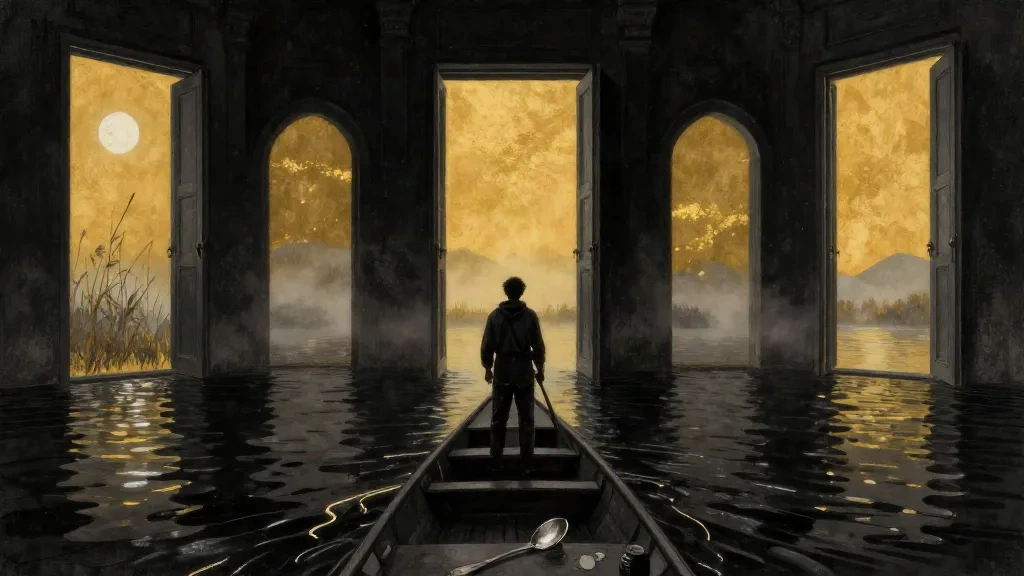
At the back of the museum of doors, where the black-lacquer walls gave back no reflections, Mara kept a small silver spoon and a jar of salt.
Every morning, before the first school group arrived, she sat beside the door marked Unspoken Beginnings. She turned the spoon once over the jar and allowed three grains of salt to fall from its bowl.
Her mother had performed the ritual when Mara was afraid to cross the river. Three grains for what she had feared, one for what she had survived, and none for what the river demanded in return. Mara had continued it for seventeen years, though she no longer believed the salt could hear her.
Her work was to chart the emotions moving beneath the city. She floated lacquer-dark plates downstream from the bridges, caught their tremors, and translated each disturbance into maps: courage resembled a steady current; grief, a stone turning beneath the surface. Her instruments were accurate, her notes plain, and her measurements private.
That morning, Mara opened the museum’s eastern door. Beyond it waited the river.
Every Bridge Remembered
The water was black with moonlight. Its current carried no reflected roofs, only thin golden lines that appeared wherever a bridge had once stood. Some were broad as roads. Others were single silver threads spanning forgotten chasms.
Mara’s survey boat trembled beneath her.
“You have brought me a record,” she said.
The river lifted a plate of lacquer from the water. Its face was blank. When she touched it with the silver spoon, the image of a bridge appeared: two children holding a plank above a flooded street, while a woman behind them held an umbrella over a stranger’s child.
Mara had not mapped that crossing. No official chart recorded it.
Another plate followed, then another. Bridges built from reeds, from ships, from woven vines, from a single immense bone. Each held a tremor the river remembered after the structure had vanished. A wedding procession flickered across one. On another, a boy stood alone on the far bank, calling a name no one answered.
Mara’s maps had always measured the water beneath her. This river measured everything beneath the world.
She lifted the salt jar. The river went suddenly still.
The Cost of Witness
“If I open the gates,” a voice said from the museum doorway, “all those crossings will be seen again.”
The keeper stood beside the door, an old woman wrapped in a coat the color of winter. Mara knew the museum’s rules: courage was never meant to be taken. Each door opened onto a possible act, and the visitor returned carrying only the strength required to perform it.
“You want a public ritual,” the keeper said.
Mara looked down at the jar. For years she had kept the ritual private because strangers might call it superstition. Worse, they might ask why a woman who measured courage still needed salt.
“I want them to see that fear can be crossed without becoming innocent.”
“Then you must let the river keep its record too.”
Mara opened the jar.
Salt fell into the black water. The current broke into thousands of golden threads, and the museum filled with the sound of ropes, footsteps, hinges, and water striking wood. The doors shuddered on their hinges. Beyond them, courage appeared in every form: refusing an apology, entering a courtroom, forgiving a living enemy, speaking a name aloud.
But the river also gave back what the bridges had cost.
Mara saw a bridge sink beneath the weight of soldiers. She saw a bride cross toward a stranger because her family had closed every other road. She saw a hand released before it could be held.
The silver spoon grew warm in her palm.
A Public Crossing
At noon, Mara placed the spoon on the museum steps and opened the salt jar before the crowd.
Three grains fell onto the black-lacquer threshold. One for fear. One for survival. None for payment.
Then she turned the spoon toward the river.
The current rose, carrying every golden bridge-line to the surface. The museum doors swung open one after another. Visitors stepped through them carrying lamps, ledgers, empty cradles, sealed letters, and tools for work they had feared beginning.
Mara did not tell them what to choose. She read the river instead.
When the old bridge trembled beneath a widow’s grief, she marked it. When a child held fast to the rope of a narrow crossing, she named the crossing public. The maps spread across the water, no longer private instruments but invitations.
By evening, the river had gathered a new line: not a bridge made of timber or prayer, but a chain of separate acts, each one witnessed by another.
Mara returned the last grain of salt to the jar. The silver spoon caught the cold moonlight, and beneath it the river shone like black lacquer dusted with gold.





