 Netwrck
Fairy-Tale Fiction.
The Museum of Openings
At noon, when the moon had left its silver stain upon the river, Iona unlocked the Museum of Doors.
The museum stood upstream, black lacquer polished to the color of a beetle’s wing. Gold dust had been swept around its threshold in the shape of a keyhole. Cold moonlight entered through forty-seven narrow windows and rested on the handles, one by one, as if counting.
Iona was a river surveyor. She mapped emotions on a moving surface, recording how fear gathered in eddies, how hope ran straighter than doubt, and how grief moved downstream in a broad, cold sheet. Her instruments rested in a linen case: a silver spoon, bright from polishing, and a salt jar sealed with wax.
Every seventh evening, she performed a private ritual. She placed the spoon at the river’s stern and the salt jar at its bow. Then she spoke one true feeling into the spoon’s bowl and carried it to the jar.
The salt kept the confession. The river carried it away.
That evening, however, Iona came to open the door marked PUBLIC GATHERING.
The Door That Swallowed the City
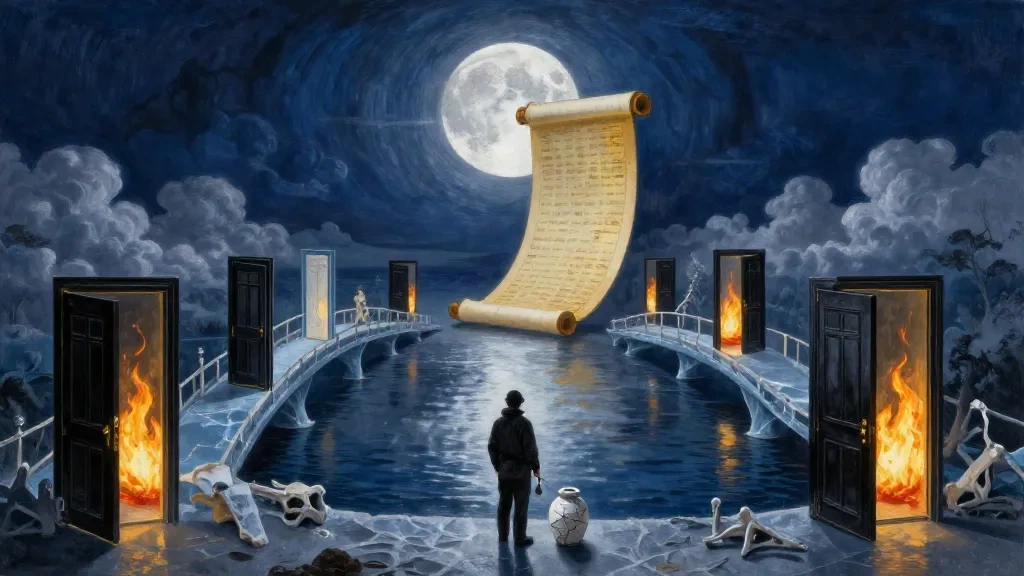
The door opened onto a white river running beneath a white sky. Its banks were crowded with bridges made of ice, cloud, bone, and burning stone. On each bridge stood a traveler, waiting to cross.
“They cannot cross without a feeling,” said the museum’s keeper. He wore seven black coats, though it was summer. “And no one may remove a feeling from the river.”
“I am not removing one,” Iona said. “I am giving the river a voice.”
She placed the silver spoon on the nearest bridge. Its bowl filled with words: forgiveness, resentment, hope, terror, wonder, regret. The river lifted them into a shining column.
“Tomorrow,” Iona told the keeper, “I will open every courage door at once. The people will stand at the crossings. The river will call their names, and the names of what they carried. I will make the ritual public.”
“Public,” said the keeper, “is not the same as harmless.”
As he spoke, the river darkened. From its depths came the sound of hammering: millions of small silver hammers striking wood and stone and iron. A scroll unfurled across the sky, black as lacquer, its letters written in gold dust.
It was the river’s record of every bridge ever built.
Not only the bridges. Every promise made while crossing them.
What the River Carried
The scroll struck the water and became a bridge beneath Iona’s feet.
She saw all the rivers that had carried the city’s hidden lives. She saw soldiers crossing toward war with grief folded inside their helmets. She saw children leaving home, carrying questions in their pockets. She saw lovers parting on bridges built from lies. She saw travelers who crossed because they had no home, and travelers who crossed because they were afraid to remain.
At the center of the scroll floated one bridge made of black lacquer, rimmed with gold. It had no railing.
Across it walked a small girl carrying a silver spoon in one hand and a salt jar in the other.
Iona recognized herself.
“That was not built here,” the keeper said.
“I built it.”
She stepped onto the bridge. Beneath her, the river spoke in the voices of everyone she had ever measured.
“You wanted to make the ritual public because you were afraid your own feeling had disappeared.”
“I wanted them to hear me,” she said.
The salt jar cracked. White salt poured into the black river, and the bridge beneath her began to shine.
The Public Crossing
At sunset, Iona opened the first courage door.
Warm air entered, smelling of rain.
She opened the second. A wind full of bells rushed through the museum.
The third brought the scent of iron. The fourth brought silence so complete that everyone remembered they were afraid. People entered from the streets, carrying their own histories. They did not bring offerings. They brought the ordinary things that had carried them: letters, keys, wedding rings, hospital bracelets, smooth stones.
At the riverbank, Iona placed the silver spoon on the black bridge. The salt jar stood beside it, no longer sealed.
“Speak,” she said.
One by one, the people crossed and named what they felt. The river did not judge their words. It widened, carrying every voice toward the sea, every fear and tenderness, every promise made before they knew its cost.
When the last traveler crossed, Iona stepped onto the bridge.
The river called her name.
“Iona,” it said, “you kept your fear in the spoon and your courage in the jar.”
She opened her hands.
The spoon fell into the water and became moonlight.
The salt jar broke, and from it rose a small, bright door.
Beyond it waited the kind of courage that begins when no one is watching.
Iona stepped through.
Behind her, the river kept flowing. Above it, the museum opened all its doors, and the city learned that every crossing was a bridge—and every bridge was a way home.





