 Netwrck
Speculative Fiction.
The Future That Did Not Hold
On the last Tuesday of winter, Mara Venn unlocked the abandoned cinema with a silver spoon.
The theater had been dark for nineteen years, but the projection room still smelled of dust warmed by sunlight. Its seats faced a cracked screen, and the walls were papered with advertisements for films no one remembered seeing. THE BRIDGE REMEMBERS. A SALT RIVER. TOMORROW, ARRIVING EARLY.
Mara entered carrying a black survey case and a salt jar sealed with wax. She set both on the balcony rail, then lowered herself to the floor beside the flooded orchestra pit. Winter light entered through a broken pane, pale and thin as a sheet of ice.
For years, she had surveyed rivers by listening to them. She marked the moods of water against her palms: the quickened current above buried stone, the long calm of a drowned field, the sudden warm pulse beneath a willow. Other people saw gauges and sediment. Mara heard what the river carried.
Every Bridge Was a Memory
The film began without a projector. A blue glow gathered at the center of the screen, and images moved across it in fragments. A bridge of iron across a victorious war. A bridge made of woven reeds over a border that vanished before dawn. A footbridge burning while children on both banks threw water toward its flames.
Each structure was followed by the river beneath it.
Mara opened the salt jar and touched a pinch to her tongue. The ritual was private: one grain for each place the water had carried her, one breath for each name she had failed to speak. Her mother had taught it to her, though her mother had never admitted the salt was more than habit.
The river lapped through the orchestra pit. It was carrying a silver bridge, a bridge built from spoons, a bridge whose stones were jars of salt. As Mara watched, the image sharpened. She stood on its eastern bank. A crowd waited behind her. No one moved toward the river, but everyone watched.
She shut the jar.
On the screen, the bridge collapsed before anyone crossed it.
The Record Refuses to Be Private
At midnight, the cinema showed another future. Mara saw herself returning to the riverbank with a hundred people, all of them carrying maps. They intended to cross at a place the maps did not name. The river rose around them, not violently, but with the patience of something correcting an error.
In the next film, no one came.
In the one after that, the river ran rust red beneath a winter sky, and the bridge burned from both ends without consuming its stones.
Mara descended into the orchestra pit. The water was cold to her knees. She spread the survey case and took out her instruments, though there was no point in measuring what refused to remain still. The current moved according to the shape of every bridge ever built. Their histories pressed together beneath the surface: migrations, marriages, betrayals, rescued children, sealed borders, roads abandoned halfway.
She understood then that the river was not keeping a record. It was asking for a witness.
When she climbed out, the screen had gone black. Behind it, hidden in the wall, she found a narrow door marked PUBLIC WORKS.
A Bridge Made in Daylight
The room beyond the screen was full of tools. Hammers had rusted to the walls. Unused planks leaned beneath the ceiling. On a workbench lay a silver spoon, clean and bright as a small moon.
Mara took it. In her pocket, the salt jar knocked softly against the survey case.
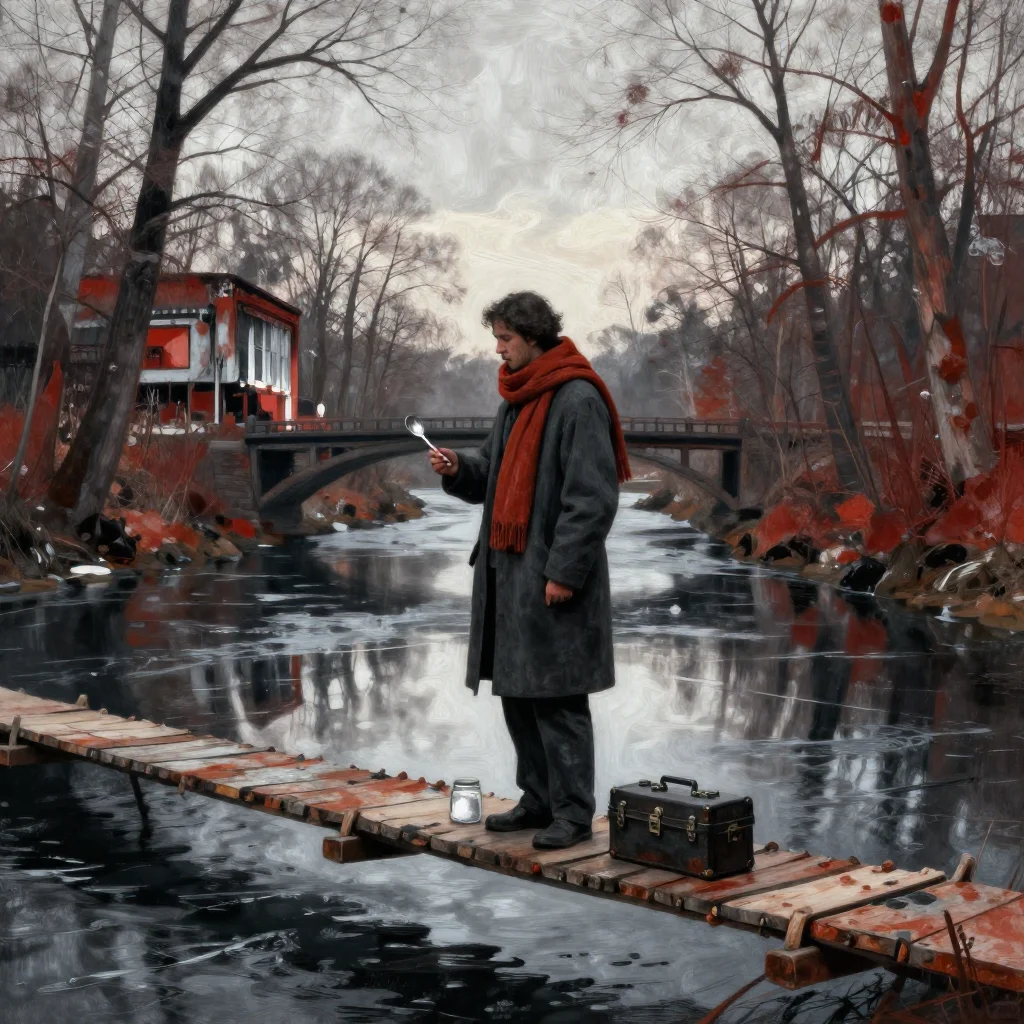
At dawn, she carried the tools outside. The river was charcoal beneath the frost, with veins of rust where the current caught old metal. She built a footbridge from planks recovered from the theater and stones gathered along the bank. The spoon became the final marker at its center.
People came because the bridge was visible from the road. They came with buckets, ropes, thermoses, questions. An old ferryman said the river had swallowed a bridge in his youth. A schoolgirl asked whether the water remembered the sound of footsteps. Mara answered truthfully: it remembered everything, but it could not choose what happened next.
At noon, when the winter sun finally reached the bridge, Mara opened the salt jar.
She did not perform the ritual alone. One pinch passed from hand to hand. Each person who received it named a crossing they had feared to make. The river brightened. Not cleanly, not safely, but enough to reveal the shape of its burden.
Far beneath the bridge, something vast moved. The spoon trembled on its marker stone.
Then one child stepped onto the boards, and the river gave back a sound like applause.





