 Netwrck
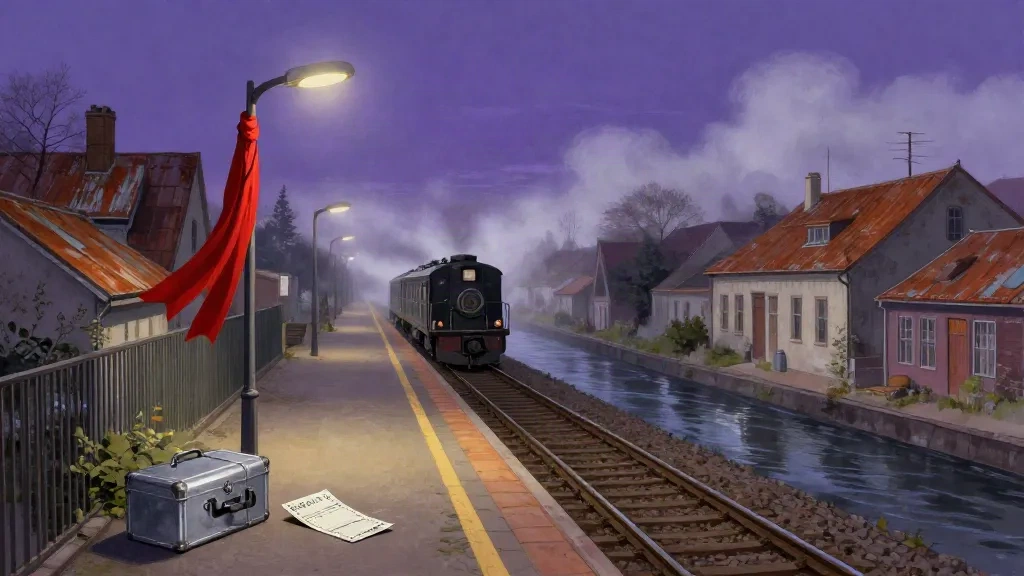
Fantasy.
The houses had homesickness
Every house in Bellwether kept its troubles in the walls. The miller's house coughed up salt whenever he argued with his brother. The chandler's house opened its windows in winter and filled the rooms with moth-wing dust. The village nurse, Mara Venn, learned to recognize the illnesses of buildings by the sound they made at night.
She carried a leather bag of silver needles, blue thread, and small bottles of chimney smoke. When a house was homesick, she stitched a charm into its threshold and persuaded its occupants to say one true thing before sleeping. The charm did not cure disagreement. It only gave sorrow a direction.
On the eastern bank, where the houses leaned toward the river, Mara found the hardest case: a narrow red-brick house with a red scarf hanging from its upper window. The scarf had belonged to Elian, the eldest son, who had not returned in six years. Inside, his mother kept his room exactly as he had left it.
On the western bank, his sister Nessa refused to speak of him. She blamed Elian for leaving their father's funeral unfinished. Mara knew the truth only because the house had told it in a thousand creaks: he had gone to find work, the river had risen, and their mother had forbidden everyone from saying his name.
Midnight was a departure
At dusk, the stationmaster arrived wearing a brass key on a chain. He carried a timetable with no final page.
“Every ending is a scheduling error,” he said, setting the timetable on Mara's table. “The river merely carries the mistake downstream.”
He had been appointed to Bellwether that morning, though no one remembered appointing him. His boots were clean, his coat smelled of rain on warm stone, and his shadow pointed upstream.
“The last train leaves at midnight,” he continued. “It travels whichever way the river turns. If the passengers board in the wrong place, they arrive in the wrong lives.”
Mara looked through the window. Across the river, Nessa stood on the western bank with a train ticket clenched in her fist. The ticket was blank except for a violet stamp and a date that had not yet arrived.
She had come to ask Mara to intervene between the sisters. Before the next midnight, she wanted Elian to speak to Nessa once, and Nessa to speak to Elian, before one of them left for the city.
What the river carried
At eleven, Mara crossed the footbridge. The river was black beneath the violet dusk, moving north beneath the station. The houses along the embankment whispered that someone had gone without saying goodbye.
She found Nessa beneath the platform clock. The red scarf was wrapped around her shoulders. Nessa had taken it from Elian's old room.
“He sent this,” Nessa said.
“He sent what?”
“The scarf. The ticket. And a promise he didn't keep.”
Mara opened the house-charm case and placed the blank ticket between them. A cold wind rose from the water. For a moment, both women heard Elian's voice, not as memory, but as a sound carried beneath the bridge.
Tell her the door was too narrow for both of you.
“He thought I was angry because he left,” Nessa whispered. “I was angry because he made me believe he wanted to leave.”
Across the river, the stationmaster rang a bell. The ticket warmed in Mara's hand. Words appeared along its edge: DEPARTURE REQUIRES TWO WITNESSES.
“We need your mother,” Mara said.
“She's too ill.”
“Then bring her voice.”
Nessa frowned, but they went to the red-brick house. Inside, the mother slept beneath a quilt patched with cloud-white squares. Mara stitched a silver thread around the scarf, then tied it to the front door.
“Say his name,” Mara told Nessa.
“Elian.”
The house released a long groan. Downstairs, the walls opened like ears.
“Tell him I kept the room,” Nessa said. “Tell him I was waiting for the courage to forgive him.”
At midnight, the river reversed.
The last carriage
The water surged backward beneath the bridge, lifting reflections toward the sky. The stationmaster's timetable filled with violet ink: ARRIVAL, DEPARTURE, REARRIVAL.
The train came without rails, its carriages floating on the reversed current. Nessa boarded with the red scarf tied around her wrist. Mara followed, carrying the ticket.
Inside, Elian sat beside a window. He looked older than the man in the house-charm, but his face was unchanged. Beside him sat their mother, young enough to be mistaken for a stranger.
“You came,” Elian said.
“The river made a mistake,” said the stationmaster.
“No,” Mara replied. “This is the correction.”
She placed the ticket on the table. Two speakers, one journey, and no forbidden destination.
Nessa took the scarf. She did not give it to her brother. She tied it around both their wrists, leaving a knot that could be untied only by choice.
“I kept your room,” she said. “I kept waiting for you to stop being angry.”
“I was angry at myself,” Elian said. “I thought leaving was the same as abandoning you.”
The mother opened her eyes. “You were both wrong,” she said, “and both late.”
The stationmaster frowned. “This violates the schedule.”
“Then amend it,” Mara said.
At dawn, the river returned to its old course. The train vanished into cloud-white mist, and the sisters stood on opposite banks, still holding the scarf between them.
The ticket on Mara's table now bore a single destination: HERE. She left it there until the next house began to cough.





