 Netwrck
Speculative Fiction.
The House on the Wrong Bank
At midnight, the river turned backward.
Maren stood on the iron stair of her house and watched the current reverse beneath the bridge, hauling black water toward the eastern hills. Boats scraped against their moorings. Wet sand withdrew from the opposite shore, exposing a pale line of stones.
She had crossed to Salt Ford every morning for nineteen years, carrying her fiddle and a silver spoon in the same pocket. The spoon had belonged to her mother, who had used it to stir tea in every tavern between the border and the northern ice. When Maren played, honest words made a new note inside the instrument. A lie produced only the familiar scrape of horsehair.
That morning, the mayor had told her the town would close the eastern school because there were no children left in the western district.
Maren’s fiddle answered with a clear, impossible G.
She packed wool, nails, and the mayor’s unsigned school order. Her desire had a shape now: a building that could survive the storyteller. Not a monument to Maren, not a song anyone might forget, but a house with beams that remembered.
Winter’s Long Signature
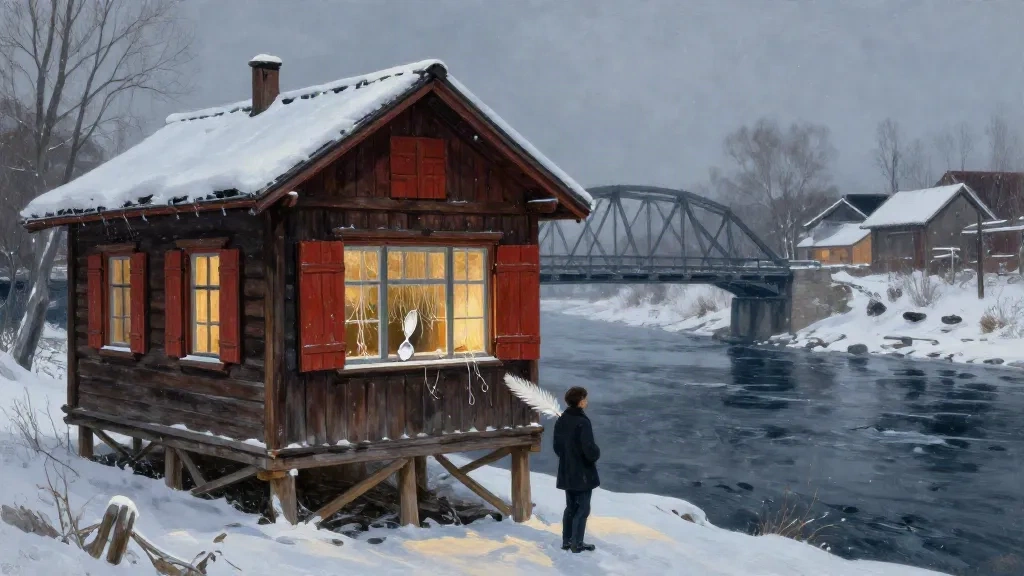
She bought four acres on the wrong bank, where the river would soon deliver its winter rubbish. The first frost came before the foundation dried. It thickened into a white crust over the windows and remained through spring, summer, and the following autumn.
For one generation, the cold refused to end.
People stopped planting. They burned chairs for heat and argued over whose memory deserved a place in the fire. Maren built her house higher, raising it on cedar posts until its windows overlooked the river. Each evening she played, and the truth-notes gathered above the rafters: bright threads of sound that hung there after the bow lowered.
The mayor said the house was unfinished.
He said it needed a mayor’s name, a cornerstone inscription, a story large enough to hold its weight.
Maren’s instrument stayed silent.
He had lied.
That night, the wind drove sleet against the eastern wall. It entered through every seam and found the silver spoon in Maren’s pocket. When she touched it, the bowl vibrated with a low note, deep as a bell buried underground.
She followed the sound beneath the floorboards.
There lay a white feather, perfectly dry, wrapped around a seed of black ice.
The Story Under the Floor
The feather belonged to no bird in the town. Maren had seen white swans on the river before the cold, but their wings had never made a sound like a door opening.
When she played beside it, the fiddle produced a note below hearing. The house answered from its beams. Every nail sang. Every nail had been hammered with a spoken truth, a memory offered freely by someone who had crossed the water and worked beside her.
Even the spoon had contributed: her mother’s last honest words, spoken while the tea burned.
Without these, the house would collapse.
Winter learned the same secret. It pressed against the windows each morning, wearing faces of frost. It whispered through the cracks that Maren had never been loved, that her mother had abandoned her, that the town had been safer before she came.
Each lie made the walls thinner.
Maren stopped defending herself. She played the truth instead: fear, resentment, the shameful relief of leaving Salt Ford, the small joy she had felt when the river turned and left the mayor stranded on the wrong bank. Her fiddle filled the house with notes that had teeth.
One generation passed. Children grew old beneath the same long winter. The border became a line drawn on a map no one could read.
An Ending That Held
At last, the white feather lifted itself from the floor.
It rose through the rafters, carrying the black ice with it. Maren played the deepest note, and the silver spoon rang in answer. The house did not resist the river when it turned. It did not resist the thaw.
The spell broke with a sound like a winter boot stepping carefully onto spring mud.
By morning, the eastern bank was green. The river ran south again. Salt Ford stood, damaged but awake, and people began walking home.
Maren entered the house and found no statue, inscription, or story of her own. The walls held only the voices of those who had chosen to build it with her. She had wanted something to survive the storyteller.
Instead, it had survived her.
She set the silver spoon on the windowsill. Beside it lay the white feather, no longer dry, no longer magic, but still unmistakably part of the house. Outside, the river moved without changing its mind.





