 Netwrck
Fairy-Tale Fiction.
The Note in the Wall
At dusk, the river ran east beneath the black-lacquered houses of Bellwether, carrying lantern reflections toward the mountains. At midnight it turned and ran west, carrying the same reflections back.
Everyone knew the rule. At dusk, the river ran east beneath the black-lacquered houses of Bellwether, carrying lantern reflections toward the mountains. At midnight it turned and ran west, carrying the same reflections back.
Neris, the town’s musician, stood on the bridge with his ear against the frozen railing. Each lie passed as a muted scrape beneath the ice. Each truth sounded clear and new: a silver note, struck somewhere behind the sternum.
He had heard one the night his mother crossed the river to escape a debt. He heard another when the mayor admitted the bridge had been built over a grave. But the truest note came from a child who said, “I saw my father steal the winter.”
Neris had no house of his own. He slept in the tower above the customs office, played for salt and bread, and kept his best coat buttoned against the wind. His desire was simple: to build something that could survive the storyteller.
Not a monument. Not a song. A house with a locked door, a deep cellar, and walls thick enough to hold a winter.
Black Lacquer and Gold Dust
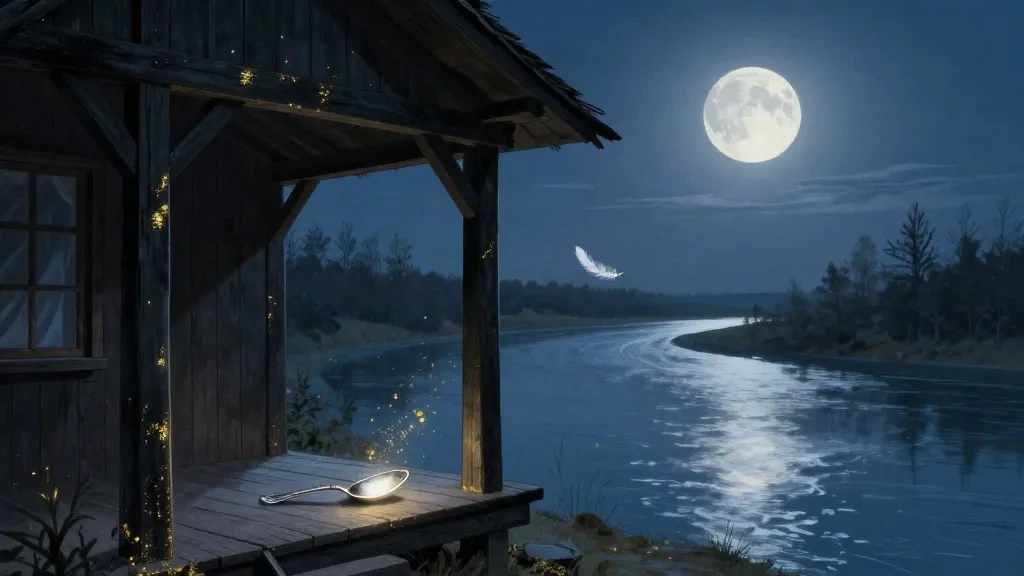
He gathered white feathers from the river’s western bank, where the water returned them each night. He gathered silver spoons from the houses of Bellwether, each one donated by someone hiding a small truth. The first spoon belonged to a widow who admitted she had poisoned her husband. Its note rang like a bell.
The second belonged to a ferryman who claimed he had never crossed the border. The third was given by a child who said the stars were not fixed, but pinned.
By full winter, Neris had built a cabin beneath the old watchtower. He lacquered its beams black and rubbed gold dust into the seams. He set a silver spoon at every corner and hung a white feather above the door.
On the first night, a family arrived. On the second, a hunter with frost in his beard. On the third, twelve people who had crossed the river and found their homes occupied by versions of themselves.
The cabin held them. It was warm. It was not enough.
The Winter That Would Not End
Winter had come before the river reversed. It had buried the harvest, frozen the bell tower, and taught the crows to keep silent. Then the autumn wind vanished.
For one generation, winter remained. Babies grew beneath snow. Trees made white fists. The river froze from both banks toward the center, then melted only in the shape of a narrow blue road.
Neris heard no new note for six years.
The cabin walls began to sing at night. A low, tuneless grinding passed through the beams. White feathers lifted from the floor and pierced the black lacquer. Silver spoons bent in the guests’ hands.
The hunter admitted he knew why. The winter had been told a story, and the story had decided to keep living. Every time someone repeated it, winter strengthened. Every time someone spoke a truth no one wanted, the cabin grew weaker.
“Then we must stop telling it,” Neris said.
“Who will remember the dead?” asked the child.
“The living,” he answered. “That is their work.”
A House Built from Silence
At midnight, the river changed direction beneath the cabin. The ice cracked from west to east, and a procession of black water passed under the walls.
Neris opened the door and stepped onto the river. The other refugees followed. They carried no candles. They carried no tools. They carried only the truth each had hidden inside the house.
The winter came to meet them. It rose around their knees, then their waists, wearing the faces of every person who had ever refused to leave.
Neris played one note on the silver spoon at his chest.
It was not a note of defeat. It was the clear, impossible sound of a finished sentence.
The river turned again. The gold dust lifted from the cabin seams and shone across the snow. The white feather rose last, circling the chimney before settling on the moon.
By sunrise, the cabin remained. The winter had not vanished, but it no longer owned the valley. The river flowed east, carrying the season’s thaw with it, and the people began rebuilding their homes on the western bank.
Neris never named the cabin after himself. He called it The Unfinished, and each spring he added one room. Whenever someone asked why it could survive, he set a silver spoon beside the hearth and listened for the truth.
Sometimes it answered with a single golden note. Sometimes it answered with silence.
Silence, he had learned, was the strongest wall a house could have.





