 Netwrck
Fairy-Tale Fiction.
The Note Under the Bridge
At noon, the river ran east beneath the black-lacquered bridge. At midnight, it ran west, carrying the border with it. Houses changed sides. Customs seals faced the wrong kingdom. Anyone who marked the stones in advance found a different town waiting at dawn.
Lio, a musician with ink-dark hands, crossed once each day to play for the border guard. Truth gave him a new note: a clear silver thread beyond the usual scale. It sounded when Captain Saye denied stealing the winter chronicle. It sounded when Mara Venn admitted she had buried her brother’s fiddle beneath the customs house.
That note gave Lio an idea. A true thing remained true when the river changed direction. He would build a house around one.
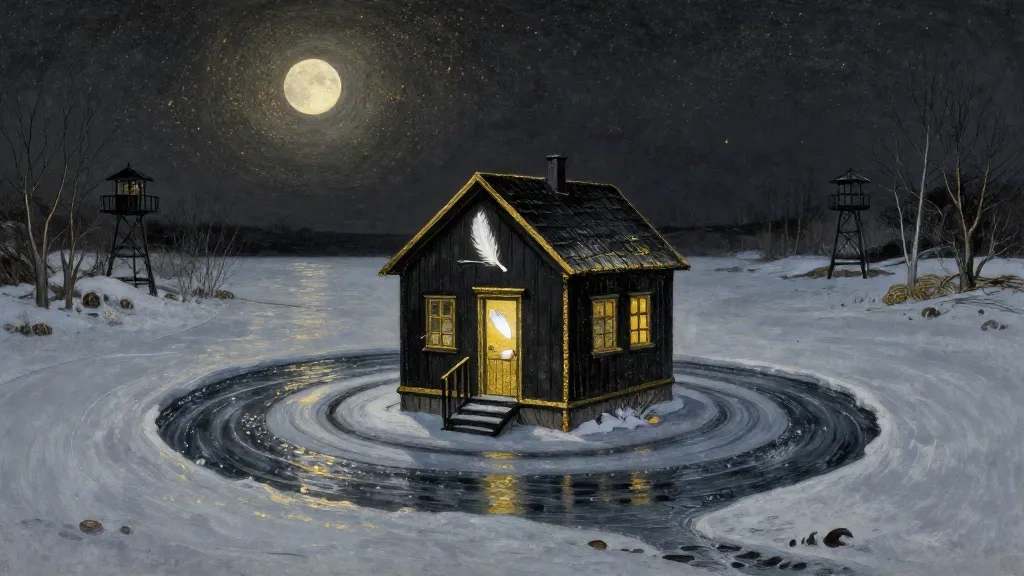
He had a white feather from the river’s eastern nest and a silver spoon from the ruined abbey, each proof that east and west were not opposites but portions of one journey. He set the feather above the door and the spoon on its windowsill. Between them he laid stones in a circle, black as beetle wings, with gold dust pressed into their seams.
“There,” he told the townspeople. “It will survive.”
Winter Without an End
The winter began before the leaves had fallen. Frost silvered the spoon. Snow climbed the white feather and refused to melt even beside the fires.
No spring followed. The children grew into adults while the passes remained white. The town learned to cut bread thin and tell fewer truths, because each one summoned Lio’s impossible note. Even the smallest sound made the walls tremble.
“A house built from truth is being built from a stone the river keeps moving,” Mara told him.
So Lio reinforced the roof with elder beams, the door with river iron, the windows with amber. He asked the oldest mason to bind the corners with black lacquer. Gold dust climbed the walls in branching patterns, constellations for a season that had forgotten how to end.
Still the river changed. Still the town’s sides changed. On the first night of the eldest daughter’s wedding, the river climbed the embankment, found one loose brick, and entered the house.
Lio heard a note beneath the water. It was the lowest he had ever known, deep enough to shake dust from the ceiling.
The Storyteller at the Door
On the thirtieth winter, a traveler came out of the blizzard wearing a coat stitched from black feathers. He carried no shadow, though the moon cast many.
“Every town is a story,” he said. “And every story needs something to fear.”
Lio played to drive away the cold. Each true note made the window frost peel away. Each false note drew new ice across the glass. The traveler listened without moving.
At last he said, “Your name has become a story too. In every house, somebody asks who taught the river to turn.”
That was true. Lio had taught it. On the night the chronicle was stolen, he had played the captain’s name instead of admitting he had heard the theft across the water. Shame had turned the current backward. Every generation had obeyed that single hidden choice.
The truth struck the room like a bell.
The white feather flew from its place above the door. The silver spoon dropped and rang against the floor. The river began to turn beneath them, not at midnight, but now.
A House for the Next River
They left the black-lacquer house empty. Lio carried the spoon across the shifting bridge; Mara carried the feather. Behind them, the traveler smiled because stories, too, require hinges.
At dawn they built on ground neither kingdom claimed. They laid the foundation in a spiral, open at the center, so the river could pass beneath without breaking the walls. Lio set the spoon in the eastern window and the feather above the western door. He scattered gold dust along the floor in two trails that met only when the moonlight entered.
There was no painted charm, no locked door, no tale to bind them there. When the winter came, it found no secret wall to freeze. When the river turned, it found room.
Years later, children asked Lio how the house had survived. He gave them no answer, for an answer would become a story, and stories can be carried into rooms that are not theirs.
Instead, he played one note.
It was the note of the river at midnight, of a feather borne home by an unseen wind, of a silver spoon holding a little moonlight. The children carried it outside and laid it on the ground, where the next season could find it.
That was enough. The house had survived the storyteller. The river had room to become something else.





