 Netwrck
Mythic Fiction.
The Door Beneath the Sand
By day, Orra Venn drew maps for the border wardens, though her hands had forgotten how to hold a pen. At night she drew doors.
Not on ordinary maps. She drew them on maps of places that no longer existed: drowned villages, vanished roads, the courtyards of houses pulled down before anyone had thought to name them. A door appeared in the blue pencil of a vanished ferry crossing. A brass knob marked the old well beneath Saint Orra’s chapel. Once, in the margin of a burned village, she drew a door wide enough for a procession of ghosts.
Orra wanted one place where lost things could rest. Not recover. Not return. Rest.
Her town, Bellwether, was split by the river Sere. On the western bank lived the people who remembered its first name, Ash. On the eastern bank lived those who insisted it had always been called Rain. At midnight, the river changed direction.
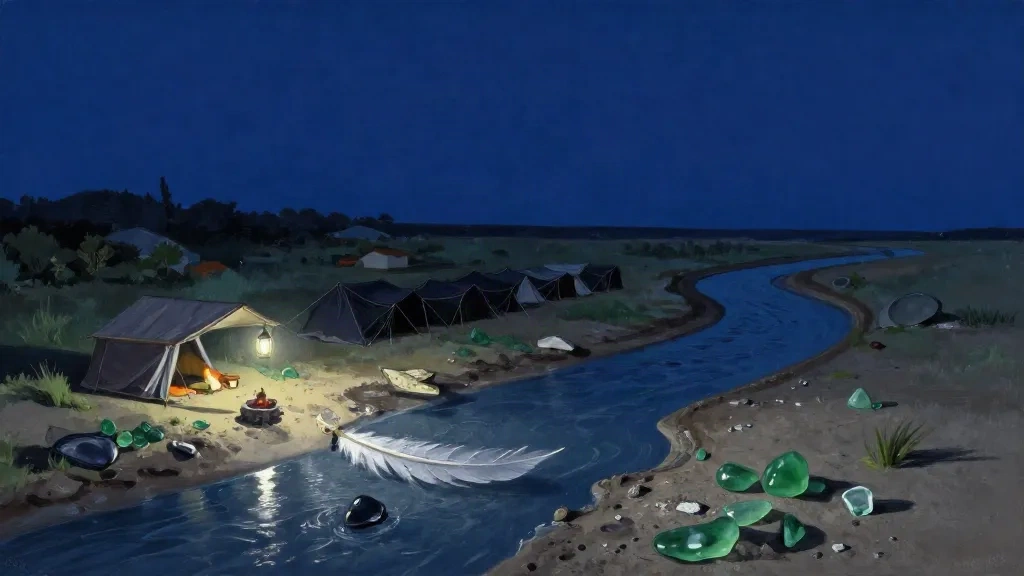
For one hour, the current ran north. The water lifted from its ordinary bed and flowed toward the hills, leaving silver mud, old footprints, and sometimes a thing behind.
Orra kept a moth wing in her left pocket. It was gray, soft, and larger than any moth she had known. Her brother had carried it when he vanished into the flood thirty years ago. Orra never stopped believing he had left it behind for her.
The Market of Expensive TruthS
The market appeared only when the river turned. It stood on the exposed riverbed in a long line of black tents, its lanterns burning without smoke.
Stalls displayed the lost belongings of Bellwether: a child’s red kite, a soldier’s false tooth, a woman’s wedding veil, a bell from the vanished Ash bridge. The merchants did not lie about what they sold. They lied about what those things meant.
At the last stall, an old woman sat beneath a cobalt canopy. On the counter lay a white feather, bright as winter milk.
“That was his,” Orra said.
“Was whose?”
“My brother’s.”
The woman named a price: the name of the town where Orra had been born.
“You have already lost that place,” the woman said. “A name is only a door with a lock on it.”
Orra touched the moth wing in her pocket. Across the river, the midnight bell began to ring. The market had opened, and every stall was waiting for someone to mistake an object for a destiny.
She had once believed maps were promises. Then she had believed they were evidence. Now she understood that both were forms of vanity. A map changed when the land changed. A memory changed when the bearer needed it to.
What the River Returned
Orra walked the length of the market, carrying a brass compass that no longer pointed north. At one stall, a boy offered her a drowned key. At another, a woman sold the smell of a bakery that had burned in Ash. The expensive things were always true, the sellers whispered. A true thing could be bought, but it could not be made to mean what you wanted.
At the white-feather stall, Orra found a small map beneath the counter. It showed Bellwether as it had stood before the river changed, with a road running through the western bank and a shrine on the eastern one. The road had no name.
“This is a door,” the old woman said. “To a place where lost things may rest.”
“Where is it?”
“You have not drawn it yet.”
Orra took out her pen. The river began to fall back into its bed. Water surged around the tents, climbing over the counters, carrying away labels and lanterns. The sellers shouted, folding their goods into sacks. The white feather rose from the stall and blew toward the empty road.
Orra ran after it.
At the river’s edge, she opened her old atlas. The paper was soft as skin. She drew a small building with no walls, only a roof, a hearth, and a row of hooks for wings, keys, feathers, and the things people had carried so long they had forgotten they were carrying.
The map drank the moonlight. Then the river stopped.
The Room That Did Not Need a Name
When it turned again, Bellwether had a new place between its banks. It was neither Ash nor Rain. It had no name on any official map.
Lost things went there when no one else could keep them. The drowned key rested beside the child’s kite. The smell of the bakery rose from a stone oven. On a hook by the hearth lay the white feather, whole and clean.
Orra entered last.
Her brother was not there. She had known he would not be. The river had kept his feather, not his body, and the market had given her the truth of that distinction without promising more.
She placed the moth wing beside the feather. One was made of darkness, one of light. Between them, the hearth held steady.
At dawn, the river began flowing south again. The room remained. Orra Venn looked at the blank map and understood that a place did not need a name to be real. It only needed someone willing to leave the door open.





