 Netwrck
Adventure.
The Door Beneath the North Wall
At the border town of Vey, the river ran east until midnight and west until noon. Every house kept two doors facing it, one for each direction, because no one trusted a town whose water could change its mind.
Mara Venn had been a cartographer for forty years. Her maps showed roads, levees, vanished hamlets, and the small gray doorways that appeared in places after the last person left. Now that she was retired, she drew doors only on maps of places that no longer existed. She kept them folded in a cedar chest beneath her north-wall room, where the river’s copper horizon showed through the shutters.
Her desire was simple enough to embarrass her: she wanted to make a place where lost things could rest.
Not people. People had homes, however temporary. She meant the key that belonged to a demolished house, the blue mitten from a vanished market, the name carved into a bridge post before the bridge fell, the small bell that had rung in a vanished schoolyard.
On the morning she found the first key, Mara drew a door for it. The map showed a stone room beside a river that flowed in three directions. She folded the paper, tucked it into her coat, and walked toward the crossing.
The Market of Certain Things
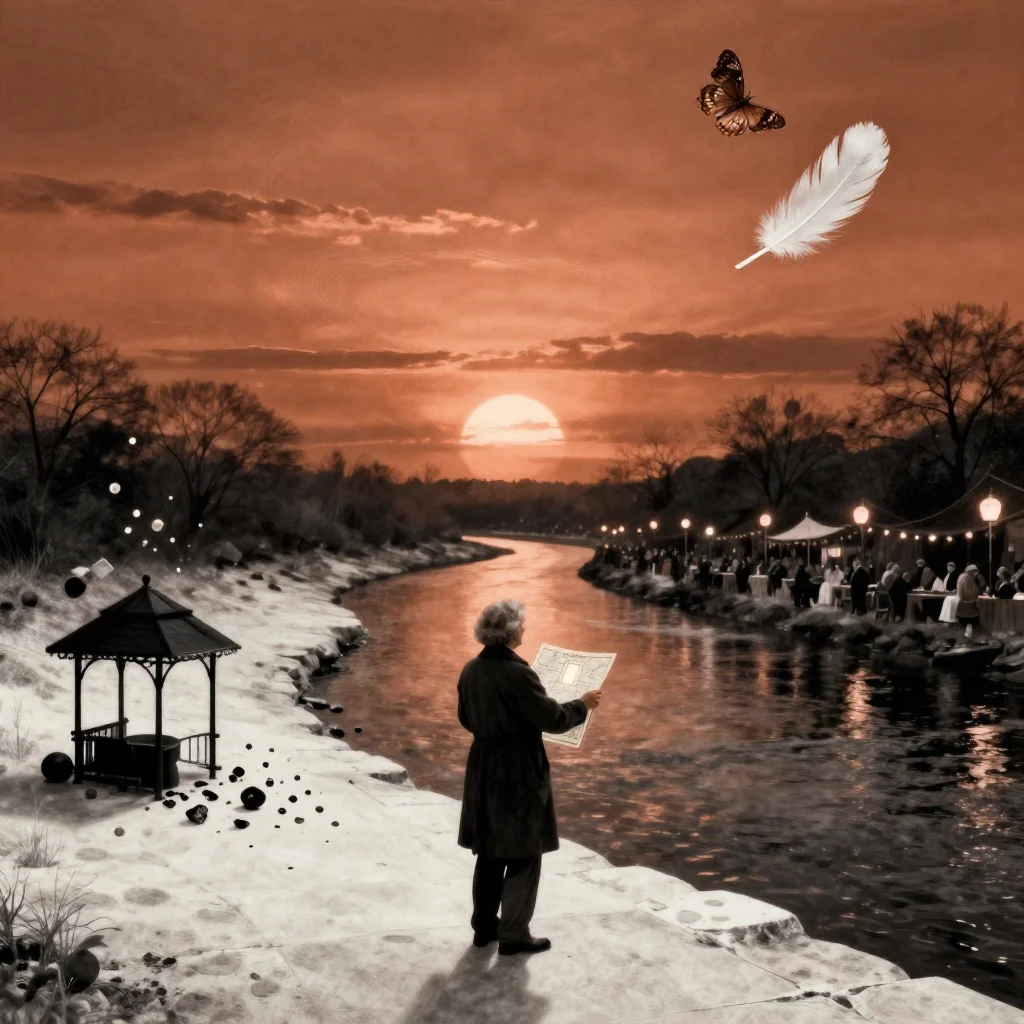
The midnight market stood where the river changed direction, on a gravel island that belonged to no bank. Booths leaned together under black-cherry awnings. A woman sold a pair of spectacles that made every liar appear transparent. A boy offered a red door guaranteed to open only once.
Mara asked the merchant in the last booth what the market accepted.
“Truth,” he said. “The expensive kind.”
He spread his hands over a tray of objects: a wedding ring, a ferry ticket, a child’s tooth, a compass whose needle pointed toward the person who had abandoned it. Each object bore a white price tag.
“Small truths are free,” he continued. “Facts about weather. Facts about numbers. But a truth someone has hidden from themselves costs what they can least bear.”
Mara placed the key on the tray. “I want a place where lost things can rest.”
The merchant examined her. “That is a wish. Wishes are cheap because they belong to everyone. What is the truth beneath it?”
She thought of the rooms she had emptied, the maps she had drawn for places erased by reservoirs, floods, and new roads. “I have spent my life recording where things were. I never made sure anything had somewhere to go afterward.”
The merchant named a price: the memory of her first successful map.
“Not the fact of it,” he said. “The joy. You will know the map was good, but you will not remember standing at the table with ink on your fingers, believing you had made the world visible.”
Under her coat, the key became warm. Mara paid.
What the River Carried Back
With the key, the merchant gave her a moth wing. It was black cherry in the lantern light, delicate as a rumor. “For the room,” he said. “Lost things require a door, a light, and something that remembers the air before the fall.”
Mara drew a door on the map of the vanished market. The room appeared beneath the northern wall: pale stone, low beams, a window facing the river. She built it over three days. She carried there the blue mitten, the bridge-post name, the schoolyard bell, and one child’s tooth wrapped in paper.
Each object quieted when it crossed the threshold. The key found a hook. The mitten rested on a shelf. The name lay in a wooden box.
On the third night, a white feather appeared beneath her door.
It was larger than any bird’s feather, and it carried a truth. Mara touched it and heard a voice: her first map had been wrong. She had misplaced the river by a mile, sending travelers toward a cliff. No one had died, but a village had lost its market for a season. The joy vanished from her memory, leaving the clean shape of a relief she could no longer feel.
The merchant’s price had not bought truth. It had bought the right to receive it.
At midnight, the river turned. Water climbed the eastern wall, found the new room, and began to flow through it. The lost objects lifted from their shelves. The white feather pointed west. The moth wing pointed down.
Mara understood then: the river did not return lost things. It returned the directions they had been refusing to take.
A Door Made of Morning
She drew one last door, on a map of the room itself. The vanished place was Vey before the river learned to change its mind: a single bank, one bridge, a hundred names still living. The door opened onto morning, cold and pale, with a copper horizon behind the hills.
Mara carried the key across. Behind her, the room filled with black-cherry water. The lost things did not drown. They became stones, bells, feathers, and small bright hinges along the new shore.
At noon, the river reversed again. The market bell rang once across the water.
Mara kept the map folded beneath her coat. The joy was gone, but the work remained. She had learned that a refuge was not a place where nothing could be lost. It was a place where loss could finally become visible.
And when the next forgotten key arrived, she would draw it a door.





