 Netwrck
Hopeful Science Fiction.
Lavender Water
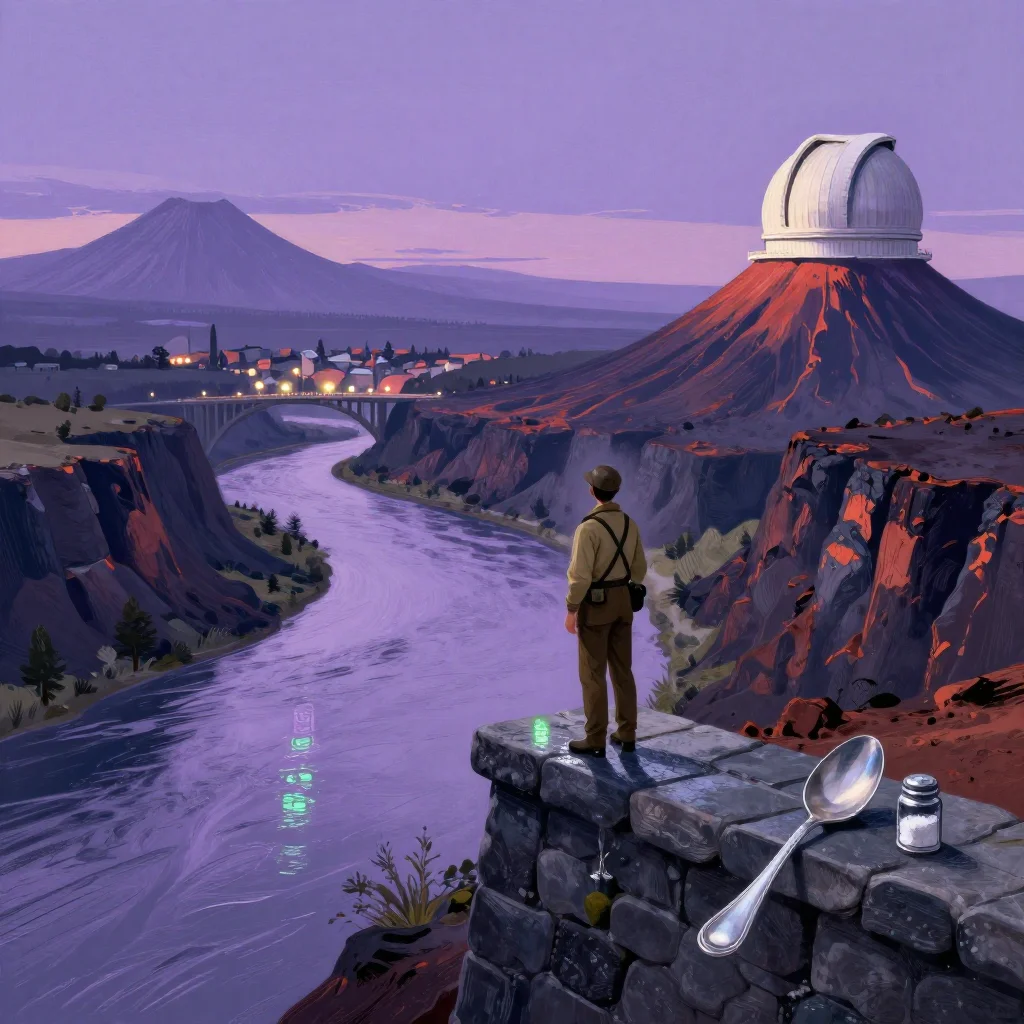
Mara Vale began each morning at the observatory’s western lip, where the floor had been cut into the dark flank of Mount Aster. Below her, the river moved through a notch of wet asphalt, carrying lavender reflections from the clouds and the green spill of the pharmacy sign in Saint Orra.
She was a river surveyor. Her instruments were a silver spoon, a salt jar, and a narrow copper wheel that measured the height of the current. When she pressed the spoon into the water, its bowl filled with a feeling. Grief arrived as a weight beneath the surface. Joy made tiny bright bubbles. Longing traveled upstream as a warm metallic taste.
For eleven years, Mara had mapped those feelings in private. She kept the records in a black atlas beneath her bunk, each page marked with a date, a location, and a color she had mixed from river silt and lamp ash. The atlas was useless to anyone who had not learned her personal scale of lavender, pea green, and the particular blue of a promise delayed.
That morning, the river carried a bridge that had never been built.
The Bridge in the Current
It appeared halfway between the observatory and the town, a pale arc trembling beneath the surface. Mara lowered the silver spoon. The bowl filled with an unfamiliar sensation: hundreds of separate memories braided together.
She saw a timber bridge in a rainstorm, its planks shining with tar. She saw a stone bridge carrying children in festival clothes. She saw a bridge made from iron sleepers, a bridge of bamboo, a bridge built by hands that had never touched the river and still left a mark upon it.
The records of every bridge ever built.
Mara opened the salt jar and scattered a pinch across the current. The grains did not sink. They gathered along the bridge’s invisible edges, each one holding a different memory. Some shone with gratitude. Some trembled with fear. One small crystal burned gold with the thought of a home seen from the far bank.
At the bottom of her atlas lay the reason she had kept her work private. Years ago, Mara had mapped the emotion of the river at the place where her brother disappeared. The river had returned only a silver spoon, polished bright, and no answer. Since then she had feared that public feeling would become public property. If the river could remember every bridge, perhaps it could also remember every abandoned person.
But the hidden bridge was moving. Each minute, it advanced toward Saint Orra.
What the Town Could Hear
Mara ran down the observatory stairs and unlocked the old signal room. The room had been built for meteor sightings, but its brass horn still carried well. She turned the wheel that released the river’s resonance into the valley.
The first note sounded like a gate opening.
Across Saint Orra, people stopped beneath awnings. A baker lifted his hands from a loaf. Children on the bridge over Mill Street pressed their palms to the rail. Even the pharmacist raised the green sign’s shutter, exposing the word PHARMACY in bright letters.
Mara had wanted to make her ritual public for years. She had imagined a ceremony: a measured cup of water, a reading aloud, a bridge laid gently across the town’s grief. Instead, the river had offered her a city’s unfinished map.
She broadcast the survey as she descended. The salt readings appeared in pale columns beside the channel. Grief marked the foundations of the burned mill. Joy pulsed where lovers met beneath the lamp. Fear clung to the abandoned railway. At every crossing, the invisible bridge gathered another memory and became stronger.
By dusk, the town had gathered on the riverbank. No one knew Mara’s color code, so she taught them. She showed how lavender meant a feeling too large for one person, how wet asphalt meant the comfort of arriving, how pharmacy green meant help nearby.
Together, they read the river.
A Crossing Made Public
The hidden bridge reached the town at moonrise. Mara waded into the channel with the silver spoon in one hand and the salt jar in the other. The current struck her knees. Every memory of every bridge pressed against her legs: departure, construction, collapse, repair, refusal, return.
She understood then that a bridge was not only a passage. It was a promise made visible before anyone knew whether the far side would be kind.
She raised the spoon. The river’s feelings climbed into its polished bowl and burst into lavender light. The salt jar shone green. A solid span formed from the water, not to erase the river, but to carry it across.
Saint Orra walked onto it together. The baker carried flour in one hand and his brother’s old lantern in the other. The pharmacist brought medicine for the night’s fever ward. Children ran ahead, calling out the names of colors. People who had never spoken to one another described the feelings that had carried them to the river.
By morning, the bridge had become stone in the town and a bright line in Mara’s atlas. She opened the atlas in the signal room and tore out the private pages one by one. She did not throw them away. She placed them in a public box beside the copper wheel, where anyone could add a reading.
The river kept moving below the observatory. It still carried the spoon’s shine, the salt’s white grains, and the memories of all the bridges ever built. But now, whenever a new crossing was needed, the town knew how to listen.





