 Netwrck
Speculative Fiction.
The Measuring Line
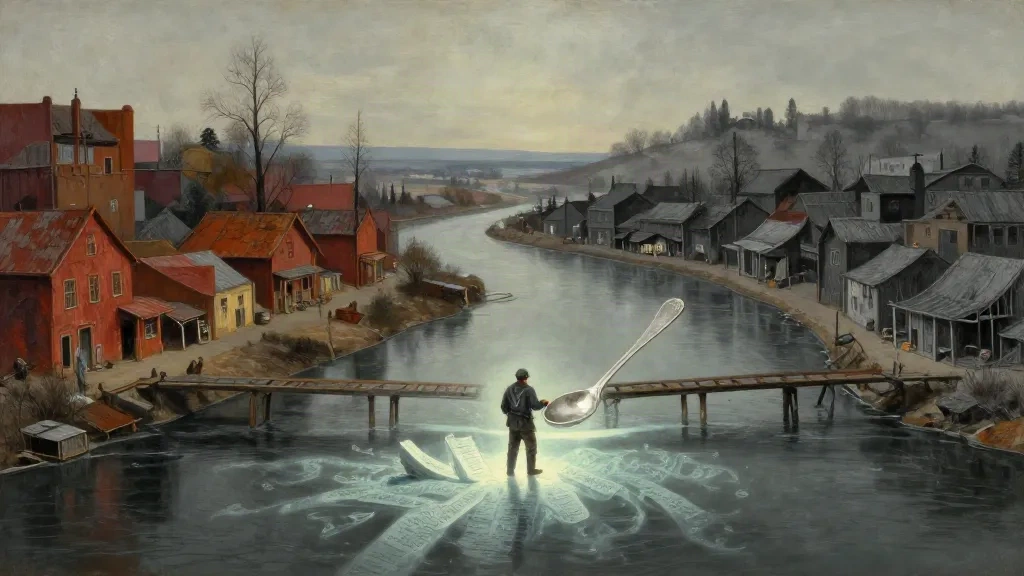
At dusk, Mara Venn lowered her silver spoon into the river and waited for the current to trouble its surface.
The border town of Silt Bell divided at the water: the old quarter on the rust-red bank, the new quarter on the charcoal bank, and between them the narrow channel where the river changed direction at midnight. By day it flowed east beneath the tram bridge. After the bells, it traveled west, carrying leaves backward and returning them bruised.
Mara was the town’s river surveyor. Her instruments were a brass compass, a line of red thread, and a silver spoon. The spoon’s bowl was polished to a pale winter mirror. When she drew it through the water, the current briefly arranged itself into lines. A smooth loop meant comfort. A knot meant fear. A broken line indicated grief too old to hold.
She copied the patterns into her atlas, but never spoke of them. The government wanted useful measurements: depth, speed, floodline. It did not want to know that the river carried homesick laughter, that envy had a greenish sheen, or that sorrow traveled downstream in little black sheets.
Every morning, Mara performed one private act. She placed a silver spoon beside her sleeping mother’s salt jar, said the name Mara had been given before the river changed, and measured the silence between one grain and the next.
What Came Back
On the night before the annual bridge inspection, the river carried a plank uphill.
It arrived against the current, black with age, and struck Mara’s red thread. She leaned from the bank and drew it free. Letters had been burned into its surface: names, dates, measurements in four different hands. The first bridge between the two halves of Silt Bell had stood here in 1841. The second had been built after the flood of 1908. The third had been designed by a woman whose name the town council had removed from every map.
Before midnight, the river showed only the living current. After midnight, it returned the river’s records.
By dawn, the water held fragments of every bridge ever built across it: iron pins, wedding ribbons, a child’s shoe, a mason’s thumbprint sealed in stone. Each carried the emotions of those who had crossed or refused to cross. The silver spoon became too heavy to lift.
The council declared the channel unstable and ordered the old bridge closed. They blamed the reversal. Mara knew better. The river had remembered a bridge nobody had announced.
The Ceremony at Noon
Her mother’s condition had worsened. The doctor said she might live until the next thaw, and only if nobody disturbed the house’s familiar arrangement of jars and spoons.
Mara’s private ritual had begun when she was seven: one pinch of salt for the person left behind, one clean stroke of silver for the person who departed. It was never enough. It was the only ritual she trusted.
At noon, she carried the spoon and salt jar to the bridge.
The townspeople gathered on both banks. Children leaned over the railings. The mayor frowned at the jar. Mara took a pinch of salt and scattered it across the water.
“For everyone we left behind,” she said.
The river did not move.
Then she raised the spoon. Its reflection widened until the entire surface became a pale, trembling page. Grief surfaced in charcoal ribbons. Relief moved in rust-red currents. Hope flickered where the sun touched the water. The hidden records of the bridges rose beneath them, audible as a low chorus of names.
Someone on the far bank began to cry. Another person followed. The mayor gripped the railing while the river displayed the demolished bridge, the one hidden beneath the parking lot, and the unbuilt bridge whose plans still waited in a drawer at city hall.
Mara understood then that a public act need not erase private pain. It only prevented the river from carrying it alone.
The Direction Afterward
At midnight, the water reversed.
This time the spoon showed no grief. It showed faces, hundreds of them, turned toward the banks. The salt jar clouded, then cleared.
Mara closed the atlas. The river would change again tomorrow, and the council would ask for a report. But the bridges had been named aloud at last, and the town could no longer pretend the river was only a border.
At dawn, a new line appeared on Mara’s atlas. It did not show where the water would go. It showed where people had chosen to meet it.





