 Netwrck
Speculative Fiction.
Shadows Before the Snow
By the first week of December, the shadows had learned to wait at the station.
They stood beneath the iron awning in their proper shapes: small children with mittened hands, a woman in a long coat, a man carrying a suitcase. Their owners arrived later by coach, stamping snow from their boots and complaining about the wind. The shadows bowed when their people bowed. They lifted their faces when laughter crossed the air.
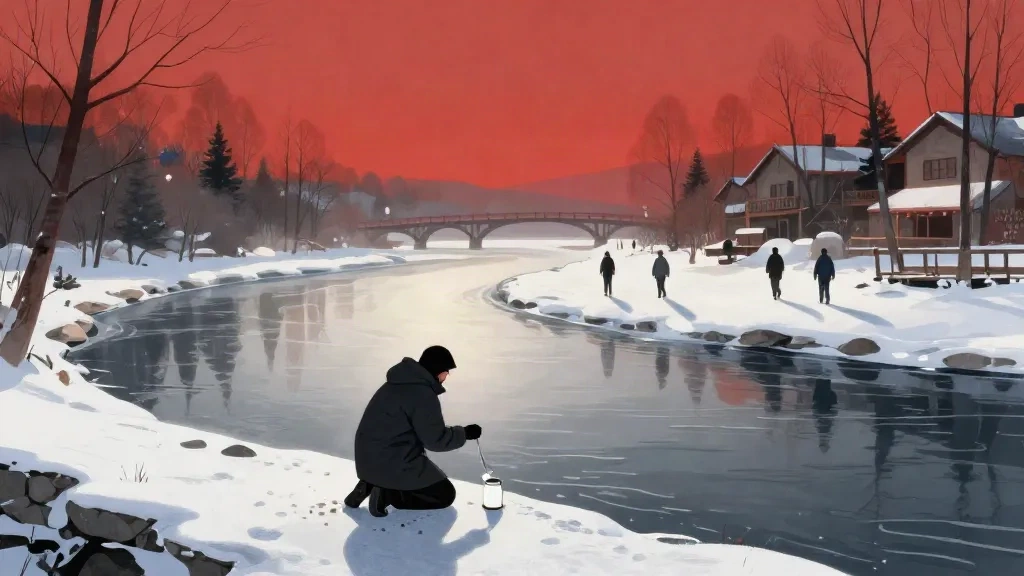
Mara Venn arrived three days before everyone else, as the resort required. She was a river surveyor, though the resort employed her to draw its ornamental skating pond on ceremonial paper. Her real work began when the ice thawed, when the current took a man’s grief and folded it into a tight blue knot beside a submerged stone.
She mapped emotions the way other surveyors mapped channels. Sorrow ran deep and quiet. Anger had bright banks. Fear moved in eddies. Desire always traveled downstream, bright as a copper nail.
Her own grief was a silver spoon balanced on the surface of the pond.
Every morning, before the guests woke, Mara knelt at the water and drew the spoon through the ice. The ritual was private. It had begun five winters earlier, when her brother Tomas drowned in a river three hundred miles south. His last message had contained only a photograph of a spoon resting beside his empty bowl.
She never knew whether he meant that he was hungry, lonely, or simply finished with the day. The river had accepted the question without answering it.
What the Current Carried
On the second morning, a salt jar appeared beneath the skating pond.
It was white porcelain, stoppered with wax, and no larger than a fist. Mara opened it. The salt smelled of stone, blood, and winter onions. Inside lay a folded paper bridge.
The bridge was made from birch bark, each span labeled in handwriting she recognized as Tomas’s.
When she lifted it out, the pond began to murmur. Not water against ice. Water against names.
She brought the jar to the resort engineer, Tomas’s old friend Emil. He looked at the paper bridge and went pale.
“The river keeps records,” he said.
“Of what?”
“Every bridge ever built. Temporary ones. Permanent ones. The ones people burned.”
He lowered his voice. “And the ones they only promised.”
That afternoon, Mara took the bridge to the river beyond the resort. It thawed beneath her boots, carrying a skin of ice toward the sea. She kneeled and placed the bridge across the current.
The water refused to accept it.
Instead, the bridge rose. Beneath it, pale lights moved along the riverbed. One by one, they surfaced: planks, beams, iron chains, stone arches, footsteps frozen mid-crossing. Every bridge in the river’s memory assembled itself in the pale winter light.
The shadows from the station ran downhill toward the bank.
They carried the silhouettes of guests not yet arrived.
The Public Shape of Grief
Mara understood then that the shadows were not warnings. They were the resort’s river, cast outward.
For years she had kept the spoon ritual private because grief seemed to belong to the person who carried it. But the river had another rule: nothing entered it without changing the shape of what followed.
Emil called the resort staff together. Guests arrived to find surveyors at the river, measuring the invisible bridges beneath the current. Some carried lanterns. Some carried salt. One child carried a spoon.
Mara climbed onto the stone landing and held up the porcelain jar.
“We are not here to map what is there,” she said. “We are here to witness what the river has carried.”
She poured salt across the paper bridge. The grains entered the seams of every bridge in the river. Old stonework strained. Rusted chains tightened. Bridges built from lies shuddered and broke apart into harmless fragments of light.
The crowd began naming the dead.
Not shouting. Not praying. Naming them plainly, while the shadows listened on the snow.
Mara placed the silver spoon in the current. For a moment, it sank. Then Tomas’s shape rose from the water—not as a spirit, not as an answer, but as a bridge made from reflected light.
He walked once across it, carrying nothing.
Then the spoon turned, caught the morning sun, and became visible to everyone.
The Water Keeps Moving
By noon, the river had passed beneath the resort without showing what it held.
The paper bridge was gone. The salt had vanished into the current. Only the spoon remained, lodged between two stones at the landing.
Mara did not take it back.
She left the jar on the railing and marked the riverbank for the next surveyor. In her notebook, beneath the official outline of the skating pond, she drew a small silver line and wrote: Private current; public crossing.
That winter, the resort no longer asked its guests to wait for the shadows.
It asked them to notice them.





