 Netwrck
Speculative Fiction.
At the Turning
At midnight the river changed direction.
In Bellwether that was an inconvenience. Barges backed into the docks until their prods found the mud, gulls slept upside down in the reeds, and Tam, who had ferried the crossing for thirty years, swore in three languages and then in a fourth he had invented. Beyond the narrow iron bridge, where the rust-red warehouses leaned over the water like drunks holding a wall, the people called it a truth. They said the river remembered the shape of the land before it learned to settle. The old ones said it that way. The young ones, that week, said nothing at all.
Then Mara Venn heard the new note.
It came up off the bridge through charcoal snow, thin and clear, the sound a wire makes when a thumb slides along it. She had played the pipe organ in the station for nineteen years, wired two cracked pipes herself, pumped the bellows with her hip. She knew every sound that wood and metal could be asked for. This was not one of them.
Her son stood in the sleet holding a white feather against his cheek. Wick had gone two years before, in autumn, with a satchel and no word, and she had told everyone it was the road south and better wages, and had played the lie into her own hands so it would sound convincing. Now he stood in the middle of the bridge, nineteen and starved, and said to no one:
“I didn’t cross to fetch medicine.”
Underneath the words, the note rose and held, bright as a struck bell.
Mara put her hand flat on the frozen rail. He had crossed to leave her. He had crossed to leave a woman who sat at the organ six days a week turning other people’s grief into air, and he had lied to the town about it, and the river had found the lie and rung it.
“You could have written,” he said, without the note this time. Nothing came up under that sentence. It was not true, so it made no sound.
“Yes,” Mara said. “I could have.”
The Silence That Lied
She followed the sound through streets glazed with pale winter light.
It led her from house to house, and everywhere she found the same thing. Old Gelder, the baker, said his bread was old, and the note came up bright. Tam said the north bank was empty, and the note came up bright, and Mara understood that he meant empty of soldiers, which was a different sentence than the one he had said. It was small and silver and easy to miss, and it rang for a long time after he had gone inside.
Two kinds. A truth said plainly rang like a glass. A truth said for comfort rang like a spoon laid edge-down on a table, so that the room could look at it and not have to pick it up.
Mirren had told her once that the winter ate the second kind. Mara had not believed her. That night she counted nine of them between the bridge and the customs house, and she believed her.
The winter had not always been able to lie. It had borrowed, the way a thief borrows a coat: first the lies people told each other to spare themselves, then the shape of the telling, and finally the voice. Now it could speak in a person’s mouth without them hearing it, which meant it could also be carried in a person’s mouth without their consent. That was the trouble with a debt that hides. Nobody signs for it.
The Woman With the Silver Spoon
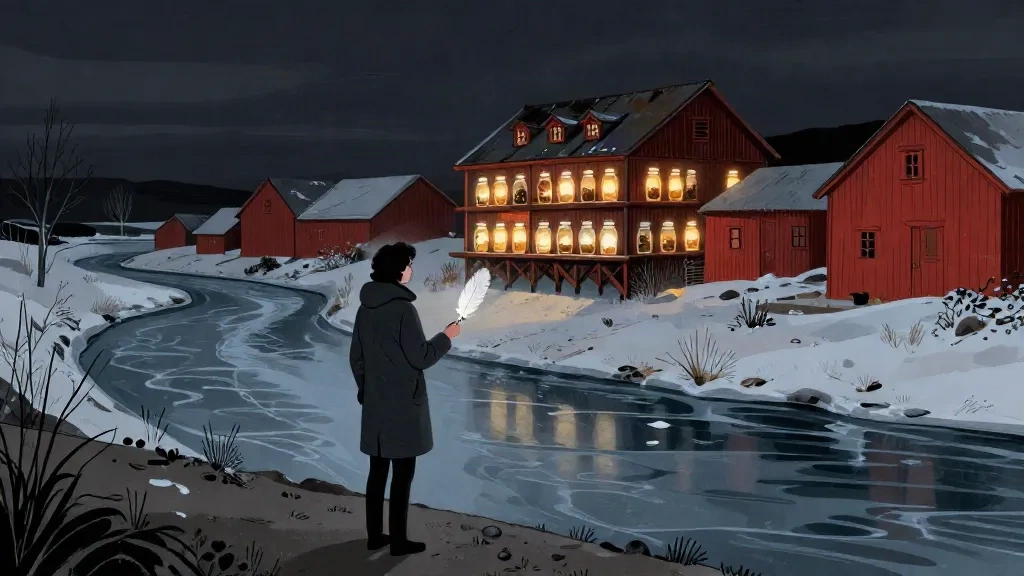
The winter sat in a room filled with jars.
Rain caught in a green stone. Autumn leaves folded like wings under amber glass. Summer heat sealed in a jar the color of a tooth, sweating faintly. And the largest jar, white and clouded, with faces turning in it in an endless procession, slow as a clock with no hands.
Mirren stood beside it in her rust-red shawl, eighty-one years old, with a silver spoon hanging from a nail behind her. Beside the spoon hung the ledger, a book of oilcloth pages bound in sailcloth, and Mara had seen it before, thirty years ago, in her mother’s kitchen, open on the table while Ada Venn cried and would not say why.
Ilsa Voss, carried the winter of 1789. Age taken: forty years.
“One generation will have to carry the winter,” Mirren said. “It always does. If the story is told correctly, it ends.”
“And if it’s not?”
“Then my daughter carries it, and her daughter, and you sit in a warm room being lied to kindly by people who love you.” Mirren turned the spoon once on its nail, so it gave a small dull shine of sound. “That is the winter. Not the cold. The comfortable lie. You have been feeding it since the bread went stale.”
Mara had known her mother’s page. Forty years, and Ada had been dead nine of them, gray and unlined and forty-nine at the end.
“You want me to think you are the villain,” Mara said.
“I am the ledger,” Mirren said. “Someone has to be. It is not a matter of wanting.”
Then the old woman lifted the spoon off the nail and held it out, and Mara understood that the price of this conversation was the same as always: someone to remember, someone to carry, someone to be younger than her years. Her mother had been told to build a church and had built a song instead, and it had not saved her, and Ada had spent thirty years teaching her daughter to hear the note so that the next one would be her.
“Build something that can survive the storyteller,” Mirren said. “A song, a house, a machine. Anything that does not need me to keep remembering it.”
The Year Without Birds
She asked for one winter’s worth of sound.
Mirren opened the white jar.
Snow came down from the ceiling of a room that had no ceiling, in a room that was the customs house. It settled in Mara’s sleeves and melted on her tongue and tasted of iron and old coins. Outside, without any night in between, the river reversed again. The locks froze with their gates open. The gulls left and did not come back, not in the first month, and Mara understood in the second that they were not coming back at all, and in the third that the town had stopped noticing, which is how a town agrees to a thing.
People stopped planting. They burned furniture and moved into the station, where Mara played through the cold, eight, ten, fourteen hours a day, because the organ was warm inside and the people were frightened and she was the only one in Bellwether who could make a room sound like it had a future in it. The river became a road, then a wall. Tam’s ferry ran on the wrong current and carried timber south for wages. The rust-red warehouses filled with salt, and the smell of the place that winter was wet stone and a dead dog and the particular sweetness of the station’s varnish, which the cold kept.
Every morning a white feather arrived on her window. No bird carried it. It lay in the sill’s dust, new each day, and Mara never once found out who left it, and never asked Wick, who was somewhere south and alive and silent.
She began building in the customs house in the fourth month. A wooden frame around Mirren’s jars, braced and glued, connected by copper wire she drew by hand from a spool, because drawing wire by hand kept her hands busy enough to not think about the ledger on its nail. Each stored season fed a pipe. She tuned them in the station at midnight with a borrowed tuning fork, lying on her back on the dusty floor with her ear to the mouth of each one, until the green stone answered rain, and amber answered a September afternoon, and the big white jar answered with a sound she could only describe as a held breath with weather in it. The winter entered the instrument and came out as wind, low and unbroken, and the sound of the wind was very nearly the sound of her mother’s voice in the kitchen saying there is a room in every song, go in and put your sorrow down.
But a machine that stores a winter is only a bucket. To empty the bucket it needs a beginning, and a beginning cannot be recorded, because a beginning is not a melody. It is the moment a living hand decides.
Mara spent the fifth month encoding the first four bars into the frame, and wrote the rest on the inside of the doors in letters small enough to shame herself, and told herself she was only hiding it so that no one would strike it carelessly. The white jar thinned that winter. On the coldest night she heard it turn faster, faces going round, and she understood then that she had built a machine with a lock on the outside and a key she had sewn into the lining of its own doors.
The Note Beneath the Ice
When Mara died, the station remembered the melody.
That was the bargain she had thought she was writing against, and it held, exactly, and not for her. Grooms and porters and one drunk bridegroom could all get the tune out of the station by now, badly, but out. When the station burned in the ninth month, a spark from the stove pipe in the customs house, the customs house remembered the machine. When Mirren forgot the road, forgot her own daughter’s name, forgot that the spoon was for collecting and not for stirring, the river still turned beneath the bridge, patient as a millstone.
Only Mara remained in the jar, and she was younger than she had been, and she was not forty-nine, and she was going to be forty-nine someday, in a way she could not think about without the faces going round faster.
She played anyway.
Her hands were gone, but the river had learned her rhythm, four bars, from four years of her pumping the bellows with her hip. It struck the bridge piers and the iron rails and the frozen locks of empty doors with a thin clear note under the words, and people heard it and told each other what they had really meant, and the small silver ones came up under those, and the jar took them. She played and the winter weakened, and she understood what she had actually built: a machine that needed a first note, and a first note needed a hand that did not know what it cost, and she had spent four months making certain that such a hand would come.
On a morning when the sky was the color of old paper, a child crossed the bridge. Eleven, maybe. A white feather in one hand and the silver spoon in the other, which means she had been in the customs house and had taken it down off the nail, which means Mirren was gone or forgetting, and Nell Garrow had stood under a cloud of turning faces and had picked up the one thing in the room that was not nailed down.
She also lied, on the way here. Mara heard it: Nell had told her mother she was fetching wood, and the note had come up small and silver under it, and it had gone straight into the jar, because the lie was the winter’s food and the lie was kind and the lie was a child’s ordinary love of her mother.
What the Child Was Given
The child opened the machine’s doors and found the letters on the inside, and read them, because Nell Garrow could read, which was the one thing Mara had failed to plan for.
She looked up at the jar. “Are you the one who stayed?”
Mara had no voice. The spoon rang once against the copper frame, and the note came out bright, because it was true, and the girl understood it the way children understand weather.
Then Nell read the rest of the inside of the doors, and Mara watched her arrive at it, watched the understanding land: the four bars encoded, the beginning hidden, the eleven years of a song Mara had been singing into a sleeping child’s room without ever once deciding to, the way Ada had sung it into her, the way the winter teaches the useful shape of itself. She had done to that child exactly what had been done to her. She had made the wanting first, so that the giving would feel like a girl’s own idea.
Mara wanted it to be an accident. She was not able to make it an accident. Both of those things were true, and one of them was a small silver note, and the jar took it.
“If I play it,” Nell said, “does it end?”
“It moves,” the spoon said, which meant something in the register between a yes and a no, and was as close to an honest answer as the instrument had ever given.
The girl put the feather on the white jar, struck the spoon once against copper, and played Mara’s song from the beginning. She got the third bar wrong and did not stop to fix it.
What the Town Owed
Spring came back to the river, and it did not flow the old way, and the town had to learn a new map or a new name for home.
The white jar emptied and cracked and the faces stopped going round, and the cost of it went into the ledger where it belonged, and the ledger had a name written in it that Mara did not choose and would not have chosen, and the name was not the girl’s. It was the machine’s. It said Venn, Mara, builder: forty years, paid by the town, disputed, and under it, smaller, in a different hand, a child’s careful capitals: and I played the beginning. Mirren had carved the sentence into the wall of the customs house without being asked to remember it, which everyone agreed to interpret as a blessing:
What survives its telling belongs to everyone.
And because it belonged to everyone, it had to be paid for by everyone, which is the only sentence in the language that has ever actually worked.
The machine went into the station square under a roof somebody finally had money for, and the book went into the station with it, and the book was not a secret anymore. It was a ledger of debts and a schedule. Each spring, when the north ice let go, someone strikes the first note, and what it takes is a year, and the year goes to the season, and the name goes in the book in front of witnesses, and no one is permitted to be too young, and no one is permitted to be too old, and there is a rule about the sick and a rule about the newly arrived and a rule, added in the fourth year, for people who had not spent a winter in Bellwether and so had no idea what they were voting on.
The first payment after the book was opened was made in pieces. Twelve households, a month apiece, the two ferry families arguing loudly about it on the theory that arguing loudly was now a civic duty. The spring came in on the twelfth month’s money and it came in well, and the fields north of the water were sown, and the birds came back in a bad year, and in a worse year, and every year after, in ones and twos, out of practice, as if they had lost the address.
Mara walked out of the customs house on an afternoon in the second week of the thaw, at forty-nine, with grey at her temples and a page in a public book, and she was the last person in Bellwether who would ever be charged a whole year at once. She did not consider that a victory. She sat in the square on the low wall by the machine most days, where anyone could read the book over her shoulder, and when someone new came down from the north in autumn and asked what the bell under the roof was for, she told them, at some length, and without being asked twice, and then made them stay for the whole of it, which was its own kind of carrying.
Wick wrote twice that winter, from the south. Mara answered both letters and put the dates on the outside so the ledger clerk could record them, because she had decided, in the end, that the difference between a debt and a shame is only whether somebody is keeping the account, and that she was not going to be the only one holding a pen in a town that had never once before been willing to read one.





