 Netwrck
Fairy-Tale Fiction.
The Measure of Moving Water
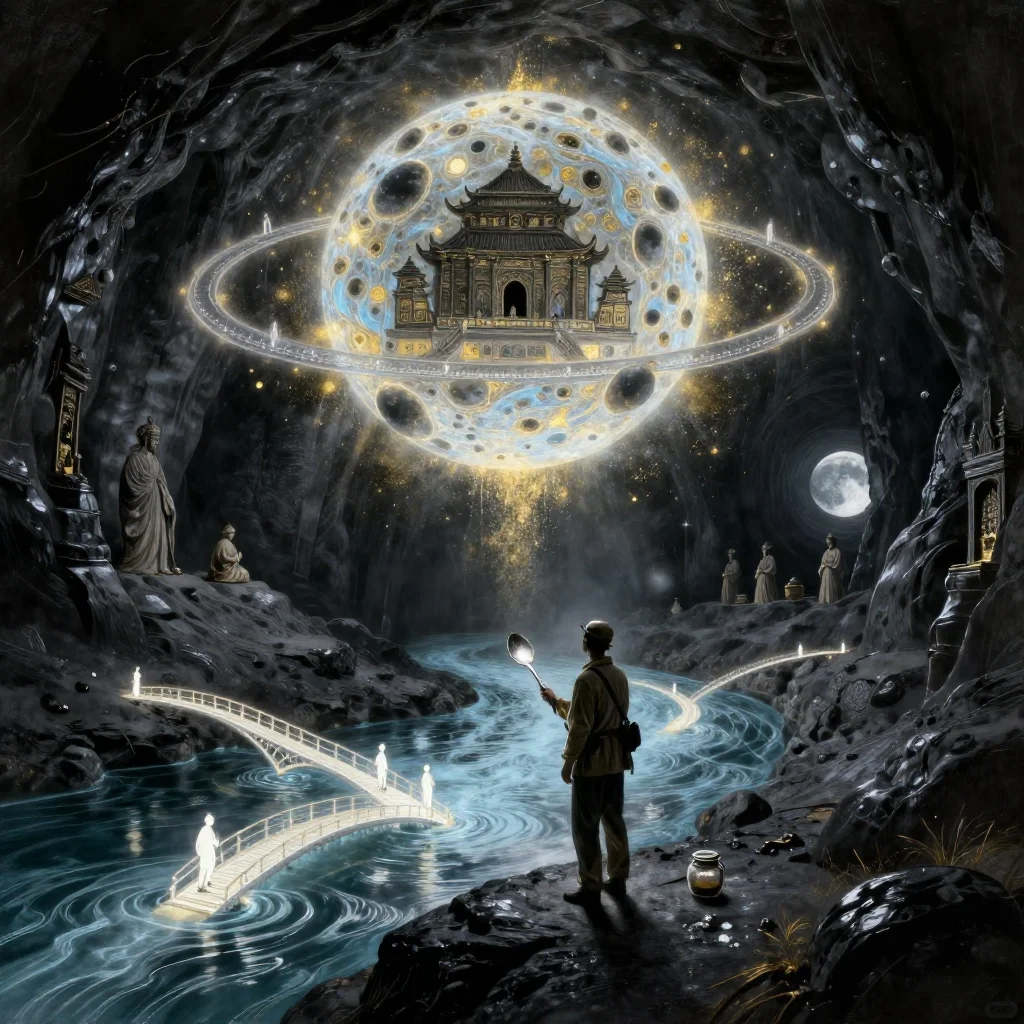
Mara kept her instruments in a black-lacquer chest bolted to the comet’s curved floor. The oldest was a silver spoon, its bowl polished until it reflected the monastery’s narrow windows. The newest was a salt jar, stoppered with wax and wrapped in thread.
She was a river surveyor, though the river beneath the monastery did not flow in any direction the stars could explain. It slid across the comet’s hidden interior, a black and silver sheet carrying the feelings of everyone who had ever touched its banks. Grief moved in blue eddies. Anger wore a copper rim. Joy made bright, brief ladders.
Each morning, Mara drew the surface on parchment. She marked where sorrow widened, where patience thinned, where shame coiled beneath the stones. The abbess called the charts private meditations. The monks called them useful records. Mara called them the only honest weather.
For years she had performed a ritual alone: at moonrise, she placed the silver spoon at the river’s edge, salted its handle, and waited for the water to tremble beneath her palm. The tremor revealed what the river had witnessed. A marriage. A betrayal. A child’s first lie.
That night, the spoon shook before she touched it.
The Bridges Beneath the Current
The river began to rise without rain. Its surface darkened, and beneath it appeared the shape of a bridge: two pale arches spanning a gorge that did not exist above ground. Gold dust gathered along its edges. Cold moonlight shone through the stone.
Then another bridge emerged beside it, then another. Some were ancient, their piers carved with names worn smooth. Some were delicate as spider silk. One burned silently, its timbers bright as sunset. Mara bent over the water and saw, under every span, a procession of figures carrying burdens across.
She knew the river carried records of every bridge ever built. Not merely the ones still standing, but the ones forgotten before the first stone was laid. The river remembered crossings: rescues, escapes, armies, lovers, children carried one by one from a burning village.
Mara copied the bridges onto a long parchment, but her hand stopped at the largest. Across it walked a woman in a black coat, carrying a salt jar. At the woman’s side marched a surveyor with a silver spoon.
They were crossing toward a crowd gathered on the far bank.
Mara recognized the surveyor’s stride. It was her own.
A Public Washing
The abbess found her at the river, sleeves soaked, the salt jar open beside her knee.
“You have been mapping the visions again,” the abbess said.
“They are not visions.” Mara pointed to the bridge. “They are invitations.”
The monks gathered. Some carried lamps; some carried tools; some brought bowls, boards, and lengths of rope. The river’s surface brightened as they approached. The figures on the bridges turned their faces toward them.
Mara understood then that the water was not preserving the past. It was asking the living to continue it.
She struck the silver spoon against the comet floor. The note rang like a bell beneath the monastery’s foundations. Then she poured salt into the river.
The surface became a mirror.
Every bridge in the ledger appeared at once, overlapping until the air was full of their crossings. The crowd stepped forward, each person choosing a span. The woman in the black coat crossed first. After her came the surveyor, no longer a reflection but a living stranger.
Mara lifted the salt jar. “A bridge is not finished when two banks are joined,” she said. “It is finished when those who cross change the world on the other side.”
The First Crossing
At dawn, the river had gone still. On the parchment lay one new bridge, drawn in gold dust. It began at the monastery and ended somewhere beyond the comet’s hidden walls.
Mara placed the silver spoon in her satchel and kept the salt jar beside it. Below, the monks began singing. Above, the stars shifted for the first time in centuries.
She stepped toward the unfinished crossing. The water widened beneath her feet, not asking where she had been, but where she intended to carry others.





