 Netwrck
Mythic Fiction.
The Note Beneath the Bell
On the last night of autumn, the river changed its mind.
Until midnight, the Sarrow ran east beneath the border town of Bellwether, carrying leaves and fishing boats toward the salt marshes. At the stroke of twelve, its current slid backward, water climbing the stone embankments as if the valley had suddenly exhaled. Boats strained against their ropes. The ferryman swore in three languages. On the bridge, already half built, the masons left their tools ringing in the cold.
They called it the turning. Once a year, the river made a border of what had been a meeting place, and the people on either bank became temporary citizens of nowhere.
Lio Venn was the town’s musician, though music had lately become a troublesome trade. He played the noon bell, the harvest dances, the funeral marches for drowned children. But since spring, a new sound had followed certain words. A clear, low note, like a tuning fork struck beneath the floor.
The note came when someone told the truth.
At first, Lio believed it was a gift. The mayor had confessed that the town granaries were half empty, and the note had sounded from inside the bell tower. A girl admitted she had broken the eastern marker, and the note emerged from the frozen canal. But the sound grew fainter with every repetition, as though truth were a coin spent twice.
On the morning after the turning, Lio found the ferryman waiting at the unfinished bridge.
“Build it high,” the ferryman said.
“The banks are stable.”
“The banks remember the old channel.”
“Then the river does too.”
The ferryman looked toward the black water. “A bridge is a promise made of stone.”
Inside Lio’s chest, the note sounded.
A Winter Without an End
The winter began the next day.
It began gently, with sleet whitening the roofs and ice stitching the puddles into webs. Then the thaw came, and the snow returned harder. The river froze, cracked, thawed, froze again. Every midnight it reversed. East became west, west became east, and the border between Bellwether and the neighboring town of Orison shifted with the current.
The mayor ordered the bridge completed before the old road disappeared. Lio joined the masons because he had decided to build something that could survive the storyteller.
He did not mean the men who carved songs from the town’s histories. He meant time itself. He meant the winter that had swallowed the last three harvests and the generations of children born beneath it.
He carved his name nowhere on the stones. Instead, he wrote each workman’s name inside the wooden molds before the concrete was poured. A name is a small bridge, he told himself. A name can carry a person farther than their body.
By the third month, the masons began telling lies to spare themselves. They said the cement was curing when it had frozen. They said the missing tools were buried when they had been pawned. They said they would leave by spring.
Their denials made no note. The true ones made a chime in Lio’s teeth.
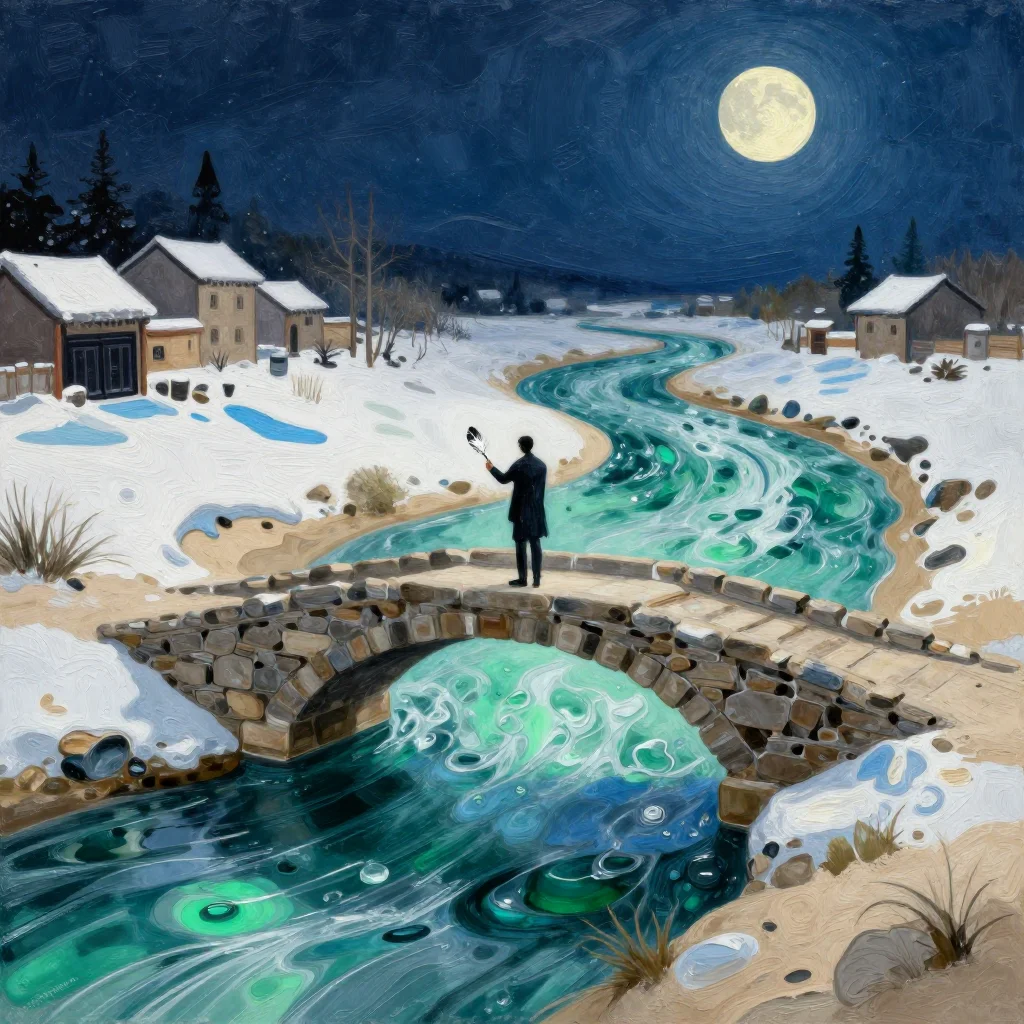
One night, a child named Sera crossed the half-built bridge alone. Her mother had died of fever, and the town council had refused to open the south shelter. She carried a white feather in one hand and a silver spoon in the other.
“My mother said the river would turn back for me,” she said.
Lio heard the note. It was the strongest truth he had ever heard.
“She said you would return,” Sera continued. “She said I should wait beside the pier.”
The river moved beneath the bridge.
Lio took the child’s hand. “Did she tell you that bridge?”
Sera looked at the unfinished span. “She told me stone could cross anything if it was given the right name.”
He remembered the feast of Saint Orra, when the old people said the river had once flowed in seven directions. He remembered a white feather trapped in the grille of the music hall, and a silver spoon buried at the bend where the Sarrow divided.
The next morning, he dug at the bend.
The Work of the Wrong Season
Under the frozen mud lay a stone plate engraved with the makers’ mark of Bellwether. The mark was not a bridge. It was a tuning fork.
Lio showed it to the masons. An old woman named Brann saw it and became afraid.
“That was the first bridge,” she said. “It crossed before there was a river.”
“Where is it now?”
“Where the winter keeps things.”
She refused to say more. At night, Lio placed the plate beneath the bridge and played his flute over it. The note born from truth rose from the stone, and the frozen river trembled.
Not a crack. Not a thaw.
A path.
It opened beneath the ice, wide enough for a sled and bright with cobalt shadow. At its far end stood a gate made of black water.
Lio entered with Sera, the white feather tucked into his coat and the silver spoon in his palm. The spoon had belonged to the ferryman’s wife, he suspected, though no one remembered her name. Along the drowned road, every winter they had endured stood frozen around them: harvesters hanging from ladders, shepherds kneeling beside dead flocks, children asleep beneath counters.
Sera pressed her palm against one frozen face. “Are they sleeping?”
“No.”
“Then why can’t they dream?”
Lio looked at the black gate. “Because the winter is waiting for a witness.”
At the gate was a woman with a musician’s hands and a river for a mouth. She asked him what he had built.
“A bridge,” he said.
“A bridge ends,” she replied. “That is its cruelty.”
The truth-note sounded.
“I have built something that can survive the storyteller,” Lio said.
“No,” said the woman. “You have built a bridge to survive yourself.”
He looked back at Sera, at the unfinished stones, at the winter gathered behind him.
“Then let it.”
The Name of the Crossing
He played the plate. The sound passed through the gate and into every frozen year. It broke the silence without breaking the ice.
Sera stepped forward. She placed the white feather at the gate’s center. The feather did not flutter. It stood upright, bright against the cobalt shadow.
Then Lio took the silver spoon and struck it against the black water.
The note he had carried for years became an answer. It rolled through the drowned town, past the old border, through the unfinished bridge. Every name hidden inside the molds began to sing.
The frozen figures opened their eyes.
They did not return to their own years. They became mortar. They became lamps. They became the warm stones beneath the feet of people not yet born.
The river released them.
At midnight, it tried to turn as always. The bridge held. Instead of carrying the current toward the marshes, it carried the current under the town, through the foundations, out toward the distant sea.
The winter broke.
Spring returned in a single afternoon. Snow lifted from roofs and fields. The white feather remained on the gate, and the silver spoon rested on the bridge where Lio had left them.
The mayor wanted a ceremony. The ferryman wanted a new lock. Sera wanted nothing except to sleep.
Lio carved no one’s name into the bridge. He carried his flute onto its center and played the note he had heard from the mayor, the ferryman, the child, and the winter itself.
Across the border, people stopped to listen.
The river ran beneath them in both directions at once, carrying the old songs toward the sea. And when the next storyteller came to Bellwether, she would find no ending written on the stones.
Only a bridge, still crossing.





