 Netwrck
Science Fiction.
The Ledger of Small Sounds
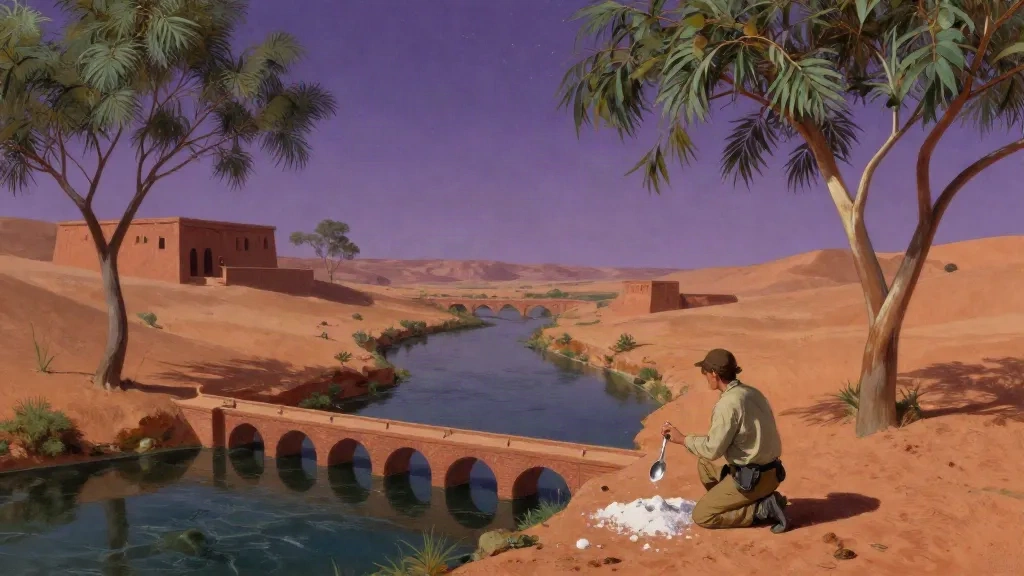
Inez kept the river beneath the observatory because it was the only thing there that moved without permission. It ran in a concrete channel six feet wide and forty feet down, cut in 1904 to bring irrigation water off the shoulder of the mountain, and it moved all night under the terracotta walls without asking the dome for a permit or the road for a favour. In summer it carried a skin of eucalyptus leaves and the tannin brown of a sky bruised over distant ranges. In winter it carried the stars badly, broken by the surface tension and the scum.
Her instruments were a silver dessert spoon, a jar of coarse salt from the flats east of the valley, and a strip of red cloth. The spoon had been a levelling tool in her mother’s hand: a small flat bowl, a short stem, tarnished silver the colour of a fish’s belly. Inez used it as a mirror. Salma had used it to sight along.
At dawn she knelt at the channel’s edge and threw nine grains. Not seven. Nine, one at a time, spaced so the current could swallow each with a separate small sound. She listened. She wrote what the water felt in a narrow leather notebook: hesitation, relief, the urge to return. The ritual had belonged to her mother, who had believed moving water could not lie. It could only postpone.
Above her, forty feet up, her daughter Vera kept the signal desk of the observatory and its row of small red lamps. The sky had been sending messages for seven hundred twenty-one nights. Somebody had to answer them, and Inez had answered none, and this was the entire argument of their lives.
“You’re doing the nine-grain thing.”
“I’m doing the seven-grain thing. You miscounted.”
“I counted your knuckles, not your fingers.” Vera did not look up from the plate. “You’ve been miscounting since you were seventeen.”
“I miscounted your father out of this valley, and it turned out accurate.”
“Tomas spent eleven years in the county archives.” Vera turned a page of the night’s record. “He can find every road in this valley except the one that isn’t on any of them. Ask him about it sometime.”
Inez threw the last grain. The current took it the way it took everything, without comment.
She had noticed in March that the grains did not land evenly. Every eleventh second, one of them struck the water alone, out of rhythm with the others, as though something on the other side were counting and had its own idea of when to interrupt. She had written it in the margin. She had written weather in the margin, and then, being honest, weather, probably.
The Eleventh Second
On the seventh night of the dry season the array lost the sky.
Vera came down the outside stair in her boots, which she never did, and stood on the terrace above the channel with one hand flat on the parapet, as though the building were breathing badly.
“The field has a null point,” she said. “It isn’t moving. It stays exactly where it is, and it is under us.”
“Under us is forty feet of water and a road.”
“It’s under the water.” Vera had the flat voice she kept for numbers. “Instruments don’t care about roads.”
Inez looked up. The lamps along the dome’s open slit burned their usual red, marking the sky where it did its work. Over the valley there was nothing. No new scratch of light, no question pressing down, nothing arriving.
Below, the river changed direction without changing course.
It rose. Not much — a foot, two — but it rose against a stone lip that had held it for eighty years, and it went over, and the level in the channel climbed toward the terrace in a slow green-black wall. And as it climbed, the things the water had been dragging along its bottom came up with it and stood there in the open air.
Bridge stones. Drowned beams, swollen to twice their cut size, black with nine decades. A length of iron chain uncoiled by the current into a shape no one had made. And beneath all of it, the pale scores of masons’ hands.
Inez put the spoon into the water.
It should have shown her face. It showed a white sky, and under the white sky a wooden footbridge with its stringers peeled open like a rib cage, burning from the piers down. Someone on the far bank was calling her name across ninety years of silt, and the name was her mother’s, in a man’s voice, and the man was in none of it.
She lifted the spoon. The image stayed on the water. It stayed the way a burn stays on skin after the heat is gone.
Then the silver began to change. The tarnish lifted along the stem in a fine ridge and let a stamped line show through, too small to read until she held it up under the lamps. Not letters. A number, and under the number a date.
BENCH 118.6. 11 MAY 1911.
“You are a datum,” Inez said. Her voice went out flat and strange across the water. “You set yourselves where everything else gets measured from.”
The spoon trembled. The water did not.
What the County Buried
Eleven May 1911 was a Friday. The sluice at the upper bend failed in the afternoon, and the flood it made ran the length of the valley in under two hours, and the footbridge built in 1904 — forty-one feet, three spans, iron shoes, hand-cut stringers — took nine men off the survey crew working the new terrace line above it.
The county’s report, forty pages, gave the cause as seasonal and the fault as bridge failure. The county’s second act cost nothing and appears in no file, and it was the removal of the footbridge from the map.
Because a bridge on a map is a structure. A bridge on a map is also a water right, a maintenance line, and a place where the county can be asked what it did in 1911.
Haouari came at four in the morning, because the road bridge above the channel was his work, and because Inez had sent a boy up the hill with a number and no explanation. He was seventy-eight. He had laid stone for forty years and he did not take his gloves off when she showed him the spoon.
“Karim,” he said. “My grandfather. He was a chainman. He was twenty-six.”
“I want the footbridge on the map.”
He turned the spoon over and studied the stamp for a long time.
“Put him back on your map and you put a number next to him,” he said. “Then somebody comes with a number. They come every eleven years, they bring a new sheet, and they ask you why your bridge failed.”
“They’d ask why the sluice failed.”
“They’d ask who turned the wheel.” Haouari set the spoon down on the parapet very precisely, the way a man sets down something that has become sharp. “You think a river forgets which hand did it?”
She had thought it. She had assumed, in the way her mother’s generation assumed, that the county was guilty of paper rather than of water.
At the top of the stairs he stopped.
“The deck boards are gone,” he said. “The county took the deck boards. Somebody needed them.”
That night Inez found her mother’s first notebook in the archive box under the desk, where it had been sitting for eleven years. The first page had water damage along the fold. The handwriting was Salma’s, small and level, and beneath the count it said:
Nine, not seven. Nine, and do not answer. They are not asking yet.
Inez sat on the floor of the signal room with the page on her knee and the lamps burning their patient red above her, and she understood that her mother had known, and had decided, and had never once said so.
The Salt Line
The next day the dry season did what it does: it got worse. Inez went down at noon with the jar, the cloth, and the spoon, and did the arithmetic she had been avoiding for three weeks.
The sky had sent a message every night for seven hundred twenty-one nights. The channel had answered every morning. Nobody had asked for the ritual. It had been in Salma’s hands, and Salma’s mother’s hands, and a county clerk’s hands before that, and the water had kept it, and somewhere under forty feet of water the message was still going out.
Her mother said do not answer. They are not asking yet. But the stamp on the spoon was not a question. It was a bench mark: a fixed point, a claim, the last thing nine men did together before the river came. And a datum, she knew, is a thing you only know by standing on it. Salma had measured from the dead for forty years without ever saying it out loud. Inez had measured from the dead since she was six years old.
So she would do the one thing her mother had never done. She would be witnessed.
At sunset she rolled the dome’s shutter back and hung the silver spoon from the open roof on a length of signal wire, where the whole valley could see the light come off it.
Then she walked down to the channel and emptied the jar.
The current took the salt and spread it, and the wind came off the mountain and dried it into a bright white line running east, and the line went out across the desert toward the road like something set down in the middle of a sentence.
It worked faster than she had allowed herself to hope. Travellers lifted their faces. A truck slowed for eleven seconds and its driver got out onto the shoulder. Children came up the observatory wall hand over hand. Somebody at the filling station shouted something about weather. In the channel the water climbed another two inches, warm and steady, and Inez felt the exact moment it stopped being private: a sensation like a door in her own chest coming off its latch.
She raised her voice on the terrace and said the number out loud, the way she would say a station, the way she had said elevation in the field for twenty-two years.
“One hundred eighteen point six.”
Her own voice came back off the water eleven seconds later, and it was older.
Across the channel a bridge stood up. It had no stone in it, no timber, no iron, no deck. Every span, cable, and pier of it was made of reflections: the faces of the people on both banks, held in the water, arranged into the shape of a thing that carried weight. Haouari’s apprentice, who was twenty-three, said her grandfather’s name without being asked, did not know where it had come from, and kept it.
Seven Hundred Twenty-One Voices
When Inez touched the spoon, the sky answered. The message came apart into seven hundred twenty-one points of light and came down, and every one of them landed on a different stretch of water, and the river began to speak in borrowed voices.
A child said, I miss the house by the fig.
A man said, I held the chain and the man behind me held the rail and neither of us let go.
A woman Inez had seen in a photograph on the archive wall said, They told us the water was low. We went down at four. We went down at four in the afternoon.
Tomas said, There is a map in the vault with a bridge on it that is on no other map, and I have looked for it for eleven years, and I know the weight of that drawer every time I open it.
His notebook was on the table. She had set it there and had not remembered doing it.
She wrote them all down. She chose none. That had always been the discipline of the ritual: no deciding which grain to throw last.
But Vera was shouting from the dome, and when Inez looked up, her daughter was pointing at the desk and not at the sky.
“The source isn’t up there,” Vera said. “It never was. The null is at the bed of the channel. The array has been decoding a signal that arrives through ninety feet of water, and it has been calling it sky because that is what we pointed the instrument at.”
“Then the stars are relays.”
“The stars are post office.” Vera’s hands were shaking on the plate. “Mother, for seven hundred twenty-one nights something has been knocking on the only door you open every morning. And you kept saying: not answering. Not answering.”
Inez looked down at the spoon in her hand, at the black water, at a hundred people on the terrace and the road below, all of them holding still in the dusk.
“No,” she said. “I answered. They could hear it. That was the answer.”
She had broadcast nothing. She had answered a letter addressed to one woman, and the whole valley had leaned over her shoulder to read it.
The Silence After
It began on the ninth night, and nobody in the valley ever agreed on the date.
The channel dropped a foot. It did not come back up. The surface that had held the stars went matte — tannin and fine sediment, the brown of tea, the reflection of nothing — and the spoon’s bowl, held to the dome slit, showed a dome slit and an empty sky and nothing else at all. The eucalyptus leaves stopped floating. They lay along the concrete at the water’s edge, dry, in a long black collar, the way a crowd looks after a speech has ended.
The erasure had begun in the county’s favour and finished in the valley’s.
Haouari could no longer remember Karim’s face. He knew there had been a face. He had the number, the date, the age, the chainman, the forty-one feet and three spans; he could get all of it out of the spoon if a man handed him the spoon. The face, the laugh, the way the man carried his hat in his hand all day because it was chain duty and he would not set it on the ground — gone. He sat on the parapet and said, reasonably, that it made no difference, and then threw the spoon across the channel and lost it in forty feet of water.
At the school above the filling station, twenty-nine children could name the road bridge, the culvert, both culverts, the aqueduct stub. Nobody could name a footbridge. A woman who had lived in the valley fifty years said the word bridge three times in an hour and meant the road one every time, and each time she said it she got a small startled look, as though the word had been emptied and refilled with something else.
On the desk, the red lamps began to blink without a source. No field, no plate, no null, no sky. Just a patient regular blink out of the instrument housing, at an interval Vera counted for an hour and would not say aloud when she finished counting it.
And Inez could not find her mother’s page.
It was still there. The fold still held its water damage. The paper still carried the raised ink where nine grains had been counted and ruled against. But the words beneath the count were gone from the page the way chalk goes off a slate, leaving the panel clean and the ghost of a hand — and the only sentence in the notebook that would survive a witness was one in Inez’s own hand, in a surveyor’s level: 118.6.
That was the bill. Not cruelty. Withdrawal. Testimony, once it is witnessed, becomes evidence; evidence closes a case; and a closed case is a place where nothing further is owed to anybody. The nine had spent ninety years in the dark, where the only witness was the water, and the water had never once asked them for a name. Inez had asked them for nine hundred names, in front of a valley, and the valley had written them down, and a name in a hand other than your own stops being yours to keep.
Tomas came home on the twelfth night and sat in the doorway with his boots on and did not say where he had been. She did not ask him. She noticed that she had decided not to ask, and she noticed what deciding had cost, and both of those things turned out to be the same size.
The Second Ritual
On the nineteenth day Inez went down to the channel with a length of iron pipe, a sledge, and a brass hammer, and she drove the pipe into the bank by hand, because the county has a form for that and the form would take four months and a number.
She cut the top level with a mason’s chalk line she had bought in town and did not return. She stamped the face of it with the number from the handle of a silver spoon lying at the bottom of forty feet of water.
118.6.
Then she said, out loud, standing alone on the bank: Karim Haouari, chainman, twenty-six, May eleven, 1911. Nine in the water. The footbridge was forty-one feet and it stood between the upper bend and the terrace. It was on the map on the eleventh of May and it was taken off it in an office. It was here.
That was the whole of it. One witness, one statement, one fact, offered the way a bench mark is offered — to whoever comes after, who may check it, who may refuse it, who may not add a name to it without standing where she stood. She had spent nineteen days learning the difference between testimony and gossip, which is that gossip asks to be believed and testimony asks to be checked.
The water came up two inches and stopped.
In the morning the channel was where it had always been, six feet wide and forty feet down. The surface held the sky again, badly, broken by the scum. A grain of salt struck once.
Inez knelt and opened the notebook to a clean page, and she wrote the word she had written every morning for thirty-eight years — hesitation — and then she took the pen out of the water and did not close the book, and left it open on the parapet where the wind could get at it, and the wind did not turn it, because there was one entry and one witness and no name on it that was not hers.
Above her, forty feet up, Vera’s desk held a single point of light, low down, under the floor, under the water. It was not repeating. It was answering, irregularly, unhurried, at whatever second it chose, the way a thing answers when it has stopped being addressed to a crowd and has gone back to being addressed to a person.





