 Netwrck
Historical Fantasy.
The Book of Unfinished Addresses
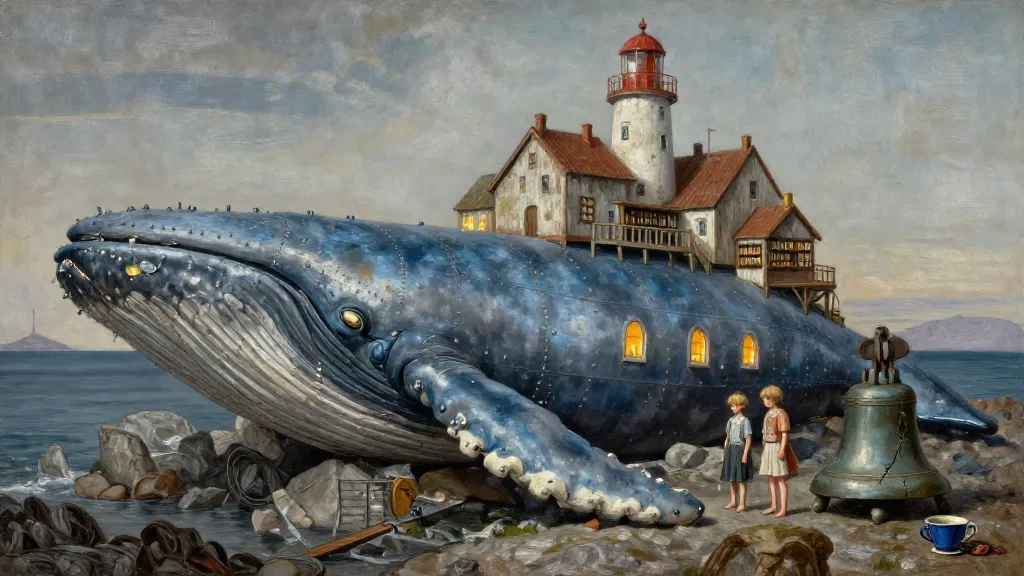
Rain silvered the windows of Stillwater Light as Mara copied the latest entry in her ledger: Mr. Alder, escaped clock. The poor man stood dripping in the entrance hall, blue springs turning behind his ears. He had come from the furnace works, where the overseers declared that stolen machinery had no right to live. Mara gave him tea in the empty teacup kept beside the catalogue. Its blue china bore no chip, no stain, and no mark, yet it never filled. A cup made for absence, her mother had said. It waited for someone to return what it had lost.
On the sill above him hung the cracked bell.
Mara opened the only unlocked drawer. Inside lay a thin volume bound in tobacco-brown leather, its title stamped in fading gold: The Book of Unfinished Addresses. Every borrower opened to a different page and saw not a map but a house. Mr. Alder had seen a narrow workshop with stars arranged in its skylight. When he touched the address, the clockwork man wept silver and was allowed inside.
“You keep lending the same impossible book,” he said.
“It is the only catalogue we own.”
Below them, the lighthouse trembled. Stillwater rested upon a great mechanical whale stranded centuries before Mara was born. Iron plates overlapped beneath the old copper foundations. Brass ribs curved under the village streets. In summer, villagers opened shutters and pretended they lived on ordinary rock. The whale breathed through submerged bellows. Once each year, its immense eyelid lifted, revealing candlelit rooms where drowned people ate at long tables.
No one spoke of the rooms. Everyone had agreed to overlook them.
The Child in the Brass Wall
The child arrived on a copper-flecked morning, barefoot and wrapped in a sailor’s coat two sizes too large. She placed the empty teacup on the catalogue, then pointed toward the western wall.
“There’s a boy inside the wall,” she said. “He’s ringing the bell with his teeth.”
Mara crossed the reading room. The brass plating showed no door, only rivets and tobacco-brown stains. But a small shadow moved behind them, conducting an orchestra of sleepy whales.
That night the cracked bell sounded without wind.
One stroke. A pause. Six more. The sound passed through the lighthouse, and rooms rose along the whale’s hidden streets. Candlelight appeared behind blank windows. Mara ran downstairs as townspeople climbed from beds, still calling the old silence.
“There is no one beneath us,” declared Harbourmaster Pell, fastening his coat over his nightshirt.
“Then why are you locking your doors?”
He stopped.
At the eastern stair, the child led them to a panel marked only with a survey number. Behind it waited the bell keeper’s room: a dead boy preserved in amber, the bell rope wound through his ribs. Yet at the rope’s end stood a transparent woman, bright as candle flame reflected from steel.
She had been forgotten by everyone except a child who saw what their fear had made invisible.
What the Whale Carried
“The bell cracked when the whale remembered itself,” the woman said. Her voice moved like a page turning. “That is why the settlement was built upon its back. A sleeping thing bears a city quietly. A waking thing casts it off.”
Mara understood then why her book always returned empty. Addresses were not found; they were given. No house welcomed an impossible resident until someone else spoke its name without flinching.
She placed the empty teacup in the dead boy’s hands. Candlelight gathered inside it, though the cup remained empty. The bell-keeper drew one final breath. His fingers closed around the cup, and the bell healed with a clear, low note.
Far below, the whale stirred.
Villagers rushed to the galleries. Steel-blue waves heaved the lighthouse, but the hidden streets held firm. Pell cut the ferry lines to ordinary shore. Mr. Alder opened his workshop to clocks that had fled their owners. The transparent woman descended among them, remembering the drowned by name until each stepped from her procession.
Mara carried the impossible book onto the lantern gallery. Its pages had filled at last with addresses in a hundred hands. Tomorrow she would lend it again. Perhaps that morning someone would arrive seeking a house for a forgotten daughter, a mechanical saint, a storm with no body, or a whale dreaming beneath the sea.
A Door Left Open
At dawn, the child asked whether the bell would crack again.
Mara gave her the key to the catalogue room.
“Only if someone is left outside,” she said.
The empty teacup remained on the sill, catching reflected candlelight without holding any. Beyond it, the whale dreamed, and the village above its back learned at last to speak softly.
Not for silence. For sleep.





