 Netwrck
Historical Fantasy.
The Book of Unfinished Rooms
By 1873, Morrow House had acquired a reputation as carefully as a coat of unpaid bills. Its tenants could remember tomorrow, next winter, the hour of their own deaths, but never yesterday. They entered with apologies on their tongues and left with their umbrellas pointing toward rain that had not yet fallen.
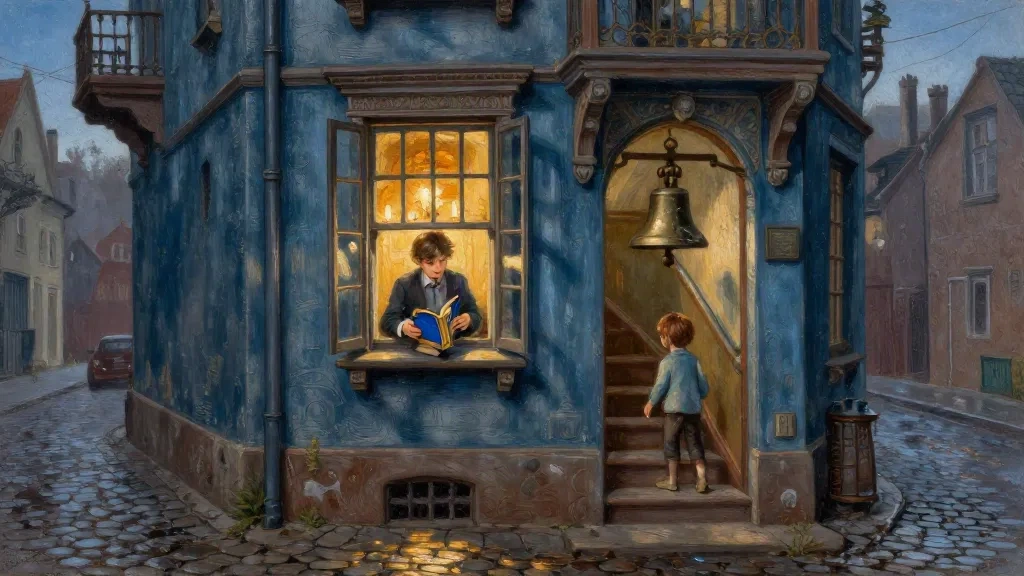
Elian Voss kept the lending room on the ground floor. He was the librarian, though none of the residents called him that. They called him the man with the useful book.
The book had no title. Its blue cloth cover had worn through at the corners, exposing boards the colour of old steel. Its pages were blank until someone described a room they had lost. Then a single line appeared, in brown ink that smelled faintly of tobacco.
Elian lent it to a railway clerk who needed to remember a bridge failing. He lent it to a widow who wanted to know which of her sons would return. He lent it to a boy who had seen his own apartment empty three weeks hence and needed proof that someone would come home.
Always, the borrower returned the book with one page filled. The room described was never the room they had asked about.
Elian wanted a home that accepted impossible residents. Not merely the respectable sort of impossible—fortune-tellers and duelists and men who turned into ravens at dusk—but residents whose memories obeyed the wrong tense. He had written to lodging houses, monasteries, sanatoriums, and a theatrical company that specialised in ghosts. Every answer ended at the same phrase: the burden of certainty is unsuitable for shared rooms.
His own room above the lending library contained a narrow bed, a brass lamp, and an empty teacup he had brought from his mother's house. The cup had never held tea. It waited for a future guest.
The Child in the Stairwell
On the first cold morning of November, a girl named Seraphina climbed the back stairs with the book tucked beneath her arm. She was seven, or would be seven tomorrow, though she insisted she had always been seven.
“I need to borrow it,” she said.
Elian pointed to the ledger. Every borrower had entered a name, a room number, and a date. Seraphina wrote: Room 6, the wall, today.
When Elian asked what she had seen, she said, “The thing everybody agreed to overlook.”
He thought she meant the water stain spreading across the ceiling. He thought she meant Mrs. Vale's vanished husband, or the boarded windows on the fourth floor, or the reason no tenant ever used the elevator after midnight.
Seraphina led him upstairs. The cracked bell hung in the stairwell, suspended from a nail driven through the wall. It had not rung in eleven years. At the landing outside Room 6, she pointed to the wallpaper.
Behind it, a window showed the building as it would look after abandonment. Every door stood open. Every room was full of people who had not yet arrived.
“They agreed not to remember that part,” Seraphina said.
Elian heard the bell fracture under its own ringing. A sound like a spoon dropped in a coal scuttle. Cracks ran through the bronze, and from each crack came a whispered future.
A Census of the Unborn
That evening, the residents gathered in the lending room. Mrs. Vale brought her husband's watch. The railway clerk brought a timetable dated 1891. Others brought umbrellas, keys, medicine bottles, letters sealed with wax.
Elian read the book aloud. Each line described a room that would be occupied before its tenant arrived. The walls were thin as paper. The windows looked onto streets where the dead still walked to work.
“This is impossible,” said the clerk.
“So is your bridge,” Elian replied.
Seraphina climbed onto the table and placed her hand over the final page. The ink moved beneath her palm, forming a sentence none of them had asked for.
Home is the place that does not require you to become ordinary.
The cracked bell rang once. Every tenant remembered a different version of the moment, and in the confusion the book fell open to a page showing Morrow House before its walls had been built.
Elian saw a street of vacant lots. He saw himself standing there with an empty teacup in each hand, waiting for someone who had not yet decided to arrive.
The Address of Return
At dawn, he carried the book to the building's foundation stone. Seraphina came barefoot down the stairs, carrying the cracked bell by its clapper.
“Will it work?” she asked.
“I don't know.”
That was the honest answer. He had spent years lending hope to strangers and asking only to be allowed a corner of his own.
He opened the book. On the last page, beneath Seraphina's sentence, an address appeared.
It was not a street address. It was a room, a name, and a future tenant.
Elian wrote his own name beside it. Then he wrote Seraphina's.
The bell split into a hundred pieces, yet each piece rang clearly. The walls of Morrow House opened like folded paper. Beyond them stood rooms full of light, untouched furniture, and doors waiting to be discovered from the other side.
Seraphina looked up at him. “Now they can come home.”
Elian placed the empty teacup on the sill. In the reflected candlelight, steam rose from it for the first time.
He did not know which future had filled it. That, at last, felt like home.





