 Netwrck
Folk Horror.
The Book Below the Market
Mara kept the market library beneath the city’s first floor, where every stair ended exactly one step above the flooded understreet. Each night, after the shutters came down, the lamps came up: blue, amber, then a pale mineral white. Stalls unfolded below the girders. Fish slept in their scales. Knives rang softly in distant kitchens.
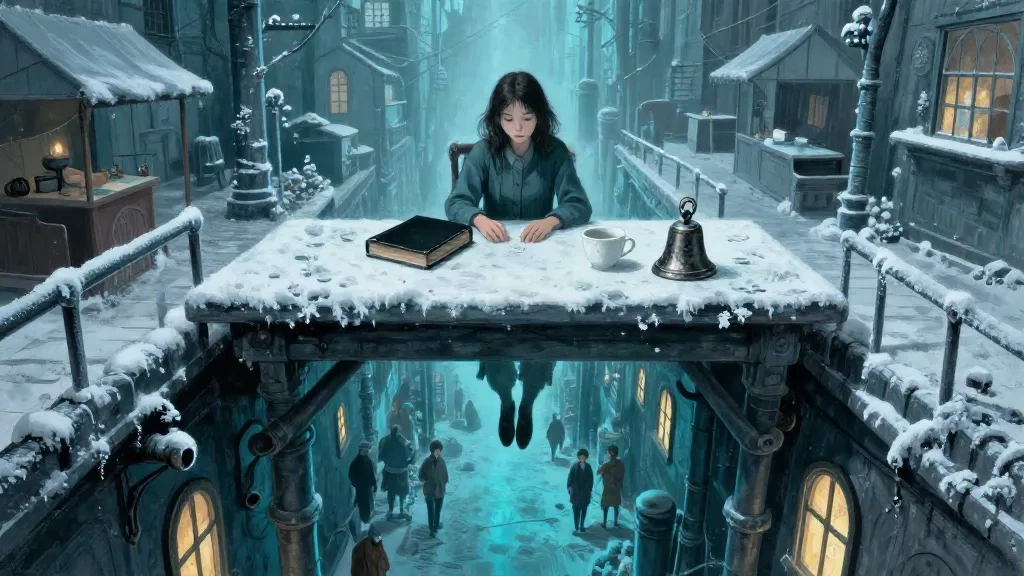
No street existed beneath the first floor, officially. Unofficially, a stair descended between a seamster’s shop and a stall selling batteries shaped like small bones. Its final landing had no door, only a reading desk scarred with rings from an empty teacup.
Mara had inherited the desk, the stair, and one black-bound book from a librarian who never returned. She knew nothing about the book except that it made a place when read aloud. Every borrow opened it to the same page, where two figures lived beneath a town’s foundations.
When a coal carrier asked for temporary shelter, Mara lent him the book. The figures beneath it rose and left their painted house.
When a woman carrying wet flowers asked for a dry night, Mara lent it again. The figures made room for her.
By winter, Mara had given the book to tailors, children, washerwomen, an old man who claimed he had been walking since before there were roads. Each borrower saw a different impossible home inside it. Each borrower found one.
Mara wanted the same. She had spent years sorting the city’s homeless, her own lodgings, and the small rooms behind the market stalls. A home, she thought, should be measured by what it tolerated, not by what it was permitted to contain.
The Child Nobody Agreed to See
On the last market night, a barefoot girl followed Mara through the hidden stair. She carried an empty teacup in one hand and a cracked bell in the other.
“They’re under the pipes,” she said. “You can hear them ringing.”
Mara heard nothing. She pointed to the reading desk, where the black book waited. “Borrow it,” she said. “Find out what they need.”
The girl opened the book. Frost spread across its black cover, so fine it looked like iron filings. The market lamps went soft cyan. Somewhere behind the walls, a lock turned.
“They live in the old street,” the girl said. “The one nobody says was ever there.”
Then she looked at Mara and added, “The bell is cracked because the tower opened.”
That was when the pipes began to speak. Not in voices. In footsteps.
Mara saw the first one: a narrow stairway opening in the wall beside her own bedroom, its steps descending into blue mist. Beneath it stood a cramped house with windows full of wet faces. A coat hung from its door. The coat belonged to the man Mara had sheltered last winter.
Everyone else saw only wall.
The Street the City Had Buried
They took the girl’s cracked bell and rang it. A flat, iron note passed through the market.
Every window in the hidden city shut.
“They don’t want a house,” Mara said. “They want to come home.”
The girl shook her head. “There is no home for them there.”
“Then why did the book make one?”
“Because you asked.”
Mara understood. The impossible residents had not been summoned by the book. They had been asking, through its borrowed rooms, for someone to answer. For years the city had answered by forgetting them.
She placed the black book on the final stair. The frozen cover opened by itself. On its page, the painted figures stood at a gate. Beyond the gate waited a black archway wide enough for every forgotten household.
Mara did not read the house into being. She wrote instead a notice, using the nail scratch she carried for loose market signs:
Rooms available below the first floor. Heat, water, and shelter for all residents. No street above the ground is required.
She pinned the notice to the final step.
The First Dawn
The girl placed the cracked bell beside it. The empty teacup went on the notice, handle turned toward the hidden gate.
At first, nothing happened. Then the house beneath Mara’s bedroom opened.
Doors appeared in walls that had always seemed solid. Shuttered windows leaned into alleys where no alley existed. A child in an ancient coat crossed the invisible street, carrying a key too large for any ordinary lock. Behind him came the coal carrier, the washerwoman, and others whose names the city had polished away.
They did not enter the library. They entered the street below.
By dawn, the hidden stair had become a road. Bell towers stood along it, each one carrying the same cracked bell. The empty teacup on the notice held clear water. No one remembered placing it there.
Mara descended until the steps passed below the market, past the first floor, past every place the city had agreed to end. The residents waited beneath a sky without buildings. Above them, frost glittered on iron pipes, and the first light of an impossible dawn turned the air soft cyan.
She set the black book on the road’s center.
“Welcome home,” she said.
The girl smiled and rang the bell. Beneath the city, the lost street answered.





