 Netwrck
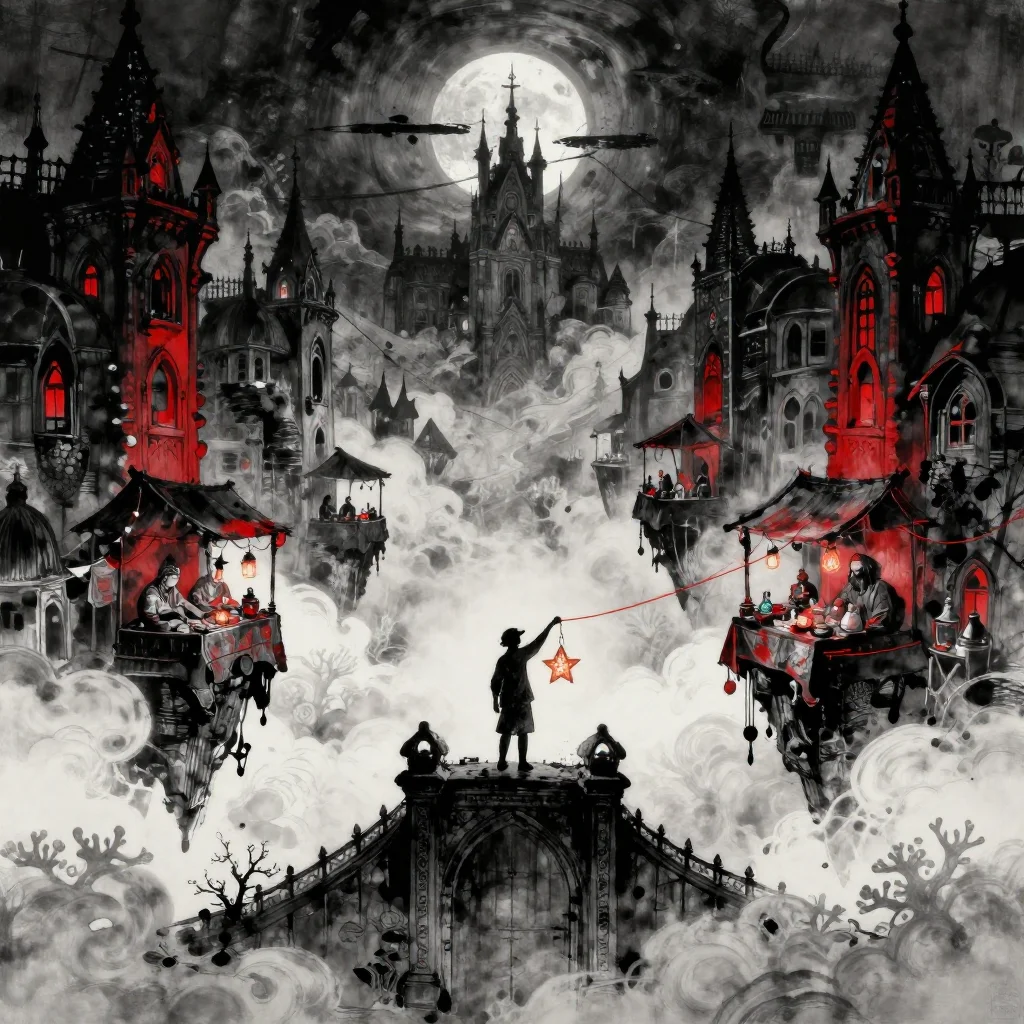
Gothic Fantasy.
The Market Below the Cloud
Mara Venn kept her lantern beneath the oldest pier of the floating market, where the boards sagged over an abyss of white mist. Each night she climbed the hanging walkways with a wick of black salt and a jar of whale tallow, illuminating the paths people avoided. Not the broad avenues crowded with borrowed memories, but the narrow gaps between stalls, the stairs that ended in rain, and the little bridges whose planks vanished when no one admitted needing them.
Her lantern had a copper star fixed inside its glass frame. Mara had found it years ago in the mouth of a drowned cathedral. Beside it, where the flame should have been, she carried a glass bird with a red thread tied around its neck.
The market floated above the kingdom of Vesper, and at its northern edge stood the border gate. Beyond it lay the provinces where memories were not traded, but surrendered. People crossed with clean hands and empty heads, permitted to forget every road that had led them away.
Mara wanted to cross. She had promised her brother she would leave before the autumn storms pulled the market down. But the gate would not accept a lantern. It would not accept a memory of a red house, a mother singing in a winter kitchen, or the last time she had seen her brother alive.
The Bell Under the Water
On the seventh evening, the bell rang.
It came from beneath the market, muffled by planks and clouds, yet loud enough to tremble through the stalls. Silver masks fell from merchant tables. Glass charms cracked. A child clutching a stolen childhood hid behind a basket of wet flowers.
The bell rang only for decisions no one admitted making.
No one had admitted deciding to abandon the floating market. No one had admitted selling a husband’s memory, a daughter’s laughter, or the sound of a name spoken before sunrise. Yet with every strike, another stall vanished into the white air.
Mara followed the sound down a stair that should not have existed. The copper star trembled in her lantern. The glass bird’s red thread tightened around its neck.
At the bottom, she found a drowned customs house suspended in the mist. Its clerk wore a mask of polished ink. Beside him floated the border register, its pages turning without wind.
“One memory,” the clerk said. “That is the toll.”
“I will surrender the memory of the crossing,” Mara said.
The clerk tilted his head. “You have none.”
The bell struck again. Above them, the market groaned as another platform tore free. A red thread appeared across the clerk’s mask, stretching through the wall, across the market, and into the glass bird.
The Decision Under Every Path
Mara understood then that the border did not want a memory. It wanted a confession. The market had been built over the space between what people chose and what they refused to name. The bell named the gap.
She opened the lantern. The copper star cast a small, sharp light across the customs house. In that light, the lost memories appeared: a soldier surrendering the memory of fear, a bride surrendering the first winter of marriage, an old woman surrendering the face of the man who left.
Each had believed the choice belonged to the border. None had spoken it aloud.
“I decide to cross without surrendering what I carry,” Mara said.
The ink mask peeled from the clerk’s face. Beneath it was no face, only a doorway opening into darkness.
“Then carry your confession across,” he said. “The border cannot take what you have already claimed.”
Mara tied the red thread from the glass bird around the lantern’s handle. The thread pulled taut, drawing a fine line through the clouds. The market’s walkways illuminated one after another, every avoided path becoming visible at last.
The Gate That Remembered Her
At dawn, Mara reached Vesper Gate. The border guards saw only a woman with a lantern, a copper star, and a small glass bird. They saw no memory worth taking.
The clerk called after her. “You have surrendered nothing.”
“No,” Mara said. “I have stopped letting the border decide for me.”
The gate opened. She crossed carrying the weight of every road she had lit, and behind her the bell rang for the final time. Its sound traveled through the market, waking the lost memories in their stalls. One by one, their owners began to return.
Years later, travelers said the northern gate no longer accepted forgotten things. They said a lantern burned beside it, and a red thread crossed every wall. Those who followed it found the paths they had feared, and discovered that courage was not the absence of darkness.
It was the decision to carry a light into it.





