 Netwrck
Magical Realism.
The Whale at Anchor
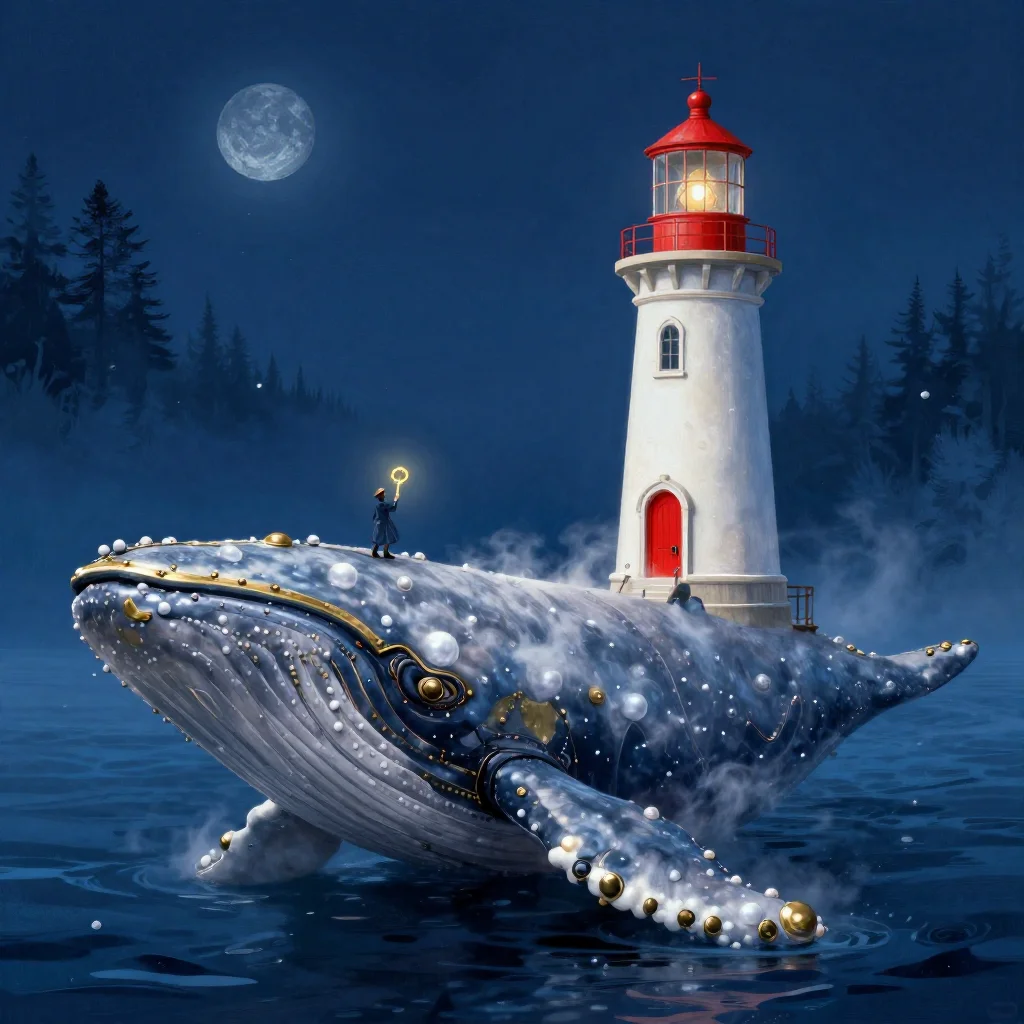
Mara had been appointed ranger of the evacuated forest for eleven years, though no forest remained. The trees had been lifted out of time and stored beneath a lighthouse, fixed on the back of a mechanical whale sleeping in the pearl-dark sea. Its brass ribs rose and fell with the tide. At night, its eyes opened a slit of midnight blue, and somewhere beneath the deck the roots of the missing forest dreamed of rain.
Her predecessor, Elian, had begun a journey around the whale before he disappeared. He carried a brass key in his coat and a map marked with places that no longer existed. His last entry read: At the third sleeping tower, ask the moon who keeps the hour. Then the page ended.
Mara had the key. She did not have the map. She wanted to finish what he had started, though the official records said his journey had never been permitted. Before leaving the lantern room, she tucked the small moon from her window into her boot. It was no larger than a pea and shone with a patient, borrowed light.
The Curfew of Tides
At midnight, the whale stopped breathing.
A creature came over the railing: a pale gull with a human-shaped shadow, a tide gauge for a beak, and six little feet that clicked upon the brass deck. It was not hostile. Its eyes held the calm of an instrument reading correctly.
“Curfew,” it said. “No traveler may cross a sleeping boundary without permission.”
“Elian crossed,” Mara said.
“Elian carried permission.”
The gull clicked its feet. “You carry a key and a moon. Those are not permission. They are evidence.”
It named the terms precisely. She could not pass beyond the second tower until moonrise. She could not speak to the tide-keepers. She could not use the brass key to open anything before the curfew ended.
Mara asked why such a law existed.
“Because the forest was evacuated from time,” the gull said. “Things left behind still believe the journey is happening. If one boundary is crossed incorrectly, they may return to a house that no longer exists.”
Then it flew to the whale’s eye and became a white seam in the metal.
The Third Sleeping Tower
Mara reached the first tower by following the small moon’s glow through the whale’s ribs. The second stood in a chamber where the sea pressed against both sides, as if the whale had swallowed a horizon. Each tower held a door marked with a year: 1891, 2034, and a blank.
The brass key warmed in her hand.
At the third tower, a woman sat on the steps polishing a silver bell. She had Elian’s scarf, though her face was young enough to be made from moonlight.
“He asked who keeps the hour,” she said. “I am the hour.”
“Where is he?”
“Where the journey ends.”
She pointed the bell toward the blank door. “He passed through before the evacuation. The forest called him home while he was still walking. He became part of the place that no longer exists.”
Mara’s hand closed around the key. The moon in her boot dimmed.
“Then I cannot finish his journey.”
“You can carry it.”
The Door That Remembered
Curfew ended without sunrise. The gull returned, watching the tide gauge in its shadow.
“Permission now?” Mara asked.
“No. The condition changed.”
The blank door unlocked. Beyond it stood a red-painted door, bright as a drop of blood on a midnight-blue sea. Behind it, wind moved through invisible branches.
Mara understood. The key was not for the tower. It was for the door that had been left behind. She inserted it.
The small moon rose from her boot and entered the lock beside the brass key.
On the other side, Elian stood beneath the evacuated forest, holding the last lantern. He looked neither older nor younger. He had been waiting for a ranger to bring the moon to the door.
“The forest was evacuated,” he said, “but the road was not.”
Mara stepped through. The red door closed behind her with a sound like a distant bell.
At dawn, the whale carried them home. Mara kept the brass key. Elian kept the moon. And somewhere beyond the sleeping sea, the forest continued its journey without a single tree out of place.





