 Netwrck
Magical Realism.
The Last Reel
Mara Venn arrived at the Orpheum with a suitcase, a translator’s notebook, and a contract promising twelve dollars for each machine she quieted. The cinema had been closed for thirty-one years, its pearl tiles dulled beneath a skin of dust. The marquee still read FUTURE ALMOST, though the N had fallen out and rested in the gutter.
She was paid to decipher the dreams of sleeping machines. Not computers, exactly. Machines that had grown tired of their work: bakery ovens dreaming of bread, trams dreaming of rails, hospital ventilators dreaming of breath. In the projection room, their dreams arrived as static on small glass plates.
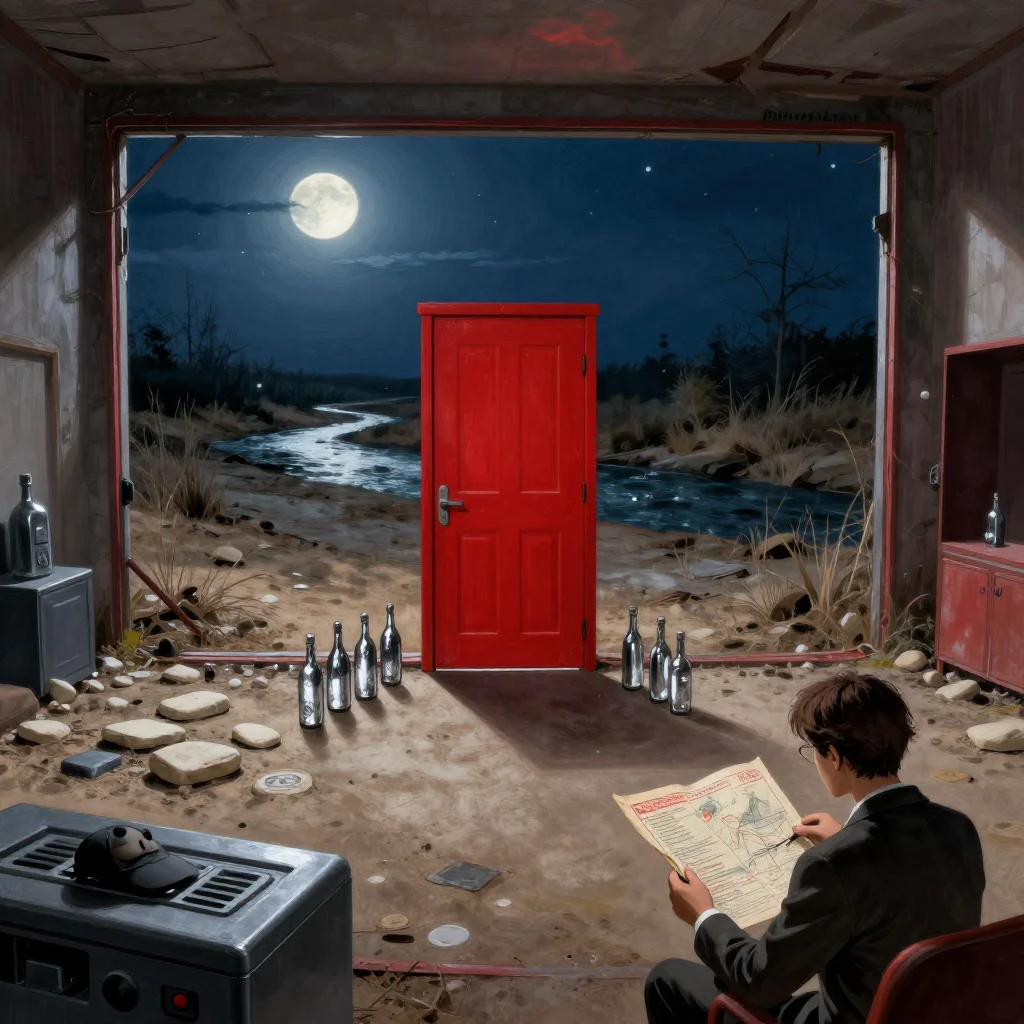
On the first night, Mara found a plate marked only 156. She held it beneath the lamp. A city appeared, then vanished. A child stood in a garden with a red door behind her. Beyond the door waited a dry riverbed filled with silver bottles. A man knelt among them, holding a map that changed shape whenever he looked away.
“Translate quickly,” said the machine beside the wall. It was an old ticket dispenser, polished by decades of absent hands. “The cinema closes when the future becomes inconvenient.”
Three Versions of the Same Vow
The dreams belonged to a machine called the Witness, installed beneath the Orpheum after the last film. It had recorded everyone who entered the cinema, but recorded what each person believed had happened.
On one plate, Mara saw her mother at the dry riverbed. She had promised to return before the river filled. On another, her father promised never to leave the unmarked door. On the third, Mara herself promised to burn the map.
“We all remember the promise correctly,” said the Witness through its speaker. “That is the problem.”
Mara’s mother had vanished when Mara was nine. Her father had locked the family’s atlas in the attic and refused to speak of it. The old promise had split them so thoroughly that each branch of the family carried a different map: one showed the route home, another the route away, another only the places where a person could disappear.
The Witness offered the final plate. On it, Mara would leave the cinema with a map redrawn from every possible future. The machine asked her to choose which promise to make true.
The Door Without a Number
The unmarked door stood behind the last row. It had no handle, no hinges, and no number. The red door was painted on its surface, though the paint had never been wet.
When Mara opened it, the dry riverbed stretched beneath a midnight-blue sky. Silver bottles lay between the stones. Each contained a future that had almost happened. In one, her mother was alive. In another, her father had never left. In a third, Mara had forgotten how to read machines.
She uncorked them one by one. The futures poured out as heat, as voices, as the smell of rain on warm pavement. Each bottle tried to persuade her that its version was the original. The one with her mother alive said the promise meant return. The one with her father waiting said the promise meant stay. The one in which Mara was ordinary said the promise had never belonged to anyone.
Then she found a bottle without a future. Inside was only a blank map, folded around a small stone. When she unfolded it, the paper resisted her fingers. Lines appeared beneath her touch, not a route through the world but a route through the disagreements: here was the house, there the attic, there the riverbed, there the red door, there a road leading away from all of them.
A Map for the Living
Before dawn, Mara drew the map on the back of the final reel. She marked no single promise as correct. Instead, she wrote where each person had believed the promise began, where it bent, and where it ended.
The Witness woke. Its gears moved without a body behind them. “You have made a map,” it said.
“A better one,” Mara replied.
She left the red door open. By morning, the Orpheum’s dusty lobby had filled with people carrying maps stitched into their coats. Some led toward homes. Some led toward strangers. One led into the dry riverbed, where the silver bottles had become a thin line of water.
Mara took the unmarked door and walked out beneath the pearl sky. Behind her, the cinema showed a film of a future that had not happened yet. The audience saw a woman with a notebook drawing roads across a blank country.
They could not hear what she wrote beneath the map, but she knew it was enough: not where everyone had promised to go, but how they might find one another when the river changed.





