 Netwrck
Magical Realism.
The Weather of Elsewhere
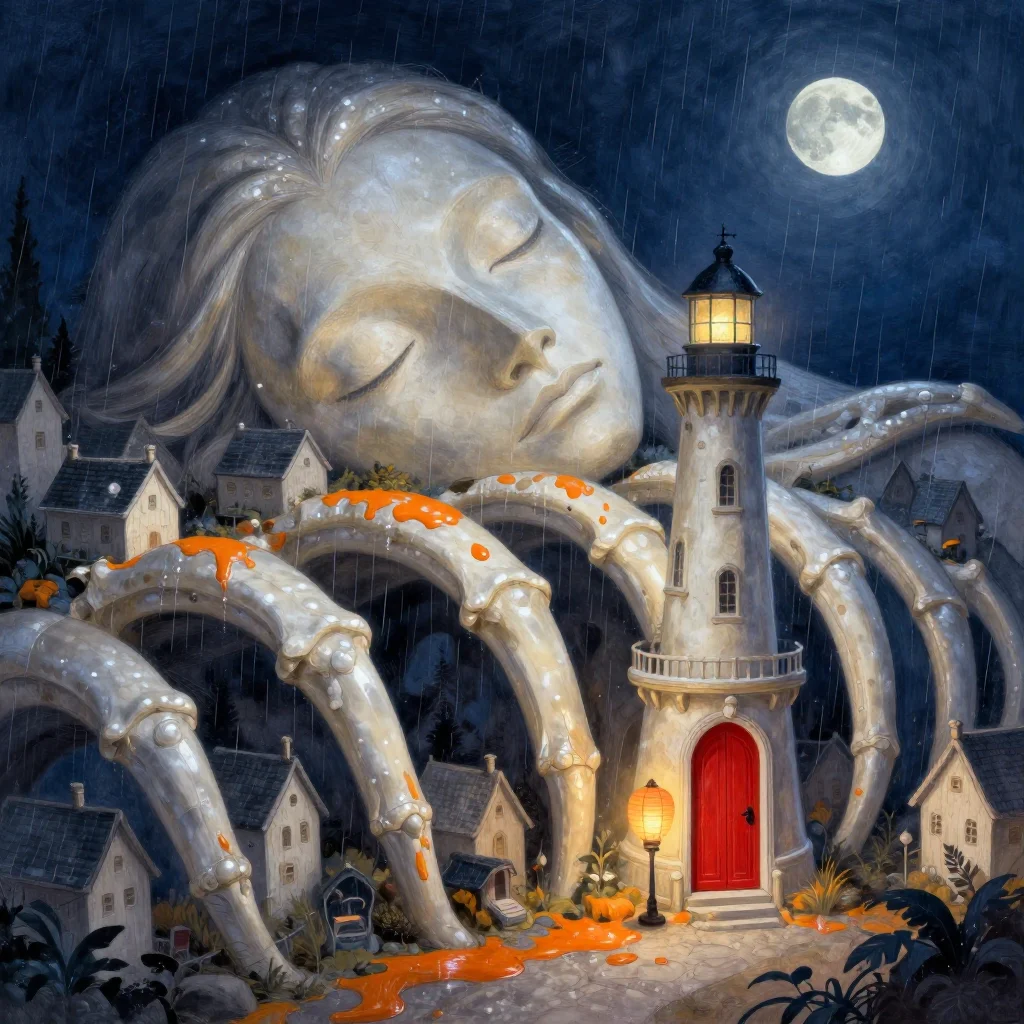
Maren kept the lighthouse on the seventh rib of the sleeping giant, where the village of Bellwether curved like a rib cage around his sleeping breath. Her tower stood beneath the small moon, a pearl the size of a plum, which rose from the giant’s nostril each night and sank into his eyelid at dawn.
Her work was to catalogue weather. The rain that fell upward. The frost that remembered July. Clouds carrying the voices of drowned cities. Maren entered each event in a blue ledger, with its wind, duration, and place of origin.
She had not entered the night her sister vanished.
That omission had been forced upon her. When Ansel came for supper, the village had looked through her as though she were a window with nobody behind it. At the market, the red baker removed her bowl before Maren reached it. Her name vanished from letters, songs, and the little copper bells on every door.
Only the paper lantern hanging outside the municipal office remained. Its folded paper bore no name, but inside its wick burned a weather unknown to any world: a warm rain smelling of oranges.
The Law Against Impossible Things
The village council met beneath the giant’s shoulder, among beams black with age. A brass plaque fixed to the table declared: All IMPOSSIBLE THINGS ARE PROHIBITED BY DECREE. The rule had been introduced three generations earlier, after a local mayor had accidentally turned the river into a choir and drowned six important hats.
Maren presented the lantern. “My sister is inside it.”
Clerk Odran looked into the wick. He frowned. “That is impossible.”
“She is.”
“Then the lantern is a municipal violation.” He stamped the paper. “Possessing an impossible person is punishable by forgetting.”
Maren appealed to the council. The council appealed to precedent. The precedent appealed to the brass plaque. By evening, Odran had placed a small red door on the lantern, painted there with one careful stroke, and ordered the keeper to bring proof before the next moonrise.
Proof meant weather. Not metaphor. A measurable storm, with a measurable origin.
A Forecast Against Decree
Maren climbed the tower and opened every window. She called to the skies of distant places: drizzle from the drowned moon, thunder from the kingdom of beetles, snow that fell in the shape of erased letters. The small moon tilted. The lantern’s wick brightened.
By midnight, Bellwether stood beneath a storm of orange rain. It fell into the market square, filling the baker’s basin, the council chamber, and the narrow channels between the giant’s ribs. People hurried home with buckets over their heads. The rain landed on Ansel’s invisible coat, and her footprints appeared in the mud.
Maren followed them to the red door.
It was not on the lantern anymore. It stood at the edge of the square, a narrow red slab beneath a sky bright as wet pearl. No handle marked its front. Maren understood, with the certainty of a lighthouse, that doors open according to the direction one is willing to walk.
She pushed.
Beyond it stood the village as it had been: pearl-white walls, midnight-blue roofs, the giant’s ribs shining with dew. Ansel waited beneath the lighthouse, younger by a winter, holding the lantern’s tiny flame in both hands.
“You took your time,” she said.
The Name That Returned
Maren reached for her. At the same moment, the brass plaque began to crack. The decree had recognized the door. By morning, every impossible thing in Bellwether might be legal, including the sleeping giant, the small moon, and the weather from other worlds. Or the council might erase Maren again, taking Ansel with her.
She held out her hand.
Ansel crossed the threshold.
The red door vanished. Rain continued falling, but quietly now, as if the sky had learned to speak in a lower voice. The clerk found Ansel’s name in every ledger. Children remembered her laugh. The baker returned her bowl.
Only the plaque remained blank.
Maren understood then that the village had not outlawed wonder. It had outlawed the obligation to witness it. The small moon rose over the sleeping giant, and its light fell across her sister’s face, no longer reflected by pearl and weather, but ordinary as a lamp.
From that night, Maren kept the lantern lit. It made no impossible claims. It merely burned beside the lighthouse door, where anyone could enter, knock, and be remembered.





