 Netwrck
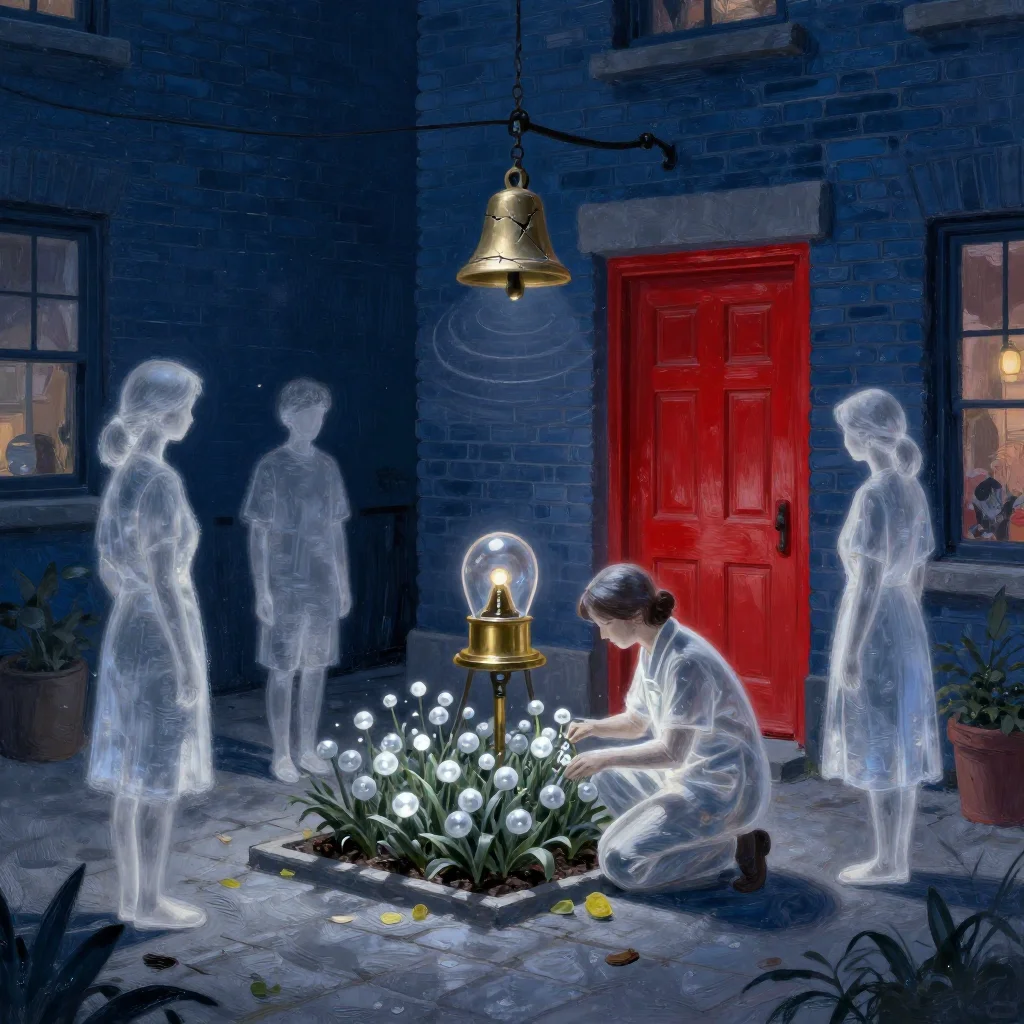
Magical Realism.
The Courtyard Behind Number Nine
Municipal gardener Mara Venn planted stories in neglected courtyards, though the city’s maps preferred to call them gardens. She loosened the pearl-gray soil with a copper fork, scattered a sentence from a missing person’s letter, and waited for the weeds to grow upright.
In Bramble Ward, the shadows were citizens. They voted at midnight, queued beside their owners, and occasionally won seats on the council. The citizens were shadows in turn, bound to the shade they cast. On bright mornings, everyone moved carefully, apologetic for the darkness they left behind.
Number Nine’s courtyard had been empty for thirty years. Its walls were midnight blue, its gutters smelled of iron, and a red door stood at the far end, locked so tightly the paint had cracked around its hinges. Mara had been told the door belonged to the Venn family. Her grandmother had planted a story there when Mara was a child: the story of a traveling musician who sheltered every lost person in the city and woke each morning with a different song.
Mara wanted to turn that story into a shelter for strangers. Not a museum, not a monument, not another locked room with a plaque. She wanted beds, hot broth, dry blankets, and a sign that did not ask what a person had done to deserve a place.
The Machine in the Cellar
On the morning Mara returned, a machine stood beneath the courtyard.
It was a brass box on wheels, with a domed glass top and a single copper lever. A brass key rested in its keyhole. The machine had no visible power source, but its gears turned whenever Mara looked away.
A label on its side read: SHELTER FOR THE UNBELIEVED. Underneath, smaller letters trembled on a paper strip: OPERATES WHILE NOBODY BELIEVES IN IT.
Mara laughed. Believing in a machine was easy enough. She put her hand on the lever.
Nothing happened.
She tried again. The machine remained silent.
“Perhaps,” said a shadow from the wall, “you need to stop believing.”
That was easy. Mara had spent years learning not to believe in the city’s promises. She planted a story about a brother who forgot his sister’s name, and watched the roots rise through the stones. She planted a story about a judge who carried a lost child home, and the weeds became a small blue flame.
She planted doubt around the machine.
At dusk, the machine coughed. Its gears turned. A wall unfolded from the courtyard brick by brick, revealing rooms filled with empty cots, unlit stoves, and cupboards that trembled as if holding their breath. The machine could build only what the neighborhood refused to imagine.
What the Bell Refused
Mara’s family story had a cracked bell. It hung in the red door’s tower, where it could call the lost home but never summon the found.
When the machine began its work, the bell rang without anyone touching it. The sound passed through Bramble Ward, and every shadow turned toward the courtyard. In the council chamber, the shadows voted against the project. They said a shelter built from disbelief would eventually become a machine for controlling hope.
Mara climbed the tower with the brass key in her pocket. It fit the bell’s hidden clapper, though the bell had no lock anyone had noticed. When she turned it, the machine stopped.
The red door opened.
Behind it was not a room but a field of shallow graves, each marked with a family name. A wind moved through them, carrying the voices of children asking for directions. Mara understood then that the musician had not sheltered the lost. The musician had sheltered the parts of people the city had abandoned.
A Door That Held
At dawn, Mara rang the cracked bell once. The machine’s walls fell away. People carried in the cots, the soup pots, the blankets, and the unremarkable courage of strangers.
By noon, the field was gone. The courtyard remained, red door open, rooms crowded and warm. The machine stood empty beneath a sky the color of a seashell.
Someone asked who owned the shelter.
“Nobody,” Mara said. “That is the engine.”
Later, she planted her grandmother’s story in the red door itself. The story had no ending. Each night, a new stranger arrived, carrying a key that did not fit any lock, and Mara learned that shelter was not a place someone inherited.
It was a story strangers kept adding themselves.
Keep the door open. The city is full of weather, and weather is always looking for somewhere to rest.
In the blue-black hours, shadows gathered at the threshold. The cracked bell answered with a low, imperfect note. Somewhere beyond Bramble Ward, another door opened.





