 Netwrck
Magical Realism.
The City of Borrowed Shadows
At dawn, the shadows of Mirebell left home before their owners did.
They slipped from doorways, gathered beneath awnings, and voted in the small square where the fountain had been dry since Mara’s grandmother was a girl. Citizens followed them through the pearl-colored streets, carrying their errands close to their bodies, careful not to step on the parts of themselves that moved independently.
Mara kept a cookshop at the edge of Lantern Market. By noon, its tables were full of people who had not yet admitted they were hungry. Some came for bread. Others came because the smell of browned onions reminded them of a mother, a winter, or a kitchen they could no longer find.
Her recipes summoned them. Not ghosts, exactly. The people who had once eaten at Mara’s table returned in memory: a ferryman with salt in his eyebrows, a child holding a blue kite, an old woman who had paid with a silver button. They sat beneath the awning and shared whatever dish she had prepared.
The trick was that they never thanked her before leaving. They always asked the same question.
“Is the red door still there?”
The Recipe Her Mother Left
Mara’s family claimed that their grandmother had once cooked for a house beneath the city, where no one could enter unless they surrendered the memory of having been hungry.
The legend had passed through the family like a recipe with one line missing. Her mother knew the ingredients but not the order. Her father knew the order but refused to speak it. On the night before he disappeared, he had left Mara a sheet of paper containing only a list:
pearl salt
midnight water
one black umbrella
the place where the river used to run
Mara found the ingredients in impossible places. Pearl salt came from the shadows of merchants. Midnight water collected in the bellies of sleeping cats. The black umbrella hung in a locked shop on Copper Lane, folded beneath a sign that read WEDNESDAYS ONLY.
When she took it, the shopkeeper bowed.
“Your mother came here too,” he said.
Mara’s hands tightened around the handle. “She bought an umbrella?”
“She returned one.”
The Gate Beneath the Dry River
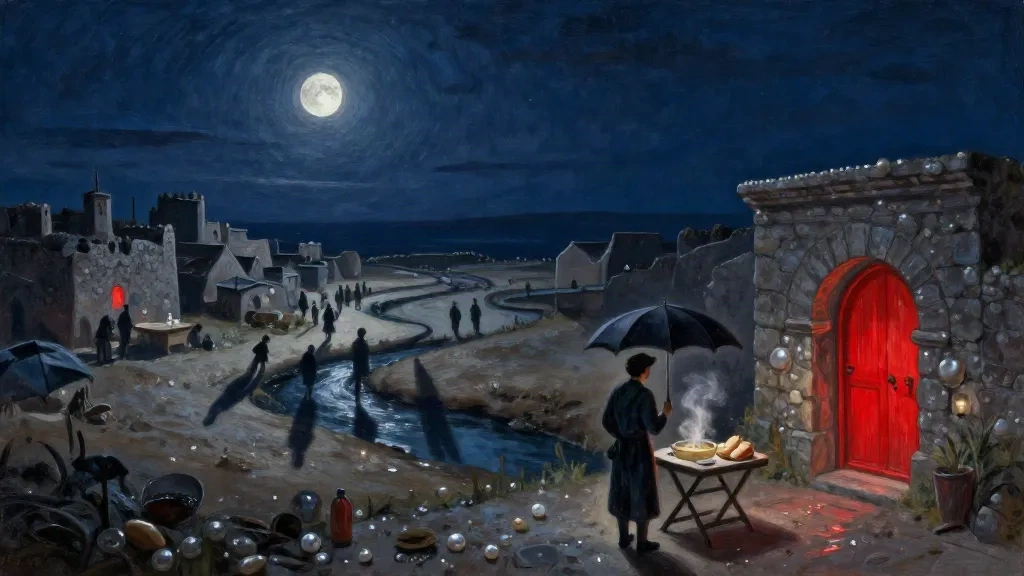
The dry riverbed ran behind the cookshop, though the oldest maps insisted a silver stream had flowed there for four hundred years. Mara walked its cracked stones with the black umbrella over her shoulder and the bowl of midnight water in her hand.
At the lowest point, the riverbed opened.
No door stood there. Only a narrow arch filled with darkness so complete it seemed to cast a shadow upon the stone. The black umbrella trembled in Mara’s grip.
A voice beneath the arch said, “One memory of hunger may enter.”
Mara set down the bowl. “And if I return?”
“You will not be hungry again.”
The cost was precise. Once paid, it could not be paid twice. If she entered, she would never know the taste of hunger again. If she left, the gate would close forever, taking the family legend with it.
She thought of her father’s silence. Her grandmother’s empty chair. The people who had visited her table and vanished before dawn.
Mara stepped beneath the umbrella and crossed the arch.
The House That Remembered Her
Inside was a kitchen larger than the market, with a red door at its far end. The walls were midnight blue. Pearl light floated in the air above copper pots. At the center of the room stood a table set for one.
An old woman sat there. Her face was Mara’s face, aged by a century.
“You came hungry,” she said.
“I came to prove the legend.”
The old woman lifted the lid from a pot. Inside, steam rose in the shape of every family member Mara had lost. “Your family did not enter a house beneath the city,” she said. “You entered a house beneath hunger. Every meal contains a door. Most people close it after they eat.”
Mara looked at the red door.
“Then prove it,” the old woman said. “Cook for the city.”
So Mara took the bowl of midnight water, the pearl salt, and the black umbrella. She made one dish from all three: broth dark enough to hold the moon, bread carrying the shine of cut shell, mushrooms gathered where shadows had touched stone.
She carried it through the red door.
Outside, the city had changed. Every citizen stood beneath their own shadow, and every shadow had become a person. They waited in the dry riverbed, hungry for something none could name.
Mara served them until morning.
At the final table, her father appeared. He looked older, but his eyes held the same silence.
“Was the legend true?” he asked.
Mara gave him a spoon.
He tasted the broth, and for the first time in his life, he remembered what it meant to be hungry.
Across the city, a single red door opened in every shadow.





