 Netwrck
Magical Realism.
Two Hundred Sixty Lanterns
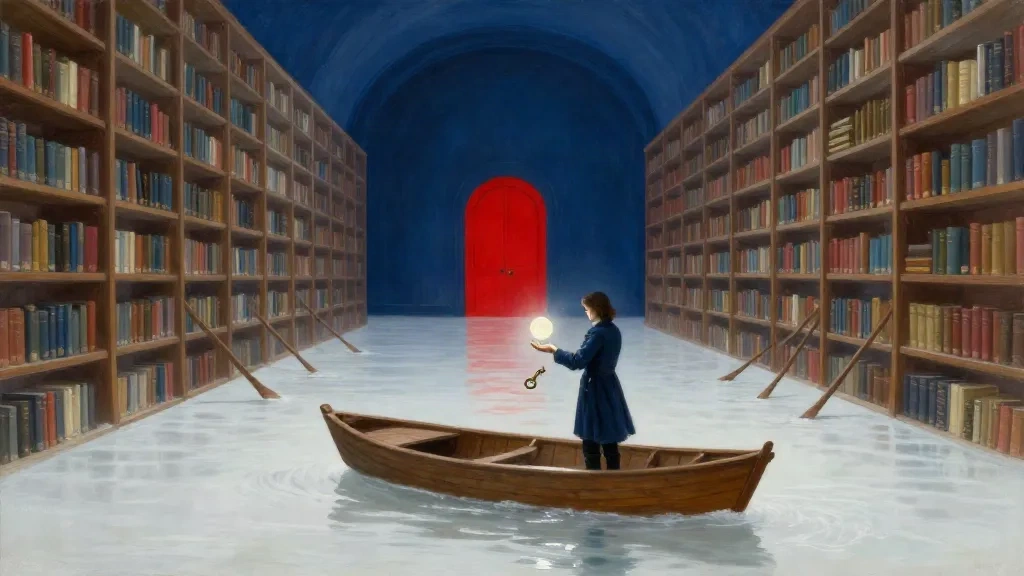
The archive had drowned twice that decade, and both times it had flooded upward. On the morning Mara Senn received her assignment, black water stood at the height of her knees in the reading room, cold as a spoon left out overnight, moving with a patience that had nothing to do with the river that fed it. Librarians in gray coats rowed between the shelves, calling catalog numbers to each other like ferrymen announcing shores across a wide and argumentative water. Above the waterline, drowned branches ticked against the tall windows. No wind moved inside the building. The air smelled of wet paper, iron, and the faint green breath of things growing in books that had been shelved wet.
Her duty was precise, and precision was the only kindness the Ministry of Continuances had ever offered anyone.
Fourteen miles east, the Vesper Forest had been evacuated from time. Not destroyed. Not relocated. Denied. Inside its boundary the trees went on growing from one minute into the next, never arriving. Rain fell upward out of the soil and returned to the clouds as mist. Wolves returned to the moment before they began running, and began again, and were content. Rangers walked the perimeter with bells on their belts to warn anyone who might accidentally step across into a day that had been cancelled.
There was a village in there. Ryemark, forty-one souls, sealed on the evening the order was signed. They had not died. They had not aged. Mara knew this in the specific way that only a person who had read the file could know it, because she had not merely read the file. She had been a records clerk in the Ministry at nineteen, and the second signature on the sealing order, the one that certified the hour of closure to the last decimal, had been hers.
She had told no one. She had joined the ranger service eleven weeks later and walked the boundaries for six years, which was either penance or a hobby, depending on who was asked. Bells rang beautifully in that forest. Nothing else did.
At noon she received a brass key. A note was tied beneath it in a dead ranger's cramped, impatient hand.
Finish what I began. Keep the moon above water. Do not be late.
The signature belonged to Ilyan Voss, missing six years, last seen carrying a lantern into the closure. His final patrol record contained one line, and Mara read it four times in the wet light of the reading room: Route incomplete.
A route is not a road. It is a debt. The Ministry paid rangers by the night, one lantern per night of survey, lit and stamped and returned empty. The ledger for the Vesper closure ran to two hundred and sixty lanterns. Two hundred and fifty-nine had come back. The two hundred and sixtieth was somewhere east of the treeline, burning in the pause, and it had been burning for six years because nobody had carried it home.
Mara turned the ledger toward herself and found, in the column where a clerk records the disposition of each lantern, the same upright hand she had been practicing in a mirror at nineteen.
The Small Moon
At dusk she launched the archive boat. The librarian who rowed her was ancient, white-haired, and precise enough to keep one finger held beneath the surface of the water, as though the water were a document and she were holding a line in place.
They went down Pearl Passage, between shelves holding land deeds, weather journals, and the births of children belonging to centuries that had not happened. Each stroke of the oars loosened papers from their bindings, and the loose sheets swam away downstream like pale fish, turning over to show the ghost of a face on one side and nothing at all on the other.
In her satchel, under the brass key, lay a small moon. It was no larger than a coin. It cast crisp light across the boat and the shelves, the kind of light that made edges look cut. When Mara lowered it toward the floor, the drowned stacks went dark and the water lost its color. When she raised it, ink surfaced on submerged pages, whole paragraphs blooming upward like kelp.
The librarian watched this without interest.
“You will need to know the hour,” she said, “not the time. They are not the same quantity in that water.”
At nine, the lamps along the river went out, one bank at a time, as if a hand were pinching them. At ten, the surface became perfectly still and gave back the whole archive upside down. At eleven, something walked over the roof of the building, and the water shivered with the weight of it, though the building is nine hundred feet long and the thing was never once heard to hurry.
It was not a monster. Curfew belonged to a tall silver creature standing upright on the flooded stacks, hands folded neatly before it, its eyes cut like the notches on a regulator's dial. It looked at Mara with the whole length of its face and no warmth at all.
“Evacuees may cross until midnight,” it said. “At midnight, the present closes.”
“And if someone is under the roof at midnight?”
“Then the roof is the present.” It turned one flat hand over. “You will know the exact moment. You will, when your small moon touches the horizon.”
“Is that a warning or an instruction?”
“It is a fact with two uses,” said the creature. “I have never lied to a ranger. I have simply declined to be kind. You will find that kindness would have made you suspicious, and suspicion is expensive this month.”
Its cruelty would have been easier to argue with than its precision.
They found Ilyan's boat wedged beneath the bridge catalog, hull split, still dry inside. His pack floated nearby, lashed shut, and on its lid someone had carved 260. The pack had been lashed from the outside, in a hurry, by a man who did not expect to be underwater but had planned to leave. Mara worked the rope free with her teeth.
Inside: a bedroll, three chalk stubs, six dry biscuits she did not eat, and a leather ledger swollen to the shape of a lung. She did not open it. Not yet. A dead man's arithmetic deserved an hour of light that was not borrowed.
The Exact Boundary
She opened the lock. The river withdrew from the forest door in a silent tide, drawing the water back into itself, and left a dry red threshold in the wall where no door had been. Beyond it stood the Vesper Forest, silver with an age that had not yet arrived. Every leaf faced two directions at once: outward toward summer, inward toward winter, and the forest breathed the way a chest breathes before a fever.
Ilyan's trail began at a cedar split by lightning, one half of it still smoldering with a fire that had been burning since before Mara was born. Brass markers led from one impossible hour to the next, driven into the earth with the care of a man planting a fence. She crossed a frozen spring in which bells rang beneath the ice at intervals of exactly one minute, all of them hers now, all of them still on her belt. She climbed a red staircase suspended between two trees whose roots hung in the sky, and halfway up, her own shadow passed her going down.
The Arithmetic of the Lake
At the final marker the path divided around a lake of black glass. On the left shore rested Ilyan's lantern, lit, its glass uncracked, its wick burning with a flame that leaned toward nothing in particular. On the right shore, floating on the lake, was the drowned city of Anselm, upside down and complete, its towers hanging beneath the surface like icicles of stone, and beyond the city, faint as a coin seen through cloth, the lamplight of Ryemark.
She saw the loop before she understood it. The village was having the same evening. It was always the same evening: the same forty-one people, the same doorway, the same dog nosing the same ash heap, the same boy at the bridge with a stick, throwing it into the water, and the water not giving it back. She watched him throw it eleven times. The eleventh throw was the first one.
Nothing in Ryemark was in pain. That was the design. Six years of perfect suppers, perfect harvests inside a single hour, no grief permitted to finish arriving, no child permitted to grow past the age they were when the order was signed. Some of them, she thought, standing on the black glass with the small moon burning cold in her fist, would choose it. Two of them had been old. She had read their ages in the file and had signed beneath them.
That thought was the horror. Not that the Ministry had imprisoned them. That the imprisonment was, by any honest measure, a kindness, and that she had been the one who made it legible.
She chose the lantern, because the lantern was the route and the route was the job, and because a woman who has come this far for one reason does not get to prefer a different one at the shore.
Her boot struck a root.
The silver creature appeared on the far side of the lake, standing on the drowned city's roof, hands folded.
“Your route,” it said.
Mara looked again. The root. The lightning scar. The tree holding two seasons in its crown. All of it had shifted. The precise creature had not lied. It had simply allowed her first error to become evidence, which was a crueler and more useful thing than a lie.
The Arithmetic of a Debt
She sat down on the black glass and opened Ilyan's ledger, because the moon was at the treeline, close enough to touch the horizon, and there was no longer any point in walking toward a thing she had not read.
The pages were ruled in the Ministry hand. Ilyan had been a careful man. Entry after entry gave the position of the lantern, the number of rings of the boundary bells, the state of the closure, and then, in the last forty pages, a thing no ranger was ever trained to write: the arithmetic of what completing the route would actually do.
A lantern is a night of survey. An unfinished route is a night still owed. Carry it out, and the boundary holds: the trees go on not-arriving, the wolves go on beginning, the clock in the trees keeps the hour it was set to. The lantern comes home. The lantern always comes home. That was the trade, and it had been available to him for six years, and he had not taken it.
Because the boundary holding was not the same as the hour holding. The pause in the forest was the pause in Ryemark. The two were one mechanism, a single lock with a single key, and the key was the small moon in the wester's satchel, and the small moon was the closure itself, seen from outside. Set it on the horizon and the lock stays shut. Raise it and the lock opens, and everything inside the loop is dealt with at once, because time cannot be given to one room in a house and withheld from the others.
The last entry was dated the fourth day of his second winter in the pause, and it was four sentences long.
I will not trade six years of their childhood for six years of their dying. I will not leave them either. If I put it down, somebody of my own choosing will pick it up, and I have known for a long time which name that would be. I am not a brave man. I have only been a patient one, and I am sorry, Mara, in advance, for the hour I am spending your life on.
She read it twice. The small moon trembled at the treeline. The creature stood on the drowned city and watched her without moving its folded hands.
“You are asking whether I will lie to you now,” it said, having apparently been listening for some time.
“I am asking whether you can tell me the price without telling me what to pay.”
“Yes.” A pause of exactly one minute. “Precision is not mercy. It is only the refusal to hide the arithmetic. You are afraid I will flatter you so that you will walk in. I do not flatter. I have seen the outcome of both routes and neither of them is comfortable, and one of them is comfortable, which is the one I would take if I were permitted a preference, and I am not.”
“And if I do nothing?”
“Then the debt is taken out of the borrower. You. You will stand in the pause until the pause is lifted by something else, which has not happened in six years and which I am not permitted to predict.”
She thought about forty-one people having the same supper six thousand nights. She thought about a boy on a bridge throwing a stick into water that would not return it. She thought about her own signature, the second line, the decimal. Then she thought about the word outcome, plural, in the mouth of a thing that had watched her arrive.
He had chosen her. That was the part she could not get past. He had not left the key in a drawer. He had written her name into a dead man's arithmetic and let the Ministry deliver it, knowing that a woman who could not stop reading files about Ryemark would eventually be sent east with a brass key and no one to stop her.
It was not kindness. It was the most exact use anyone had ever made of her.
What the Ranger Carried
She had one minute before the small moon touched the horizon, and in that minute she did not think about the world, because the world was not the part that was hard. She thought about the order of operations. She thought like a clerk, because clerks were the only people in the Ministry who had ever been paid to be careful.
Step one: the debt. A route is carried by a person, not a thing. The lantern is not the carrier. She would have to be inside the closing hour to carry it, which meant the boundary had to open for her while she was still owing it, and there was no arithmetic in Ilyan's forty pages that permitted that.
Step two: the key. The key did not open a room. It opened a way through the forest that time had misplaced, and the way was the lock-shaped hollow in the lantern's base, which she could see from where she sat, which is the only reason she had not already been drowned.
Step three: the moon. The creature had told her to keep the moon above water. Not above the horizon. Above water. She had spent six years taking that for a piece of stagecraft.
She stood up and put the brass key into the lock-shaped hollow of the lantern, and the small moon, which had been sinking obediently toward the horizon all evening, rose instead.
White fire came down through the forest in a single white column, not burning but resuming, and time resumed in every direction at once. Leaves burst out of the pause, green and enormous, each one choosing its season. Roots struck earth with a report like distant guns. Wolves bounded off a treeline and did not come back. Rain fell downward for the first time in six years and the whole forest wept audibly, the sound of it enormous and slightly ridiculous, the sound of a hundred thousand people exhaling at once.
The lantern went out in her hands. It was empty, and it was light, and it was a two-hundred-and-sixtieth lantern, and she was carrying it.
On the shoreline of the lake, in the water up to his knees and getting no wetter, stood Ilyan Voss, young and transparent, beginning again the walk he had lost. He did not run toward her. He began walking, the way a man does when he has six years of the same four paces to make again and intends to make them properly this time.
“I could not finish alone,” he said.
“You could have asked me first.”
“I did. Six years ago. You had not been struck by anything yet.”
“That is not what I meant.”
“No,” he said. “It is the only answer I have. I am a patient man, Mara, and I have spent all my patience.”
She wanted to hit him, and she wanted to be forgiven, and she wanted, more than either, to be a person who was owed something by the world, so she took his hand, and it was cold, and it was the first honest cold she had felt in six years.
They crossed the black glass together. The silver creature watched from the drowned city's roof as the small moon hung above the water, violating neither curfew nor dawn, which is the whole of what it had ever promised, and no more.
What the Loop Was Given
On the bridge at Ryemark, the boy threw the stick.
It landed. It did not come back. The dog, who had been young for six years, was suddenly old, and then was simply a dog, and then was a dog that barked, once, and then went and found a place in the sun to lie down in. The woman in the doorway with the ash on her apron looked up at the sky as though it had insulted her, and then began, with enormous dignity and no time left to waste, to shout for someone named Osten about the roof.
It was not silent. Mara had braced for silence. It was extremely loud, the loudest hour of Mara's life, and it went on for the length of a single evening, because an evening is what the loop had been holding, and the loop released all of it at once, and nobody in Ryemark was spared a second of it. They were allowed to grow. They were allowed to age. Two of them were allowed, at last, to be finished.
Mara stood in the shallows and let it come, and understood, in the ordinary and unbearable way of understanding anything, that the Ministry had been right. It had been a kindness. A lock, held shut, held against the moment it was holding. She had signed the hour to the last decimal and she would have signed it again, and the thing she had done tonight had not been to open a door for forty-one people. It had been to give them the rest of it, which was not the same thing, and could not be taken back by anyone who had meant well.
The creature appeared at the treeline, small as a heron, its dial-eyes cut toward the village.
“The route is complete,” it said.
“I know.”
“Then the boundary is paid for and I am no longer required here.” A pause of one minute, which was apparently how long the creature thought, or how long it allowed itself. “You will find I have no opinion. I said so. I will say only that a lock that is opened is still a lock, and you are the one holding it open, and there is no hand left to close it but yours.”
Then it was not there, and the archive water went out of the shelves in one long exhalation, leaving a smell of wet stone and dry paper in a reading room with a floor for the first time in six years. The gray coats complained for a week about the damp. Nothing has flooded since.
What the Ranger Carried Afterward
Mara filed the completed route under Ilyan's own name, all two hundred and sixty nights of it, lantern by lantern, in a hand that shook only on the last line. Then she walked to the boundary and hung the brass key in a tree on the east side, where it opened no door, and where it shone, faintly, on wet bark, for as long as the forest stood there.
She stayed with the service. She asked for the Vesper line specifically, and got it, because nobody else would take a line that rang bells once a minute and had no incidents to report. She walked it for nineteen years. She never once told anyone, in all that time, that she had been the second signature on the sealing order, and she never once told Ilyan either, in the two years he lived after she brought him out, and he never asked, which she decided to take as a kind of agreement and never entirely trusted.
She kept the small moon. It was a coin of ordinary silver after the fire, no larger than a thumbnail, worth eleven pence, and it did not light anything, and she kept it in the pocket with the bells.
On a wet afternoon in her fourteenth year on the line, a girl of perhaps nine came through the trees to the boundary and stood on the wrong side of it, dripping, holding a question she had clearly walked a long way to ask. Mara counted her steps the way she always did. The girl said her name was Osten's granddaughter. Mara said the name quietly twice, and the girl did not notice.
“Why does the key still shine?” the girl asked. “Mother says it opens nothing. Father says it opens something and you won't say what.”
Mara considered the true answer, which was that she had put it there so that no one would be able to use it, and that it shone anyway, which is what happens to the things you nail to a tree to stop you thinking about them.
“Because some journeys are not taken,” she said. “They are carried.”
The girl considered this and found it, on balance, satisfying. Then she said, “Whose?”
And Mara, who had spent nineteen years being a person who knew the exact moment, and who had twice known it exactly, answered honestly for the first time in her life.
“Mine,” she said. “Partly. And a lantern's worth of somebody else's.”
The girl nodded, satisfied by that too, and went home through the wet trees, and the bells rang once a minute over the water in the black forest where the trees had gone on not-arriving, and beneath the frozen spring something that was not a bell answered, once, and then was quiet, and Mara Senn did not go and look.





