 Netwrck
Magical Realism.
The Last Screening
By day, the cinema was a shell of peeling posters and dusty ticket booths. Its roof leaked pearl-colored light onto the seats, and the projection booth held a single machine that showed films of futures that almost happened.
At night, Mara unlocked the red door at the back of the lobby and waited for the audience to arrive. They came from wet streets, narrow rooms, and towns that had forgotten them. They sat in the dark while the screen flickered: a city saved by a bell that had never been rung; a woman returning home five minutes before the fire; a boy planting a tree in a country renamed by morning.
Between screenings, Mara opened her library cart. On it rested one book bound in blue cloth, its title written in letters that rearranged when she looked away. She called it The Book of Near Misses. The librarian before her had called it something else.
“It is not prophecy,” Mara told each borrower. “It is permission.”
One Book, Many Hands
The book contained addresses of places that did not yet exist. It contained recipes for repairs that could mend anything except the past. In its margins, strangers had written instructions for surviving their own possible deaths.
A ferryman borrowed it to discover how to bring his drowned brother home. A seamstress borrowed it to find a door that opened onto a city where clothing could remember its wearers. A woman carrying a paper bird borrowed it because the bird had begun returning from the south with messages addressed to her.
Every borrower returned the book before dawn. Every borrower had a solution, but none had found what Mara wanted. She wanted an address where impossible residents could remain impossible without being corrected.
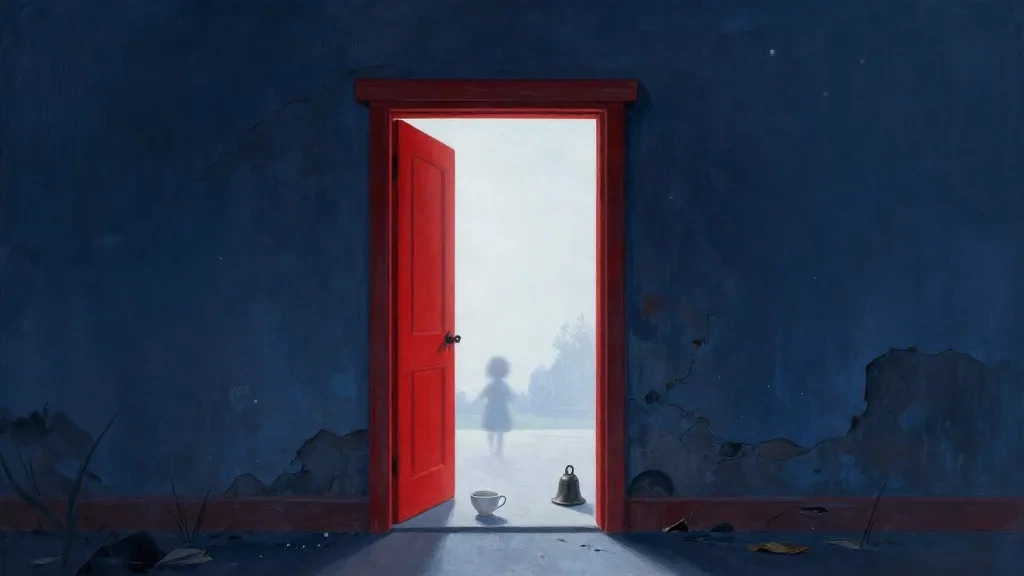
On the final reel, the cinema showed a house with pearl walls, midnight-blue windows, and a red door standing in a field of snow. A woman entered carrying a cracked bell. A child followed her, holding an empty teacup.
What the Child Saw
“That is not a house,” said the child, pointing at the screen. “That is a decision.”
Her name was Ily. She had come alone, though her shadow arrived before her and disappeared whenever the projector changed films. While the audience saw an empty house, Ily saw a small figure standing behind the red door. The figure wore a coat of ash and held a key made from moonlight.
“What is it?” Mara asked.
Ily looked troubled. “The thing everyone agreed not to see.”
On the screen, the house vanished before the woman could enter. The audience gasped. The projector stopped.
Mara opened the Book of Near Misses. Every page was blank except for a line printed in red: A home cannot be found by those who are looking for it.
Ily touched the page. The empty teacup appeared on Mara’s cart, followed by the cracked bell. Both were real. The bell rang once without moving.
“She is waiting for the door to be named,” Ily said.
The Address of Almost
Mara did not know the woman’s name. She knew only that the house had been built for everyone the world had discarded: children born with two shadows, people who remembered tomorrow, those whose reflections had grown older than their bodies.
She wrote the address in the book: The house behind the last screening, where the overlooked are admitted.
At dawn, the red door stood in the lobby, solid and warm beneath Mara’s hand. Ily pushed it open. Beyond it waited the pearl room, its midnight-blue windows looking onto the near-miss future.
The woman with ash on her coat turned. The figure behind her raised the moonlight key.
Mara crossed the threshold with the empty teacup and cracked bell. The door closed behind her, not to keep the world out, but to give the impossible a home.





