 Netwrck
Magical Realism.
The Glassmaker’s Morning
Mara kept ordinary mornings in a cupboard beneath her workshop, one blue thread tied around each brass knob. The first thread held the dawn that had arrived before the mill whistle. The second held the afternoon her brother returned. The third was empty. Every morning she blew a pane for a room in another world, and every pane carried a little light through its surface.
That morning, she wanted nothing more extraordinary than to keep breakfast warm for her father. He had promised to taste her honeyed plums before the ferry arrived. Beside the river, where every bridge was a promise and every river a witness, the red bridge showed only pearl-colored water beneath its arches.
Before Mara lit the furnace, someone knocked from inside the wall.
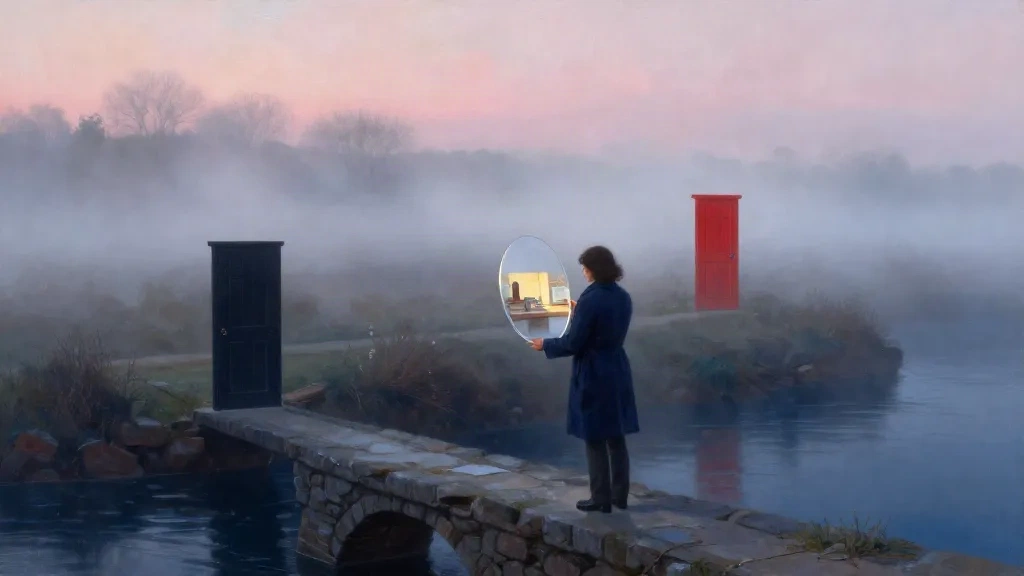
The sound came three times: a pause, two taps, then a scrape beneath the plaster. She found a narrow seam behind the tool rack. An unmarked door stood where no door had been, black wood without a handle, with a blue thread knotted through its keyhole.
What Everyone Agreed to Forget
Across town, people were speaking too quickly. The baker called yesterday’s rain tomorrow’s rain. Children insisted the clock had always been late. At the ferry landing, the boatman explained that the river had never carried a drowned man, although the river plainly carried his red coat downstream.
Wherever Mara walked, the truth loosened from the town. A woman said her brother was a stranger, then wondered why she was crying. A child laughed and covered his mouth. The trail of blue thread on the ground became clearer, but the path beside it grew safer as each person denied what they knew.
The thread led her to the red bridge. At its far end stood a field of tall grass, and beyond the grass, a house with pearl windows. One pane was dark.
“That room is waiting for you,” said the ferryman, though Mara had not asked him. “Everyone agrees it is better left empty.”
He pointed toward the water. A man in a red coat rose from the current, calm and clean, holding a small blue thread.
Mara understood then. The town was not changing its past. It was making the past too painful to name. Each denial shortened the danger, and each shortened danger took another piece of the morning.
The Window She Could Not Keep
Inside the workshop, the empty thread trembled. Mara drew hot glass from the furnace and shaped it into a narrow oval. She meant to make a window for the dark room, but her hands remembered her father’s plate instead. The glass opened onto the kitchen table: flour, chipped cup, honeyed plums untouched beneath a linen cloth.
The door in the wall opened by itself.
Beyond it waited a room full of strangers, all wearing the faces of people who had forgotten her. They begged her to look away. One offered her a thousand mornings, every one flawless and unnamed.
Mara put the blue thread around the oval pane. The glass warmed in her hands. Across town, the baker began to remember the rain. The boatman began to remember the red coat. The children stopped laughing.
Her father’s voice rose through the pane.
“You said before breakfast.”
She looked away from the room of strangers. The unmarked door slammed shut. The red bridge trembled, and the river gave back every true thing it had carried.
The Door Painted Red
At dusk, Mara found a new door beside the workshop, painted a single deep red. It had a handle. Above it, no name.
Inside waited her father, flour on his sleeves, smiling over the plums. He had remembered. The ordinary morning had returned with him.
Mara tied the last blue thread to the doorknob, then opened the door. Beyond it, the town breathed.





