 Netwrck
Mystery.
The Door at Closing Hour
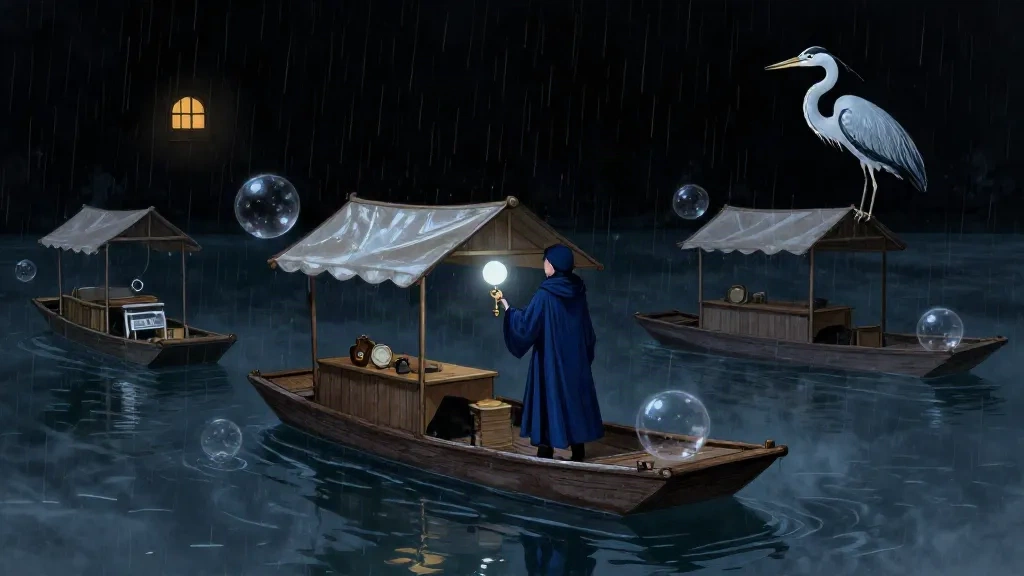
By the time Mara reached the floating market, the rain had turned the stalls into islands of blurred silver. Memory hung beneath their awnings in glass bubbles: a wedding bell, a kitchen knife, a child's black tooth. Each had lost the hand that surrendered it.
She came for one.
Seven years earlier, cartographer Ilyan Vale had left the evacuated forest carrying a map of the year the forest had been cut out of time. He had promised to return before the second dawn. Instead, his lantern, his boots, and one crimson glove appeared on the market dock, arranged as neatly as tools in a watchmaker's shop.
Mara was the forest's ranger now. The trees remained where they stood, but animals, birds, and seasons had vanished. Each night the boundary advanced one pace closer to the trunks. She wanted to finish Ilyan's journey. More than that, she wanted to know why he had sent her a brass key in a letter with no return address.
The key lay cold in her palm. On one side was a crescent moon. On the other, stamped into the metal: FOURTEEN.
The Moon That Would Not Rise
At the market's center, beneath an empty canopy, a small moon hovered above a table of clocks. It was no larger than an apple and gave off the warm amber light of a single farmhouse window.
The clocks all showed different hours, but none had hands. A brass bird on the table clicked open.
“Curfew,” it said. “The moon may not cross the northern arch after the second bell.”
Mara looked up. The creature responsible for curfew was circling beyond the stalls, a long-necked heron with silver feathers and a clock for one eye. It did not attack. It merely measured the market with slow, exact turns.
“I need the moon for one journey,” Mara said.
“Journeys require limits,” replied the heron. “Carry it three gates. Return it before the water turns black. Leave no borrowed hour behind.”
The first gate appeared when she spoke Ilyan's name. The second opened beneath a stall selling a childhood covered in snow. At the third, Mara found Ilyan's lost lantern burning inside a cage.
Inside the cage lay a note: Do not follow my light. Follow the missing hour.
The Hour Without a Name
Mara lifted the small moon into the cage. Amber poured through the bars. The heron's eye struck once.
Every memory on the market brightened. In them, she glimpsed Ilyan's cartographer's hand tracing coastlines, signing documents, pressing his thumb to seals. He had not abandoned the forest. He had stolen the hour in which the evacuation had failed, then hidden it inside the moon to keep the boundary still.
But a stolen hour could not remain hidden forever. Each night, it pulled the forest one step nearer the market.
Heron landed across the path. “Return the moon,” it said.
Mara understood then. Curfew was not a threat. It was containment. If the moon crossed the arch while the missing hour was awake, the forest would spill into every ownerless memory on the market, and thousands of displaced lives would lose the last boundary between them.
She turned the brass key. Fourteen clicks opened inside the moon.
The Second Dawn
The small moon cracked along its crescent seam. A warm amber window appeared high in the black sky, reflected in rain-silver water below.
On the far side stood Ilyan, older, holding the map she had been given. He had spent seven years walking through an hour no one else could enter.
“I could not bring the hour back,” he said. “It would have erased the forest.”
“Then neither could I.”
Mara took his hand. The ranger's forest had one keeper; the lost hour had another. Together they crossed the narrow bridge between them.
At dawn, the heron closed its iron beak around the last fragment of moonlight. The market settled into silence. Somewhere beyond the northern arch, the forest remained exactly where it was.
Mara kept the brass key. She did not keep the moon. On clear nights, one amber window appeared in the sky, and beneath it a small path continued through the trees.





