 Netwrck
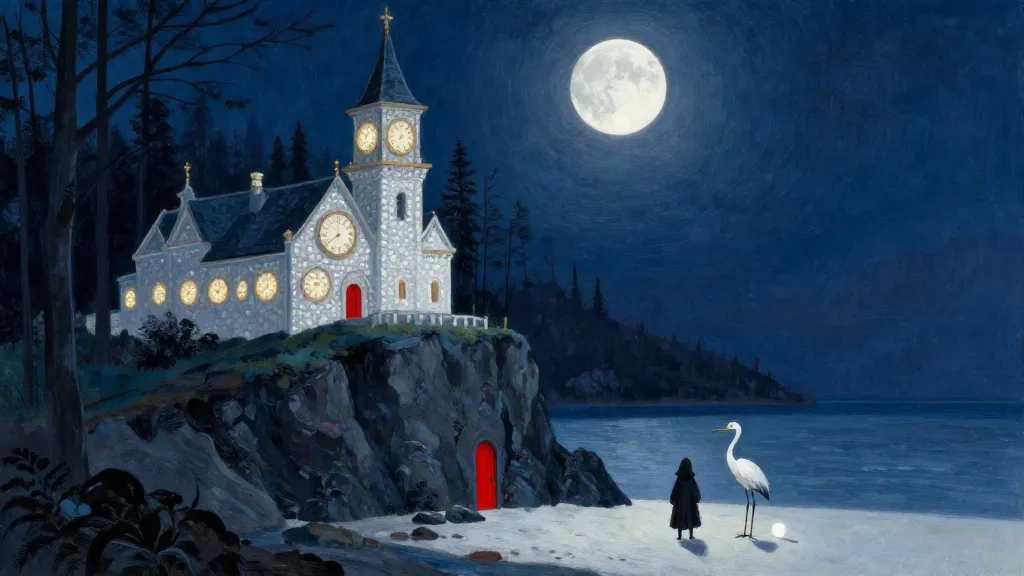
Magical Realism.
The Monastery Without Morning
Mara arrived at the monastery of clockmakers in the blue hour, though the sun had not risen and the western sky remained pearl-colored. The monastery clung to a cliff above a country where noon sometimes arrived before breakfast and birthdays were disputed by the seasons.
At the gate stood a monk with a brass key hanging from his neck. He did not greet her. He looked instead at the small moon she carried in her pocket, a white stone no larger than a bird’s egg.
“You are late,” he said.
“There was no reliable time.”
“That is not an excuse. It is a condition.”
Inside, the clockmakers worked without bells. Their workshops were filled with moon-shaped gears, silver threads, and tiny doors opened only by careful questions. Beyond the windows, the forest waited under midnight blue.
Mara had come because her predecessor, Elian, had disappeared there. He had been a ranger too, assigned to patrol the boundary where the forest had been evacuated from time. Before he vanished, he had begun a journey toward its oldest landmark: a red door standing alone beneath a tree that had no leaves.
His final note had contained one direction, written in his careful hand: When the borrowed hour arrives, follow what has already been missed.
That had been twelve days earlier.
The Exact Boundary
The forest began where the monastery road ended. Its trees were dark, straight, and perfectly still. No wind moved through them. No insects answered. Every leaf held the same bead of moonlight.
Mara entered carrying Elian’s brass key and the small moon.
At dusk, a creature crossed the path. It had the long legs of a heron, a face made of polished copper, and a silver crown hovering above its head. It bowed without bending its body.
“Curfew begins when the first star is visible,” it said. “No traveler may cross the river before the moon is full.”
“How long is that?”
“Exactly long enough.”
It was not hostile. Its voice held no anger, only the tenderness of a rule that had survived every argument. Mara had seen its kind in the marsh villages: creatures that sealed wells, counted seasons, and punished no one except those who arrived late.
She looked at the small moon. Its glow had not changed.
“The moon is not full,” she said.
“It will be.”
“When?”
“That is the definition of full.”
The creature lifted one thin hand. In the darkness beyond it, a road appeared, pale as bone.
Mara stepped onto the road. The creature did not stop her. That was worse than a threat. It had permitted her to violate the curfew, which meant it believed she belonged to a different arrangement of rules.
What the Key Remembered
Inside the forest, Mara found Elian’s campsites in impossible order. The first held burnt wood from a fire that had not yet been lit. The second contained footprints traveling backward. The third held a note addressed to her.
Do not wait for the right hour. Wait for the one you can survive.
She pressed the brass key into a crack in the earth. The ground opened onto a staircase descending beneath the trees. At the bottom waited a room filled with clock faces, all turned toward her.
One face showed Mara entering the forest.
Another showed her leaving.
The third was blank.
The small moon began to glow. She held it beneath the blank face, and the clock hands moved. A path appeared through the clocks, leading to a red door.
Behind her, the curfew creature’s voice came softly down the stairs.
“You have crossed the forbidden hour.”
“I know.”
“Then you must finish the journey before the mistake becomes permanent.”
Mara understood then: the creature had not imprisoned time. It had been containing the hour in which the forest could be lost again.
The Red Door
The red door had no handle, only a narrow keyhole shaped like a crescent. Mara fitted the brass key into it.
It turned.
Beyond stood Elian, younger than when he vanished, with dust on his sleeves and a map in his hands.
“You took the long way,” he said.
“You left the first way.”
He smiled. “I wanted someone stubborn enough to find the second.”
Together they crossed the red threshold. The forest returned all its stolen hours at once: birdsong, rain, the warm breath of summer, a child’s laughter from a village no longer evacuated. Time entered the land and moved forward gently.
The curfew creature waited beneath the final clock. It bowed as Mara passed.
“Thank you,” she said.
“Do not thank me yet. Precise things are rarely forgiving.”
At dawn, Mara placed the small moon beside Elian’s empty grave. The brass key remained in her hand, warm from the door that had opened a way through the impossible hour.
Her journey was finished. The forest’s was not.
And somewhere beyond the monastery walls, a clock struck an hour no one had asked for.





